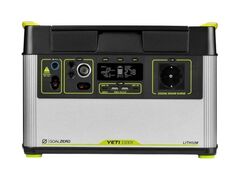

What the claimed 1516Wh is really worth
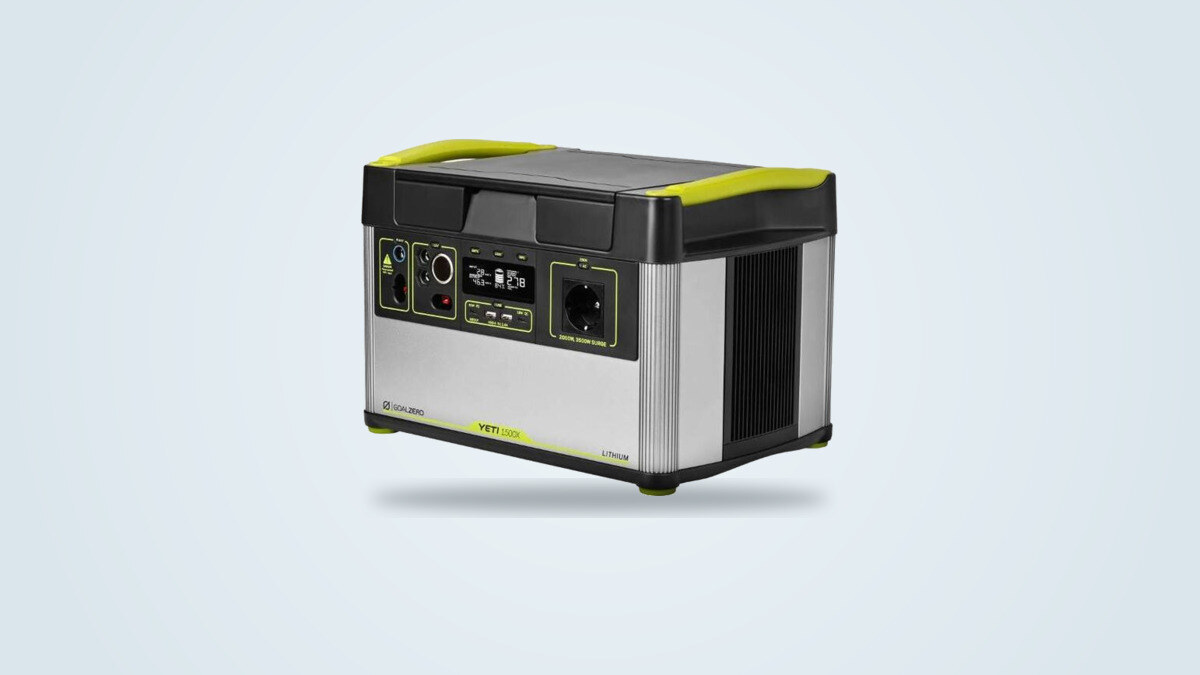
The 1516Wh figure sits on the Yeti 1500X's label and throughout its marketing, but it is a nominal battery capacity, not energy a mains-plugged appliance can actually use as-is. Between the two sits the inverter, which itself consumes part of the energy converting the pack's direct current into 230V AC, and that loss is not constant: it grows with the power drawn.
Under a 200W load, close to a typical backup use case (fridge, lighting, electronics), the Yeti 1500X delivers 1267Wh, or 83.6% of the claimed 1516Wh. Under a much heavier 800W load, output drops to 1093Wh, just 72.1%. The mechanism is physical and predictable: an inverter's resistive losses scale with the square of the current drawn, so they grow faster than the power itself. The practical consequence: the Yeti 1500X is proportionally more efficient on small, sustained loads than on large continuous ones, the opposite of what a spec sheet showing a single capacity figure suggests.
NMC chemistry: the Yeti 1500X's real cost
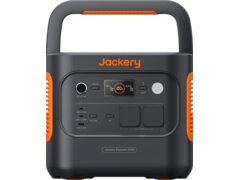
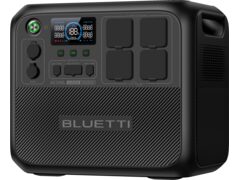
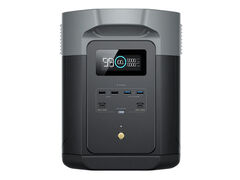
Almost every recent power station reviewed on this site uses LiFePO4 (lithium iron phosphate) chemistry, prized for its longevity. The Yeti 1500X is the exception: it uses an older Li-ion NMC (nickel manganese cobalt) chemistry, rated by Goal Zero for only 500 charge cycles before dropping to 80% of its original capacity. Three direct rivals in the same capacity class claim, at the same 80% threshold, 6 to 8 times more cycles: 3000 for the Bluetti AC200L and the EcoFlow Delta 2 Max, 4000 for the Jackery Explorer 2000 v2.
This technical choice is neither a mistake nor a hidden flaw: it reflects the age of the Yeti X range, launched in November 2020, before LiFePO4 became standard at this price point. But it weighs directly on real-world running cost: a station recharged once a week reaches its 500-cycle threshold in a little under 10 years, while a 3000-cycle rival would last more than 55 years under the same conditions. For heavier use (frequent outages, daily van life, job sites), the absolute gap narrows but stays proportionally the same. Charging and discharging the Yeti 1500X are specified between 32 °F and 104 °F (0 °C and 40 °C), a standard range for a consumer lithium chemistry, with nothing notable in either direction.
Goal Zero has itself since settled the question: the brand has been selling a brand-new sixth-generation Yeti 1500 range since 2026, with a LiFePO4 battery rated for 4000 cycles, which shares neither the enclosure nor the specifications of the Yeti 1500X reviewed here despite the very similar name. This new range does not retroactively replace 1500X units already in use or still on shelves, but it confirms, from the manufacturer's own standpoint, that the 1500X's NMC chemistry is now a previous-generation technology.
2000W continuous: a promise kept, and briefly exceeded
On paper, the Yeti 1500X claims 2000W continuous and up to 3500W surge through its AC outlet, with a pure sine wave inverter. A combined load of about 2250W, beyond even the claimed continuous rating, was held for around six minutes without the inverter's protection tripping. That is a fairly rare positive sign: most power stations only just meet their power promise, few exceed it, even briefly.
The real caveat is not about the power itself but about accessing it: the unit sold in the UK and the rest of Europe has only a single 230V outlet, against two 120V outlets on the North American version. Running several mains appliances at once needs a power strip, unlike several direct rivals fitted with two to four outlets as standard.
Charging: fast only as an option, slow out of the box
The Yeti 1500X ships with only a 120W AC charger, which takes 12.5 to 14 hours for a full charge from empty, one of the longest in its class. Getting down to 7 hours needs an optional 230W power supply; getting down to 3 hours needs an optional 600W power supply, both sold separately and not included in the base price. The fast charging featured in the brand's marketing is not what actually ships in the box.
An older fast-charge accessory compatible with the Yeti 1500X, the "25A Fast Charge" power supply, was the subject of an official US fire-hazard recall in 2020: the connector between the supply and its output cord could loosen and overheat the electrical connections. Goal Zero offered a free repair to affected owners at the time. The power supply currently sold alongside the Yeti 1500X is not that same unit.
On the solar side, a built-in MPPT controller accepts up to 600W of input, across a 14 to 50V voltage range and up to 50A, enough to fully recharge the station in one good sunny day using the brand's Boulder or Nomad panels. The connector remains proprietary, though, in an 8mm format less common than the MC4 standard used by most third-party panels: an adapter is needed to connect a solar panel from another brand.
Standby drain: the quiet real weakness
Beyond output under load, a power station also loses energy simply while waiting, unplugged, ready to serve. Standby drain on the Yeti 1500X is among the highest in its category, on the order of a few percent lost each month when not in use. Goal Zero explicitly recommends leaving the unit plugged into the mains permanently rather than storing it full and unplugged, a practice other manufacturers instead advise against sustaining on their own batteries.
That recommendation is not trivial: it assumes a home with a socket free at all times, and it carries a cumulative electricity cost over time, even if small at any given moment. It is nonetheless consistent with the station's design, whose battery management system is built to tolerate a permanent charge without the claimed premature degradation.
Noise and build quality: the most consistent strength
This is the most consistently praised aspect of the Yeti 1500X: its fans only switch on above roughly 300W of power drawn, staying off below that, including during mains charging. In everyday use (lighting, electronics, a small fridge), the station stays quiet. Its anodised aluminium shell is also seen as genuinely rugged against knocks and daily use.
The warranty, though, stays short: 2 years, where most recent LiFePO4 rivals in this capacity class (Jackery, Bluetti, EcoFlow) offer 5. One unit also suffered its bundled AC charger overheating badly enough to melt a hole in the plastic tray holding it, with the unit beeping loudly at intervals; it was replaced under warranty. A single case does not establish a failure rate, but it shows the bundled charger deserves some attention in use.
Connectivity: adequate, but dated for 2026
Port selection is decent without being generous for 2026: two USB-C ports (one at 60W in/out, a second at 18W), two USB-A ports capped at 12W each, a wattage that now looks dated against current fast-charge standards, and a 360W high-power 12V port alongside more conventional 12V connectors. The built-in LCD screen shows the essentials (charge level, power in and out) without needing the app.
A 12V inflatable mattress pump rated at 8A tripped the protection on the station's 12V DC port, while the same pump ran normally when plugged into the mains outlet: a useful reminder that a power station's 12V ports tolerate brief, high current draws less gracefully than a standard mains socket. Remote control runs through the Goal Zero app over Bluetooth and WiFi, functional but basic in its options next to the apps of more recent rivals.
Ageing chemistry against LiFePO4 rivals
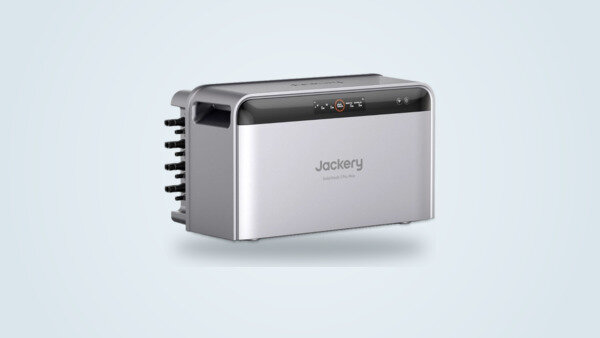
Against three direct rivals in its capacity class (roughly 1.5 to 2kWh), the Yeti 1500X offers less nominal capacity, far fewer claimed cycles, and a shorter warranty, at a price that is close to or above theirs.
| Criterion | Goal Zero Yeti 1500X | Jackery Explorer 2000 v2 | Bluetti AC200L | EcoFlow Delta 2 Max |
|---|---|---|---|---|
| Price | €1,290 | €799 | €1,499 | €949 |
| Capacity | 1516 Wh | 2042 Wh | 2048 Wh | 2048 Wh |
| Chemistry | Li-ion NMC | LiFePO4 | LiFePO4 | LiFePO4 |
| Cycles to 80% | 500 | 4000 | 3000 | 3000 |
| Warranty | 2 years | 5 years | 5 years | 5 years |
On paper, this table does not favour it. Its real advantage lies elsewhere: Goal Zero is a genuine pioneer of the sector, present since 2009, well before EcoFlow, Bluetti or Jackery entered the market, and its reputation for ruggedness holds up in the Yeti 1500X's build. Launched in November 2020, it is still sold new nearly six years on, an unusual commercial lifespan in a segment where generations typically turn over every 12 to 18 months.
Real availability in the UK, Europe and the United States
Commercial availability of the Yeti 1500X varies sharply by market. In France, it remains sold new through Leroy Merlin at €1,290, with pickup available at most physical stores, a distribution channel that is rare for this type of product, usually confined to online sales. In the United States, it remains available new directly from Goal Zero and via Amazon.
Elsewhere in Europe, the picture is far less favourable: no new retailer is identified at the time of writing in the UK, Germany, Italy, or Spain, and Goal Zero no longer runs an active European site, with its goalzero.eu domain now redirecting to its American site. A European buyer outside France is left choosing between a used unit, an import, or a general retailer that stocks it only sporadically.
Who the Yeti 1500X suits, and who it does not
It suits buyers who value rugged build quality and quiet day-to-day running, want an inverter that holds, and occasionally exceeds, its power promise, or specifically benefit from its Leroy Merlin store distribution in France for an immediate purchase or an easier exchange.
It does not suit buyers after the best capacity-per-pound value on the market, anyone planning very frequent use that runs up hundreds of charge cycles a year, or anyone wanting fast charging included out of the box without an optional accessory to buy on top.