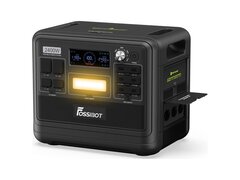

From 1512 to 1807 Wh: what the output changes
The 2048 Wh printed on the case is a cell capacity. What comes out of the sockets is always lower, and the gap here is particularly instructive: depending on how you empty the station, you recover between 1512 and 1807 Wh. Nearly 300 Wh of difference on the same machine, the equivalent of a small portable battery in its own right.
The mechanism applies to every station of this type, but it is unusually pronounced here. The inverter that produces the 230 V draws a roughly fixed amount of power whenever it is switched on, regardless of what is asked of it. Running a 100 W lamp for fifteen hours gives it fifteen hours to take its cut; running a 2000 W kettle for a few minutes gives it almost none. At identical capacity, a small draw spread over time is the most expensive scenario.
One detail deserves highlighting, because it is rare: the manufacturer itself applies a 0.85 factor in its own runtime examples. In other words, Fossibot does not claim to deliver 2048 Wh and calculates its own promises on roughly 1740 Wh of usable energy. That is a candour few spec sheets show, and it lands exactly in the middle of the measured range.
What a full charge really costs
The other half of the question is what has to go in to fill the battery. Over a complete cycle, expect roughly 2127 Wh drawn from the grid to recover 1659 Wh, which puts round-trip efficiency at 78 %. A little over a fifth of the energy paid for never comes back out.
This is where the F2400 pays for its price position. A station of the same capacity from an established brand reaches 85 % on the same exercise, seven points better. Over one cycle the gap is about 150 Wh; over three hundred cycles, several dozen kilowatt-hours.
That difference is inconsequential in mobile use, where you fill the station at home before setting off. It becomes real in two cases: daily stationary use, where you pay that fifth on every cycle, and solar use, where lost energy is energy you have to produce twice over. The F2400 is a reserve, not an energy optimisation device.
To its credit, though: in inverter operation the measured efficiency climbs to as much as 98 % on heavy loads. The mediocrity of the headline figure comes from the full charge-then-discharge cycle, not from the instantaneous behaviour of the electronics.
The 90-minute recharge, and the condition everyone forgets
This is the most visible marketing claim about this station, and also the one needing the most care. The "90 minutes" figure does appear in the manufacturer's documentation. It comes with a condition that changes everything: it assumes combining mains charging AND 500 W of solar panels, in full sun with ideal orientation.
On mains alone, the official figure is two hours, at 1100 W of input. And the times actually observed sit higher still.
At 1100 W, a full charge takes between 2 hr 30 and 2 hr 45, around a quarter longer than the claim. Set to 700 W, it stretches to 3 hr 45. That is not a flaw in itself, and it is consistent with the charging efficiency discussed above: filling 2048 Wh at 1100 W cannot take less than two hours in absolute terms, and losses add the rest.
One design point deserves praise along the way. Input power is set with a physical dial on the front panel, with no menu and no phone involved. Charging at 700 W rather than 1100 W spares the battery and eases the load on a fragile supply, a campsite or an old consumer unit. Few stations offer that adjustment so directly.
Maximum input, combining mains and solar, reaches 1600 W. That combination is what produces the 90-minute claim, and it is only achievable on a fine day with well-oriented panels.
Three sockets in Europe, six elsewhere
Here is an important trap on this product, absent from the most prominently advertised specifications. The F2400 exists in three regional versions, and they do not share the same mains connectivity.
| Version | Mains sockets |
|---|---|
| European | 3 sockets |
| American | 6 sockets |
| Japanese | 6 sockets |
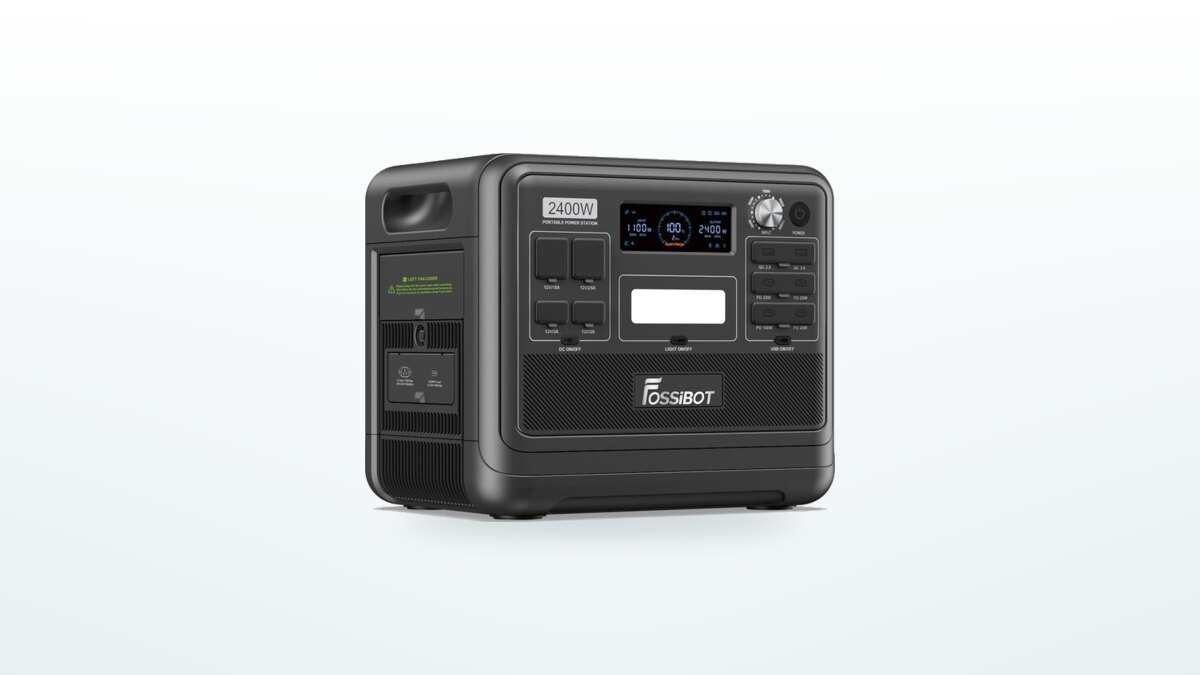
The model sold in Europe has three 230 V sockets, not six. A front panel covered in outlets belongs to the American or Japanese version, not the European one. For a 2048 Wh station meant to run several devices, three sockets are a little tight, and a power strip quickly becomes necessary, which is no great hardship but is worth anticipating.
Power itself does not change: 2400 W continuous and 4800 W surge on every version, with a pure sine wave inverter. Those 4800 W of surge absorb the start-up draw of a fridge compressor, a pump or a power tool without difficulty.
The 25 A 12 V output, the asset nobody mentions
This is the most interesting thing about this station, and it deserves to be highlighted. The F2400 carries a 12 V output rated at 25 amps, roughly 300 W of direct current, on top of the usual car socket.
| Type | Detail |
|---|---|
| 230 V sockets | 3, pure sine wave |
| USB-C | 1 × 100 W and 3 × 20 W |
| USB-A | 2 × 18 W (fast charge) |
| High-current 12 V | 1 × 12 V / 25 A |
| Car socket | 1 × 12 V / 10 A |
| DC 5521 | 2 × 12 V / 3 A |
All these direct-current outputs are regulated, meaning the voltage stays stable as the battery empties, where many stations let their 12 V drift. In practice that allows a compressor fridge, a water pump or a motorhome's 12 V circuit to be powered directly, without going through the inverter. And as we have seen, avoiding the inverter is precisely what recovers the most energy.
Neither of the two direct competitors at this capacity offers a 12 V output at this current. For a camper conversion or a cabin, that is a concrete advantage worth more than many marketing arguments.
Conversely, the USB-C split deserves a word: only one port reaches 100 W, the other three cap at 20 W. Enough for a laptop and three phones, but not two laptops at full speed.
What genuinely is missing: no app at all
This is the F2400's heaviest omission, and it is absolute. This station has no app, no Bluetooth and no Wi-Fi. No remote control, no consumption tracking on a phone, no charge scheduling, no firmware updates.
Everything the station can do, it shows on its screen and sets with its buttons. To know the state of charge, you have to be there. To switch off an output, you press it. To change the input power, you turn the dial.
Depending on the use case, that absence ranges from a detail to a dealbreaker:
- Inconsequential if the station stays within reach, on a site, in a workshop or while camping. You look at it, you set it, done.
- Awkward for home backup, where an alert on your phone when the outage hits has real value, especially if the station sits in a basement or garage.
- Disqualifying for a holiday home or a remote plot, where you want to check from afar that there is energy left. There, look elsewhere.
Noise and heat
On a station of this output, ventilation can quickly become a sore point. The F2400 comes out well, with one important nuance depending on the load demanded.
Below roughly 500 W, the fans barely engage at all. That is the band most domestic uses live in, a fridge, lighting, a router, a computer, and the station is genuinely discreet there. It can sit in an occupied room without a thought.
Beyond that, and particularly during a fast 1100 W charge or under sustained output, the level reaches around 55 dB. Since no measuring distance is stated, that figure allows no rigorous comparison with a competitor, but the order of magnitude matches a normal speaking voice: clearly audible without being unpleasant.
The logic to remember is simple: it is the power demanded that makes the noise, not the station itself. An F2400 running a fridge is silent; the same one charging at full speed while a kettle boils is not. If quiet matters, the input dial is precisely what lets you charge more gently, and therefore more discreetly.
As backup: 10 ms and real flexibility
This is one area where the F2400 behaves like a far more expensive station. Its switchover to battery during an outage takes under 10 milliseconds, a delay no computer, router or fridge will notice.
Added to that is a capability not every station has: simultaneous charging and discharging. The F2400 can stay connected to the mains while powering appliances from its own sockets, recharging from the surplus. That is exactly the arrangement needed for a permanent home UPS, and here it is endorsed by the manufacturer rather than merely tolerated.
With 2048 Wh available and 2400 W of power, it covers a fridge, a freezer, lighting, the router and a computer through a good part of an overnight outage. Its 4800 W surge absorbs two compressors starting at once, which is the real test of a backup station.
The one shadow remains the absence of alerts: if an outage happens while you are away, nothing will tell you, and nothing will tell you what is left when you get back.
Solar and temperature: the two real limits
Two characteristics bound this station's use more surely than its price, and they are rarely highlighted.
Solar input caps at 500 W, through a single MPPT controller. For a 2048 Wh battery, that means four hours of full sun and ideal orientation for a complete charge, and more in real life. It is enough to top up a charge or maintain a level in seasonal use; it is not enough to live off solar, where you want to fill the reserve within the useful window of a winter day. Relative to its capacity, the F2400 is markedly less well equipped for solar than most 2 kWh stations.
| Situation | Permitted range |
|---|---|
| Discharge | -15 to +40 °C |
| Charge | 0 to +40 °C |
| Storage | -15 to +40 °C |
The second limit is thermal, and it is stricter than it looks. The 40 °C ceiling applies to discharge as much as to charging, yet a plant room, a van parked in the sun or a summer building site regularly exceed that threshold. And as with every lithium battery, charging is impossible below 0 °C: a station left in an unheated vehicle over winter will still power devices, but will not refill.
Its LiFePO4 battery is rated for 3500 cycles before dropping to 80 % of its capacity. At one full cycle a day that is close to ten years, well beyond the two-year warranty the manufacturer's policy applies to this range.
Against the 2 kWh benchmarks
The F2400 is judged first on what it offers for its price. Here is where it stands against the two most established stations of the same capacity, at prices observed in mid-August 2026.
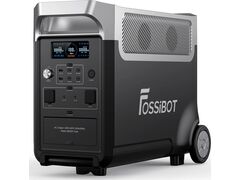
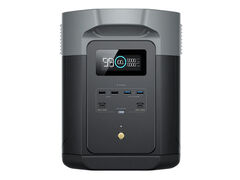
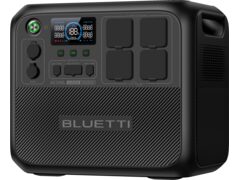
| Criterion | Fossibot F2400 | EcoFlow Delta 2 Max | Bluetti AC200L |
|---|---|---|---|
| Observed price | 699 € | 949 € | 1499 € |
| Capacity | 2048 Wh | 2048 Wh | 2048 Wh |
| Power | 2400 W | 2400 W | 2400 W |
| 230 V sockets | 3 | 4 or more | 4 or more |
| High-current 12 V | yes, 25 A | no | no |
| App | none | yes | yes |
| Expandable | no | yes | yes |
| Weight | 22 kg | about 23 kg | about 28 kg |
The price gap is enormous and it is real. At identical capacity and power, the F2400 costs 250 € less than the EcoFlow and 800 € less than the Bluetti. It even beats them on one count, the high-current 12 V output.
What you give up in exchange is clear and comes down to three things: remote control, capacity expansion, and the service network of an established brand. The first two are verifiable on a spec sheet. The third only reveals itself when you need it, and that is the real gamble of this purchase.
One last practical point: the F2400 comes in black and green, with roughly a 90 € gap in the black one's favour for a rigorously identical unit. There is no technical reason to pay for the colour.
Who it suits, and who it does not
The F2400 is a generous machine whose compromises are legible. It hides no serious flaw; it accepts precise trade-offs, and everything depends on whether they land on your use case.
It suits home backup, where its 2048 Wh, its 2400 W, its sub-10 ms switchover and its simultaneous charging cover a household for several hours at the price of a station half the size elsewhere. It suits a building site or a workshop very well, where its 4800 W surge starts power tools and its quiet running below 500 W goes unnoticed. It suits a camper conversion particularly, thanks to its regulated 25 A 12 V output which runs a compressor fridge without passing through the inverter, something its rivals cannot do. And it suits anyone who wants the largest possible reserve for a given budget, which is precisely its reason for being.
It suits poorly an installation you cannot keep an eye on: with no app and no alerts, a holiday home or a remote plot are outside its remit. It suits poorly an ambitious solar project, its 500 W input being weak for a 2 kWh battery. It suits poorly daily home storage, where its 78 % efficiency is paid on every cycle. And it suits poorly anyone planning to expand capacity later: it cannot be expanded, and a whole new station would have to be bought.
What remains is the essential, and it explains why it is talked about so much: at 699 €, it offers a capacity and an output nobody else provides at that price. It is not the most refined or the most connected station, it is the one that gives the most available energy per euro spent. For many uses, that is exactly the right criterion.