
What the 512 Wh are really worth, and why that depends on the output
The 512 Wh printed on the case are a cell capacity, eight cells in series for 20 amp hours. It is not what comes out of the outputs, and on this machine the gap depends above all on which output is used.
Through the 230 V socket, the energy recovered settles at 366 Wh at 50 W, 373 Wh at 150 W and 377 Wh at 500 W. The curve is almost flat: eleven watt hours between the lightest and the heaviest load, two points of efficiency.
A fourth reference point points the same way: at low current, the 12 V output returns 424 Wh, or 83 % of the claimed capacity. Four figures, one lesson: it is the inverter that costs, not the speed at which the energy is consumed.
What really changes things: the output used, not the speed
Here is the most useful point in this review, and the least known. Instinct says that a battery gives back more energy the more gently it is asked. On this machine the load changes almost nothing; the output changes everything.
The efficiency of the 230 V output stays within a hair: 71.5 % at 50 W, 72.9 % at 150 W, 73.6 % at 500 W. Two points across the whole range, and it is by pulling hard that the machine gives back the most, not by pulling gently.
The mechanism comes down to the conversion stage. A device plugged into the 230 V socket forces the inverter to make alternating current out of the pack's direct current, and that conversion is paid for in losses and heat. The DC outputs skip that step: USB-C gives back the most, around 88 %, and the 12 V output around 87 % at high current.
Beware one received idea, though: the 12 V is not a direct tap on the pack. It is a step-down converter, capped at 126 W, which pays for its own conversion. At low current it falls back to 83 %, and its lead over the 230 V socket is halved.
606 Wh at the wall to give back 377
The figure that decides the bill is not capacity but round-trip efficiency: how much has to go through the metre to get one watt hour back out of a socket?
It takes 606 Wh to refill the pack, and 377 come back out of the 230 V socket, an efficiency from the wall to the socket of around 62 %. Charging on direct current and drawing through USB-C, the same path climbs to 78 %, giving a spread of 60 to 78 % depending on how the machine is used. On the 230 V socket that is poor, and it is structural: the smaller a station, the more the conversion electronics, whose draw is roughly fixed, weigh against the pack they serve.
For comparison, the 1 kWh stations of the same brand run around 77 to 80 % on the same path. The difference comes not from build quality but from size.
What it draws while powering nothing
Two regimes coexist, and the gap between them turns on a single button.
With the 230 V output switched on and nothing plugged in, the machine absorbs between 12 and 25 W, inverter and fan included. Against 377 Wh available, that is enough to empty it in under a day in the worst case. With the output switched off, the draw falls to a few watts and the wait is counted in days.
X-Boost: the 1000 W are not what they seem
The spec sheet announces 500 W continuous and 1000 W with X-Boost. The second figure deserves an explanation that the manufacturer does not give.
X-Boost does not double the power available. It lowers the output voltage, from 240 V to under 170 V. A resistive appliance labelled 1000 W plugged into it draws little more than 500 W, and heats accordingly. That is not a defect, it is the very principle of the feature: it allows a too-hungry appliance to be plugged in, provided you accept that it works at half pace.
On the model just below it in the same range, a 400 W hotplate plugged in with X-Boost active draws only 297 W. It works, but it heats less, and the water takes longer to boil. The manufacturer itself describes the feature as lowering the operating voltage of the appliance in order to reduce its consumption. The marketing, for its part, merely announces a power figure.
Another limit, rarely written down: beyond 500 W, only one of the two sockets stays powered. The station does not spread 1000 W across its two outputs.
Facing motors: one simple rule, the soft start
The 500 W continuous are held with margin: 522 W pass for thirty seconds before cut-off, and a peak of 721 W holds for one second. That is comfortable for the category.
But the real limit against a motor is not read off the label of the appliance. It depends on the way that appliance starts.
| Appliance | Power | Result |
|---|---|---|
| Sander | 310 W | Passes, with a peak beyond 800 W |
| Orbital sander | 400 W | Passes |
| Rotary hammer | 750 W | Passes, provided the ramp-up is gradual |
| Angle grinder with no soft start | 720 W | Cuts out instantly |
A 720 W angle grinder makes the station drop out where a 750 W rotary hammer passes. It is not the power that decides, it is the current surge at start-up.
The manufacturer acknowledges as much for a use it puts forward itself. Its manual warns that the station, plugged in normal mode into a fridge, may be switched off automatically because of the fluctuation in the electrical supply of the fridge, and recommends setting the output to never switch off in the app. In other words: the compressor can trip the very machine sold to back it up.
One hour, and that promise is kept
This is the field where the machine keeps its word without reservation. A full charge takes 58 minutes to 1 h 03, against the one hour announced.
Charging slows at the end of the cycle, which is normal and desirable: 80 % in around forty minutes, then the last twenty per cent in about twenty more, at far lower power.
Solar, on the other hand, needs bringing back down to earth. The input accepts 220 W, and a panel of that rating delivers around 190 in good conditions. But with a 160 W panel in midwinter, a full charge took more than two days, where the sales page announces three hours.
One last point, seasonal: charging is impossible below 0 °C, a normal protection for this chemistry. It resumes above 3 °C. Note that the electronics go by the real temperature of the cells, not that of the air: a station brought in from the cold takes time before it accepts any current.
46 dB at one metre, and a badly set fan
During a mains charge at full speed, the noise level reaches 46 dB at one metre, around ten decibels above the background noise of an office.
The 62 dB figure often put forward is a sales footnote, with no distance or load specified, repeated as though it were a comparable result. It is comparable to nothing.
The real reproach is not the level anyway, it is the trigger. The threshold wanders between ten watts and three hundred, and the fan can be heard turning with nothing plugged in, on a cold machine. Over four years on sale, that behaviour has never been corrected.
While charging, the ventilation follows the input power and not the temperature. A vigorous solar charge runs the fan flat out on a case that has stayed cold. The workaround exists and costs only time: reduce the charging speed in the app. The one-hour recharge is the noisy mode.
None of this appears anywhere in the manufacturer documentation, yet the noise is frankly high on fast charging, and night-time use is best avoided.
On backup: what the spec sheet promises and what the manual forbids
The changeover is announced under 30 milliseconds. It has to be said plainly: no figure exists for this model. The only one in the family belongs to the Pro version, at 20 ms.
What is established comes down to one sentence: a desktop computer, a storage server and a network switch all ride through the cut without flinching. But a UPS placed downstream detects the gap and switches to its own battery. The dip is therefore real.
The manual sets the limit itself, and it is unusually frank. The function does not support zero millisecond changeover and must not serve a server or a workstation. Better still: if backup is the main use, it recommends connecting one single appliance, under 750 W, because the overload protection can trip at the very instant of the changeover. A backup station that risks cutting out at the moment of taking over is a limit worth knowing about beforehand.
Two additional points should be added. The 230 V output does not always come back on by itself when the power returns, where the sales page promises automatic restoration. And while running on the mains, the machine can discharge then recharge in short cycles, fan included.
A series fault acknowledged in writing, and never fixed
This point has to be known before considering this station for unattended solar backup, because it targets exactly that use.
With a solar panel permanently connected, the machine reads zero per cent as night falls, then finds its real level again within seconds as soon as the sun or the mains comes back. It therefore behaves as though empty at precisely the moment it was being counted on.
What makes the case notable is the answer from the manufacturer. Evidence in hand, it acknowledged in writing that the behaviour is not limited to that one unit and may concern products of the series, and that a standard exchange does not guarantee it will be eliminated. No recall followed, no fix was published.
The workaround is simple, but it cancels the point of the arrangement: unplug the panel at night, or give up leaving the station to watch over things on its own.
Two sockets, not four: the trap of the European version
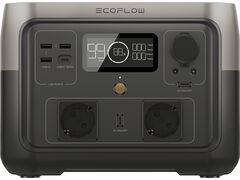
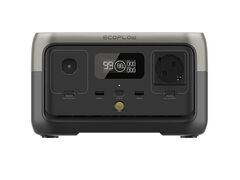
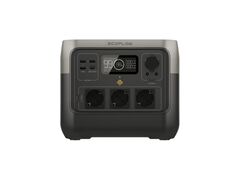
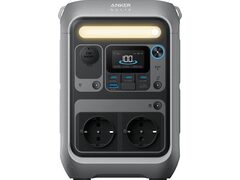
The European version of this station has two 230 V sockets. Four is often written. That is the count of the American version, whose far more compact sockets fit four across the same panel where two Schuko already take up all the room.
The error spreads all the more easily because the manufacturer publishes the socket count of its European version nowhere. Its manual writes AC output socket, in the singular and with no quantity, and its product pages say nothing about it. Added to that is an ambiguous sales phrase, four ways to recharge, which designates four supply modes and turns easily into four sockets under a hurried pen.
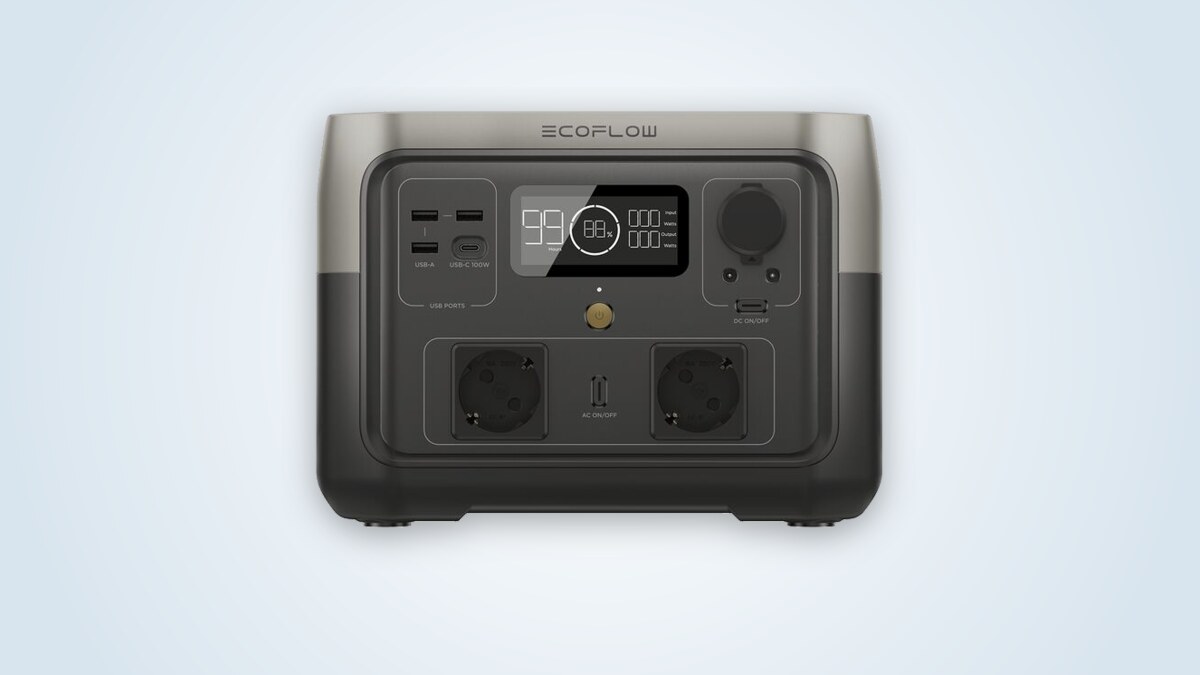
The rest of the connectivity is more generous: three USB-A ports sharing 24 W, a 100 W USB-C that works in both directions, a 126 W cigarette lighter socket and two DC outputs. The station accepts no expansion battery, however: its capacity is fixed.
A machine at the end of its run, and what that is worth
Worth knowing before buying: this station is out of stock across every manufacturer store, in France as elsewhere in Europe, at the full price of 399 €. No end-of-line announcement has been published, no date, no designated replacement. It is a withdrawal in fact, not in law: the maker has stopped supplying its own channel and lets resellers run down their stock.
The consequence is a fragmented market. In France the floor price for a new unit settles around 360 €, without this being a dated promotion: it is a structural end-of-life low. In Italy, by contrast, the rare offers go above list price, for want of official distribution.
What reassures: the five-year warranty names this model, with shipping covered, and the station never had an expansion battery, so there is no dependence on an accessory on its way out. What worries: no spare parts programme is published, and one clause voids the warranty if the unit goes more than six months without being either charged or discharged, which is precisely the backup use it is credited with.
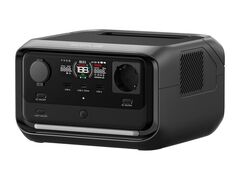
A word on the following generation, because it lights up the trade-off. The River 3 range offers no equivalent single block: its largest one-piece model tops out at 286 Wh, and the 572 Wh advertised correspond to an assembly of two blocks, for 449 € and 8.2 kg. Against that, the discounted River 2 Max offers 512 Wh in a single 6.1 kg case, for around a hundred euros less. What it really loses is not capacity: it is the backup changeover, three times slower, and quiet running.
Who it suits, and who it does not
It suits anyone looking for 500 Wh they can carry for a weekend, a van or a work site, and who will ask the machine for power in its good range, between one and three hundred watts. It also suits anyone who wants to recharge fast: one hour for a full charge remains a solid argument in 2026.
It does not suit anyone who wants to power small loads over time, where its efficiency collapses. Nor anyone looking for silence. Nor anyone counting on leaving it as an unattended solar reserve, because of the acknowledged night-time fault. Nor anyone who wants to protect a server, which the manual explicitly forbids.
One last figure to sum up the trade-off. At today's market price, the claimed watt hour comes to around 0.70 €. The equivalent assembly from the following generation charges 0.79 € for it, with two blocks and two kilos more. The outgoing generation is, for once, the best buy in its own range.