
What the claimed 1024 Wh are really worth
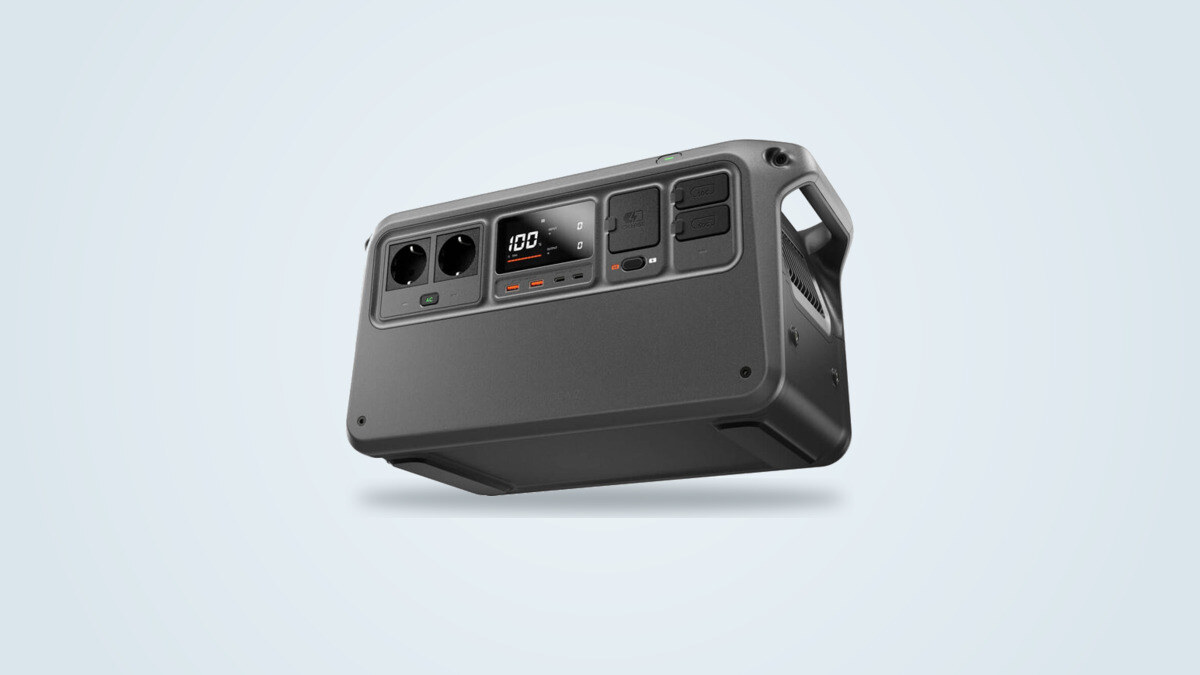
DJI rates the Power 1000 V2 at 1024 Wh, the same capacity as the first generation. That figure describes the energy stored in the cells, not what actually comes out of a wall socket once the inverter has taken its share.
Two independent measurements, taken on two continents with different methods, place real-world output between 820 and 880 Wh. The roughly 7% gap between them most likely comes down to differing protocols (continuous resistive load on one side, a standardised comparison across dozens of stations on the other) rather than any real variation between units. That convergence is a good sign: the Power 1000 V2 sits in the upper-middle of its category, neither excelling nor disappointing on this particular point.
The loss, in the 15 to 20% range, splits between the inverter's own conversion efficiency and the management electronics' power draw. It is in line with most LiFePO4 stations of this power class: neither a standout nor a laggard. In everyday terms, those roughly 850 usable Wh amount to around forty full smartphone charges, six to seven laptop charges, or several hours running a small camping fridge. Big, one-off loads such as a raclette grill or a kettle remain this station's natural territory: its 2600 W were built precisely to absorb that kind of draw.
2600 W, power that actually holds
The Power 1000 V2 raises continuous output to 2600 W, up from 2200 W on the first generation. That figure is not just a box claim: an independent measurement puts the surge peak at 4400 W, a comfortable 1.7 times the continuous rating that lets it absorb the inrush current of motors or resistive heating elements without tripping a protection circuit.
| Appliances combined | Combined load | Result |
|---|---|---|
| Microwave and kettle | about 2323 W | runs without a cut-out |
| Microwave and ceramic heater | about 1800 W | runs without a cut-out |
| Kettle and ceramic heater | about 2023 W | runs without a cut-out |
These combinations, close to the maximum continuous rating, triggered no protection cut-out. That points to honest sizing: the station holds its promise rather than reserving it for a few seconds of peak before dropping back, a common shortcut on this kind of product.
Against the original Power 1000, the extra 400 W of continuous output (2200 to 2600 W) opens up appliances it could not run alone: a raclette grill, a powerful vacuum cleaner, or two creative workstations plugged in at once. The trade-off, logically, is paid in noise and weight, covered further down.
37 minutes claimed: the best-confirmed promise
DJI states a 0 to 80% charge in 37 minutes from the mains, and a full charge in 56 minutes. It is the most heavily marketed claim on this product, and also the one independent measurements confirm most clearly.
| Measurement | Result obtained | Gap versus the claim |
|---|---|---|
| DJI's own claim | 80% in 37 min, 100% in 56 min | reference |
| First independent measurement | 100% in about 54 min | very close, slightly faster |
| Second independent measurement | 86% in 37 min | slightly better than claimed |
| Third independent measurement | 100% in about 64 min, 50% in 24 min | slower, likely a different mains circuit |
Two measurements out of three confirm, or even slightly beat, DJI's figure. The slower third result most likely comes from a different mains circuit or voltage than the other tests: a station's charge speed depends directly on how much power the wall circuit can deliver, a variable that is rarely identical from one country or installation to another. Overall, the marketing claim holds up well under scrutiny, which is not a given on this market.
On 12 V, from a vehicle, a full charge takes about 78 minutes at 1000 W. That is a useful option on a road trip, though it draws heavily on the vehicle's electrical system and should be reserved for an alternator in good condition.
Noise: a real gap between the spec sheet and real load
DJI highlights a 26 dB noise level, a figure that corresponds to standby or idle operation. As soon as the station is actually working, whether delivering output or fast-charging, the fan speeds up and the noise level climbs noticeably.
| Situation | Noise level |
|---|---|
| Standby or idle | about 26 dB (DJI figure) |
| Output or charging around 1000 W | about 37 to 42 dB |
| Fast charging or output above 1800 W | about 50 to 52 dB |
The gap between the headline figure and real-world use is nothing unusual on this market: most manufacturers quote their most flattering number. It is still worth knowing before buying, especially for use in a bedroom or an enclosed space: an overnight fast charge will be clearly audible. The simplest workaround is to start a fast charge before going to sleep rather than overnight, or to accept a longer but quieter default charge speed. This increase over the previous generation (26 dB versus 23 dB claimed) is the direct trade-off for the power increase: an inverter delivering 400 W more continuously sheds more heat, and the fan has to keep up.
Solar input: generous on paper, never included as standard
The Power 1000 V2 accepts up to 1200 W of solar input, a high ceiling for a station of this size. That figure, however, assumes equipment the station does not include: solar panels do not plug directly into its SDC port, a separately sold DJI MPPT adapter is required.
With that adapter fitted, a measurement taken over a full sunny day obtains between 850 and 950 W of solar power actually received, from panels rated at 1200 W. That ratio, roughly 70 to 80% of the theoretical ceiling, is fairly good for the category: most nomadic solar setups struggle to exceed 50 to 60% of their panels' rated peak power once orientation, cell temperature and cabling losses are accounted for.
The real caution here is less about the solar input's own performance than its dependency on an optional accessory: forgotten at the start of a trip, or simply never bought, it makes solar charging entirely unusable. It is a design choice that simplifies the station's internal electronics, but shifts the cost and the logistics onto the buyer.
The SDC system: a real asset for DJI creators, a constraint for everyone else
Two proprietary SDC ports set the Power 1000 V2 apart from the rest of the market. They allow direct charging of DJI drone and gimbal batteries, at a speed beyond what a standard mains charger delivers.
For a pilot or videographer already invested in DJI gear, the difference matters over a shoot day: getting a drone battery back in thirty minutes rather than an hour and a half genuinely changes how a scouting trip or a set is organised. That is the product's central argument, and it holds up.
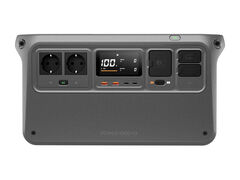
For every other use, though, this focus closes doors that competitors leave open. The station has no native 12 V or cigarette-lighter output: powering a car cooler or a vehicle vacuum needs an optional cable that converts the SDC port into a 12 V socket, not included as standard. Same logic for solar, already covered above. Two 140 W USB-C ports (280 W combined across both) and two 24 W USB-A ports round out the connectivity, a solid base for laptops and phones, but one that does not make up for the lack of a generic 12 V output.
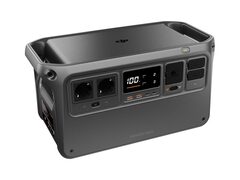
The DJI Home app adds remote control of charge and discharge thresholds, useful for preserving the battery over time, plus real-time consumption monitoring. That control, however, is tied to a WiFi connection: without the app, the station still works, but loses most of its remote monitoring. Another physical limitation worth flagging: the two AC outlets, set close together, make it awkward to use two bulky mains adapters at once, a detail that will not show up on a spec sheet but is noticeable in daily use.
Up to 11264 Wh: an expandability few buyers discover
Contrary to a common assumption, the Power 1000 V2 is not a fixed-capacity station. DJI sells an expansion battery, the Expansion Battery 2000, rated at 2048 Wh each. Up to five can be connected to the station, taking total capacity to 11264 Wh.
| Configuration | Total capacity |
|---|---|
| Station alone | 1024 Wh |
| Station plus one expansion | 3072 Wh |
| Station plus three expansions | 7168 Wh |
| Station plus five expansions | 11264 Wh |
This is a genuine option, though it requires a firmware update before the first battery is connected, and it represents a substantial investment: each expansion battery costs close to the price of the station itself. It does, however, change the nature of the product for anyone planning ahead: what looks like a nomadic top-up station can become a credible multi-day home backup reserve, without switching devices.
For simple nomadic use, this expandability will remain theoretical. For a growing home backup project, or to equip a camper van in stages, it is worth knowing before buying: it does not always feature prominently in the product's marketing material.
What the internal design reveals
Inside, the Power 1000 V2 packs sixteen LiFePO4 cells at 3.2 V and 20 Ah each, wired in series to form a 51.2 V, 1024 Wh pack. This cylindrical cell format, from a Chinese supplier specialised in stationary storage, differs from the prismatic cells found in several competitors. The same supplier also equips other stationary-storage manufacturers, a reassuring sign of industrial maturity for the chemistry used, even if it remains less known to the public than the big names in large-format cylindrical cells.
Electronic protection relies on a multi-cell monitoring circuit paired with three 40 A fuses in parallel and a precision current-sense resistor, an architecture in line with what is expected at this price point. The inverter module, with its conformally coated circuit boards and dedicated dual cooling fans, shows a level of design care that is not always present among manufacturers newer to this market.
On the support side, two corrective firmware updates shipped in the year following launch, none of which bricked any units. The warranty runs to 5 years by default. One real weak point remains, already mentioned: the connectors, whether the AC outlets or the USB and SDC ports, have no protection against splashes or dust. For a product also aimed at camping and van life, the lack of covers or seals is a genuine gap, best offset with a little extra care outdoors.
Against the original Power 1000 and the direct competition
The comparison with the previous generation sums up this V2's direction well: more power, faster charging, an added screen and WiFi monitoring, at the cost of a little extra weight and noise.
| Criterion | Power 1000 (1st generation) | Power 1000 V2 |
|---|---|---|
| Continuous output | 2200 W | 2600 W |
| Charge 0 to 80% | 50 min | 37 min |
| UPS switchover | 20 ms | 10 ms |
| Screen and WiFi | none | LCD screen, WiFi, DJI Home app |
| Weight | 13 kg | 14.2 kg |
| Claimed noise level | 23 dB | 26 dB |
Against direct competitors of similar capacity, the Power 1000 V2 remains the fastest to recharge and the most powerful in continuous output. The EcoFlow Delta 2 tops out at 1800 W and the Jackery Explorer 1000 v2 at 1500 W, both clearly behind on this specific measure. Neither, however, locks the buyer into as strong a proprietary charging ecosystem: on that point, the right choice mostly depends on what gear the buyer already owns.
One note for a reader outside the UK: the US market receives a version with four AC outlets instead of two, a real difference that will not show up in product photos, which are identical from one market to another.
Who it's for
This station is designed first for a specific profile, and it serves that profile very well.
It is an excellent fit for a creator or pilot already invested in DJI gear: charging drone batteries at speed through the SDC ports is a genuine time saver in the field, and the available power comfortably runs several creative workstations or a set light. It also suits anyone who mainly wants fast charging and high output in a portable format, without needing a 12 V port or built-in solar input.
It is a weaker fit for three profiles. Anyone camping in a van and relying on solar day to day will need to budget for the MPPT adapter on top of the sticker price. Anyone needing a 12 V output for a car cooler or vehicle vacuum will also need to plan for an optional cable. And anyone sleeping in the same room as the station will have to live with a clearly audible fast charge.
That leaves the question of expansion. For simple nomadic use, it will stay theoretical. But for a household planning a backup reserve that can grow over time, the ability to scale up to 11264 Wh without switching stations genuinely changes the equation, provided the incremental cost is acceptable.