
DJI Power 1000 V2
(19 reviews)
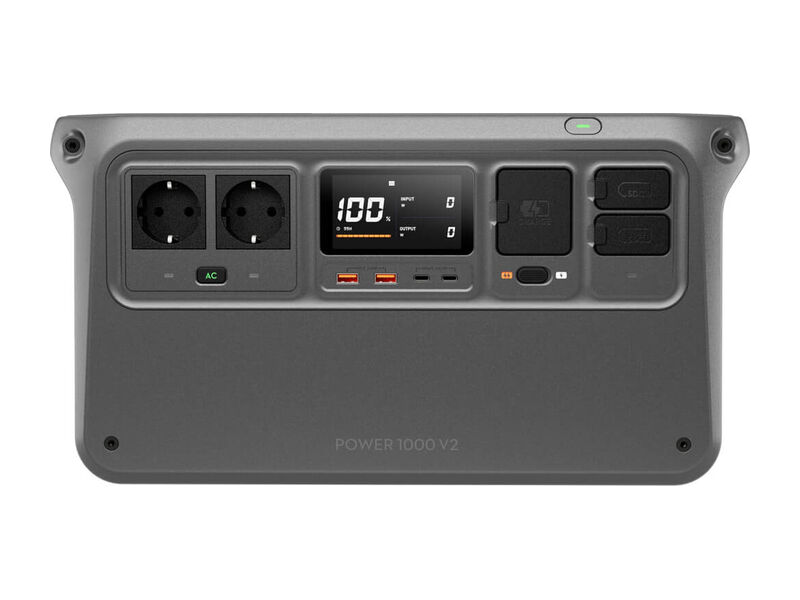
More powerful and faster: the DJI Power 1000 V2 delivers 2600W from 1024Wh and recharges to 80% in 37 minutes. The next-gen station for nomadic creators.
Buy at AmazonAs an Amazon Associate I earn from qualifying purchases.
Characteristics
- Power: 2600W continuous
- Capacity: 1024Wh LiFePO4
- Recharge: 0 to 80% in 37 min
- UPS: 10ms switchover
- 2600W, lightning recharge and WiFi monitoring via the app
Detailed overview: DJI Power 1000 V2 1024Wh portable power station
The DJI Power 1000 V2 is the next generation of DJI's flagship portable power station, from the specialist in drones and creator gear. With the same 1024Wh capacity as the original model, it markedly raises continuous output to 2600W (versus 2200W on the Power 1000), positioning itself as a versatile and particularly powerful station for its size.
Its LiFePO4 battery retains over 80% of its capacity after 4000 charge cycles, a mark of longevity. Its real revolution is recharge speed: it goes from 0 to 80% in just 37 minutes from the mains (versus 50 minutes on the first generation), and reaches 100% in 56 minutes. Its UPS function now switches over in 10ms, twice as fast as the original Power 1000, a real plus for protecting sensitive equipment during an outage.
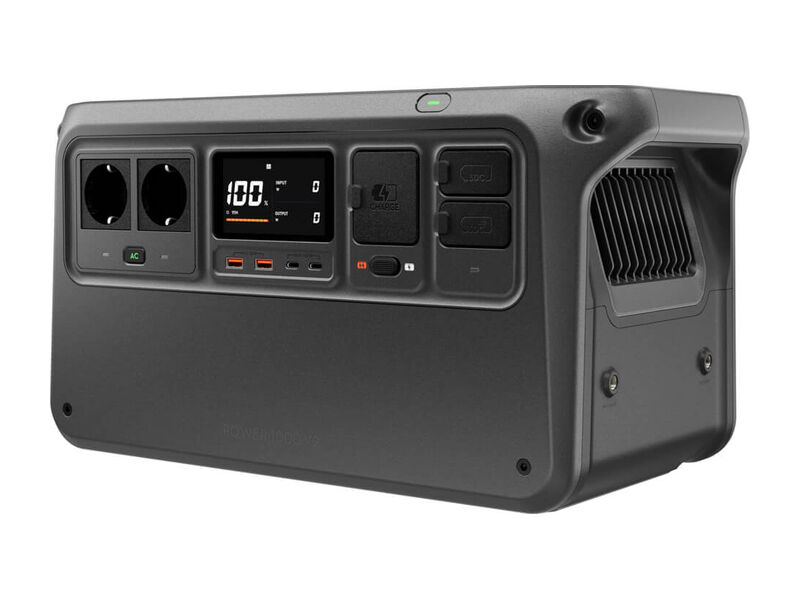
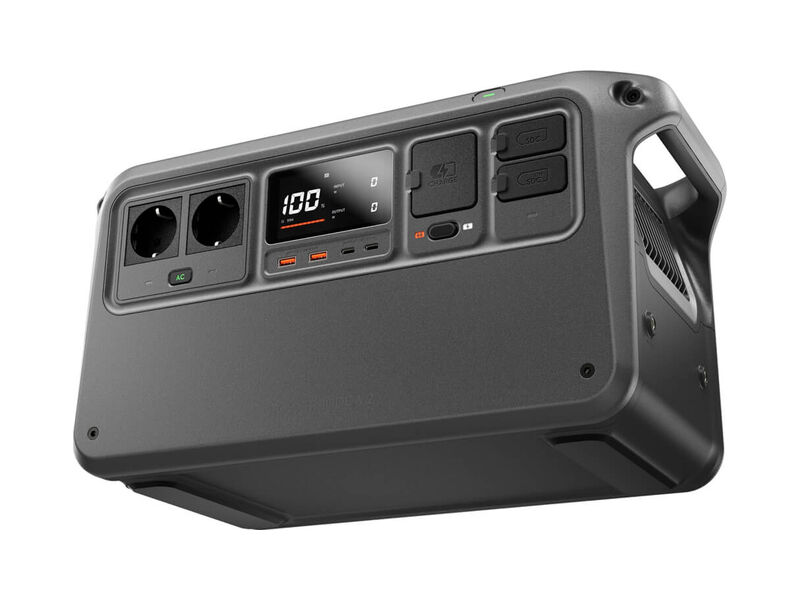
For connectivity, it keeps two AC outlets in Europe (up to four in some markets), two 140W USB-C ports and two USB-A ports. It still has DJI's own SDC ports for fast charging of certain brand drones and batteries. A notable addition: a full LCD screen and WiFi connectivity let you monitor charge and control the station remotely via the DJI Home app, a feature absent on the original Power 1000.
A touch heavier (14.2kg versus 13kg) and slightly louder (26dB versus 23dB) than its predecessor, the Power 1000 V2 clearly favours power and charge speed. Against the compact Power 1000 Mini (1008Wh, 800W), it targets more demanding use. Its limits: solar charging needs an optional MPPT adapter not included as standard, and its price remains high. For creators and intensive nomadic use wanting the best of the DJI Power range, the Power 1000 V2 is a solid, forward-looking choice.
Full specifications
Detailed characteristics (EAN: 6937224115156)
Battery and capacity
| Rated capacity?Total stored energy in watt-hours. The higher the figure, the longer the runtime. | 1024 Wh |
|---|---|
| Delivered energy, measured?Energy that actually leaves the battery and reaches the devices. Always below the stored energy, as conversion costs heat. Taken from our in-depth review. | 880 Wh |
| Expandable capacity?Whether capacity can be increased with add-on batteries. | No |
| Removable battery?The main battery can be removed or replaced by the user. | No |
| Battery chemistry?LiFePO4 (LFP) lasts far longer and is safer than NMC. | LFP (LiFePO4) |
| Charge cycles?Number of full charges before capacity drops to the stated threshold. | 4000 cycles (80 %) |
AC output
| Continuous AC power?Power the unit can sustain continuously on its 230 V outlets. | 2600 W |
|---|---|
| Inverter type?A pure sine wave is essential for sensitive electronics and motors. | Pure sine wave |
| AC voltage / frequency?Voltage and frequency of the AC output (230 V / 50 Hz in Europe). | 230 V / 50 Hz |
| Number of 230 V AC outlets?Number of mains outlets available on the unit. | 2 |
| RV / TT-30 outlet?Dedicated 30 A outlet for North-American style RVs. | No |
Recharging
| AC charge 0-80%?Stated time to go from 0 to 80% on mains power. | 37 min |
|---|---|
| AC charge 0-100%?Stated time for a full charge on mains power. | 56 min |
| Max solar input?Maximum solar power accepted at the input (PV panels). | 1200 W |
| MPPT controllers?Number of independent MPPT solar inputs (yield optimisation). | 1 |
| Vehicle charging (12/24 V)?Can be charged from a vehicle's cigarette-lighter socket. | Yes |
| Pass-through charging?The unit can power devices while charging (pass-through). | Yes |
Ports and connectors
| USB-C ports?Number of USB-C ports and the fastest port's power (laptops, phones). | 2 × 140 W |
|---|---|
| USB-A ports?Number of USB-A ports and maximum power (small devices). | 2 × 24 W |
| 12 V output (car socket)?12 V cigarette-lighter output and its power (coolers, pumps…). | No |
| Other DC outputs?Additional DC connectors (Anderson, DC5521, XT60…). | SDC, SDC Lite |
Portability
| Weight?Net weight of the unit, battery included. | 14.2 kg |
|---|---|
| Dimensions (L × W × H)?Overall size of the unit in millimetres. | 448 × 225 × 230 mm |
| Form factor?Portable (hand-carried), transportable (heavy), or wheeled. | Portable |
| Wheels?Built-in wheels for moving the unit. | No |
| Telescopic handle?Retractable handle like a wheeled suitcase. | No |
Safety and environment
| Certifications?Standards and approvals obtained (CE, RoHS, UN38.3, UL…). | CE, RoHS, UN38.3 |
|---|---|
| Discharge temperature?Temperature range in which the unit can deliver power. | -10 to 45 °C |
| Charge temperature?Temperature range in which the unit can be recharged. | 0 to 45 °C |
Backup / UPS
| UPS / EPS mode?Automatic switch to battery on a mains outage (backup). | Yes |
|---|---|
| Switchover time (rated)?Delay before switching to battery; under 20 ms suits a PC or router. | 10 ms |
Noise and thermal
| Noise level (rated)?Manufacturer-stated noise; a quiet room is around 30 dB. | 26 dB(A) |
|---|---|
| Quiet mode?Setting that limits fan noise, often by capping charge power. | No |
| Self-heating battery?Battery pre-heating to allow charging in cold weather. | No |
Display and connectivity
| Display?Type of screen showing power, runtime and alerts. | LCD |
|---|---|
| Bluetooth?Bluetooth link for nearby control. | Yes |
| Wi-Fi?Wi-Fi connection for remote control and monitoring. | Yes |
| Mobile app?iOS / Android app to control the unit. | Yes |
| Local control (no cloud)?Control possible over Bluetooth without an account or internet. | No |
| Solar connector?Connector type of the solar input (XT60, Anderson, MC4…). | SDC (via DJI MPPT adapter) |
Availability and warranty
| Market launch?Date the model first became available on the European market. Useful to place its generation: technology moves fast in this segment, and a device several years old may be at the end of its commercial life. | July 2025 |
|---|---|
| Warranty?Length of the manufacturer's warranty. | 5 years |
User manual / Instructions for use (PDF)
⚡ How long will this power station run a device?
With 1,024 Wh, the DJI Power 1000 V2 external battery runs a fridge (50 W) for ~17h or an LED TV (90 W) for ~9h40.
| Home | Runtime |
|---|---|
| Refrigerator (50 W) | ~17h |
| Dehumidifier (300 W) | ~2h55 |
| Espresso machine (1300 W) | ~40 min |
| Space heater (1500 W) | ~35 min |
| Outdoor & workshop | Runtime |
|---|---|
| Wi-Fi router (15 W) | ~58h |
| Water pump (60 W) | ~15h |
| Desktop PC (250 W) | ~3h30 |
| Angle grinder (900 W) | ~60 min |
Rough estimate: real consumption varies, and very power-hungry appliances (heating elements) must stay below the output power.
What is this power station best for?
-
Photo & Video Ideal
Designed by DJI for creators, the Power 1000 V2 handles a demanding set with ease: its two 140W USB-C ports and dedicated SDC ports recharge DJI drone batteries, mirrorless bodies, gimbals and lights in record time, while its 1024Wh and 2600W run several creator workstations at once. Its lightning recharge (80% in 37 minutes) lets you top it up between sessions without ever interrupting a shoot. The LCD screen and WiFi monitoring via the DJI Home app let you keep an eye on remaining charge from a distance while it recharges in the van or the gear truck. LiFePO4 chemistry (4000 cycles) and a warranty of up to 5 years make it a durable investment for a professional videographer, and its 14.2kg format stays reasonable for following a light crew scouting or reporting.
-
Remote work Ideal
For intensive nomadic work, the Power 1000 V2 combines power with smart monitoring: its 2600W effortlessly run a computer, several monitors, a printer and lighting, and its 1024Wh ensure a full day away from the outlet. Its UPS function, with a switchover of just 10ms (twice as fast as the original Power 1000), protects the session from micro-cuts without lost work. The DJI Home app lets you monitor charge and set battery thresholds remotely, a real plus for regular professional use. Its two 140W USB-C ports recharge a powerful laptop and a tablet along the way without a mains brick. A full recharge in just 56 minutes brings it back online quickly between meetings, a clear step up from the 70 minutes of the first generation.
-
Home & Power cuts Suitable
During an outage, the Power 1000 V2 covers the essentials with a healthy power margin: its 2600W handle demanding appliances where many compact stations cap out, and its 1024Wh keep the router, computer, lighting and a small fridge running for several hours. Its UPS function switches over in 10ms for a near-imperceptible transition, real peace of mind for sensitive equipment. A full recharge in 56 minutes tops it up quickly once power returns. To cover a whole home for several days, aim instead for an expandable 2kWh model.
-
Motorhome & Van life Suitable
In a van or motorhome, the Power 1000 V2 makes a good top-up for several days: its 1024Wh cover lighting, ventilation, charging of all devices and light cooking, and its 2600W accept a hungrier appliance without flinching. With a solar top-up via the optional MPPT adapter, it extends autonomy in good weather. Compact for its power (14.2kg), it stows easily in a van's storage space. For very long trips with heavy consumption, an expandable 2kWh station will be more relaxed.
-
Road trip & Car Suitable
On a road trip, the Power 1000 V2 recharges fast at stops and keeps your essentials running: it holds a cooler cold, replenishes all photo and video gear thanks to its 140W USB-C ports, and recharges laptops and phones without draining the vehicle's battery. Its very fast recharge (80% in 37 minutes) lets you top it up fully over a lunch break. Its 1024Wh and 14.2kg easily find a place in a boot. For long successive nights without driving, a solar top-up via the optional adapter usefully extends its autonomy.
Our team's recommendations based on the model's capacity, output power and weight.
Comparison
How does the DJI Power 1000 V2 compare with the original and rival 1000Wh stations?
| Criterion | DJI Power 1000 V2 | DJI Power 1000 | EcoFlow Delta 2 | Jackery Explorer 1000 v2 |
|---|---|---|---|---|
| Power | 2600W | 2200W | 1800W | 1500W |
| Capacity | 1024Wh | 1024Wh | 1024Wh | 1070Wh |
| Recharge 0-80% | 37 min | 50 min | 50 min | Not disclosed |
| Noise | 26dB | 23dB | Not disclosed | 22dB |
Against the original Power 1000, the V2 gains markedly in power (2600W versus 2200W) and recharge speed (37 minutes versus 50), at the cost of a slight increase in noise and weight. Compared with the EcoFlow Delta 2 and Jackery Explorer 1000 v2, at similar capacity, it remains the most powerful and fastest-charging in its category, with the bonus of WiFi monitoring via the DJI Home app and fast SDC charging of DJI drones.
Related video
Video: DJI FINALLY Got Serious About Power! - Power 1000 V2 Review - Published on 05/01/2026
Our tester's review: Christophe Delpuech
The DJI Power 1000 V2 takes everything that made the original Power 1000 great and pushes it further: 2600W on tap instead of 2200W, and a staggeringly fast recharge, 80% in 37 minutes versus 50 on the previous generation. We tested it on a shoot and during a simulated outage: it takes hungry devices in stride, and relaunches in record time between sessions. The screen and DJI Home app monitoring are a real day-to-day plus, you can check the charge without walking over. One small downside versus the original: it's a touch heavier (14.2kg) and slightly louder (26dB versus 23dB), a logical trade-off given the extra power. Solar charging needs an additional adapter, not included as standard, which adds to the bill. Still, for anyone wanting maximum power and charge speed in this format, the Power 1000 V2 is today the best version in the range.
In-depth review DJI Power 1000 V2: our full review 4.3/5 Read our full review → Capacity and efficiency 4.3 Delivered power 4.4 Recharging 4.6 Ports and control 4.0 Build and endurance 4.1 Noise 3.7Frequently asked questions: DJI Power 1000 V2 1024Wh portable power station
The V2 keeps the same 1024Wh capacity but raises output to 2600W (versus 2200W), recharges to 80% in 37 minutes (versus 50), switches over on UPS in 10ms (versus 20) and adds a full LCD screen with WiFi monitoring via the DJI Home app.
It recharges very fast from the mains: 0 to 80% in about 37 minutes, and a full charge in about 56 minutes, among the fastest times in its category.
Yes, up to 1200W of solar input, but this requires an optional DJI MPPT adapter, not included as standard with the station.
Yes. It has DJI's own SDC ports allowing fast charging of certain DJI drones and batteries, an asset for the brand's videographers and pilots.
With 2600W output and 1024Wh, it powers almost every everyday device: video gear, computers, small appliances, tools, a portable fridge, within its runtime limit.
Need help choosing?
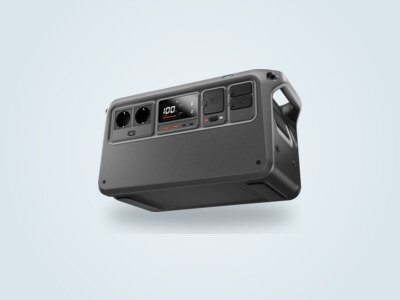
Other products in the "Versatile power stations" category
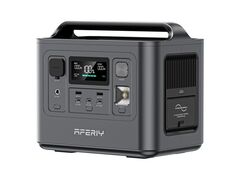
Aferiy P010
See price (5)
512Wh and 800W (1600W surge) in a 6.5kg footprint, backed by a 7-year manufacturer warranty: the Aferiy P010 bets on longevity as much as on compactness.
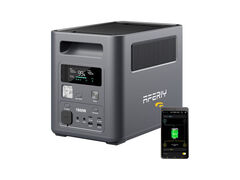
Aferiy P180
See price (12)
With 1024 Wh, 1800 W (up to 3600 W peak), a 90% recharge in 60 minutes and just 11.6 kg, the Aferiy P180 aims for lightweight versatility.
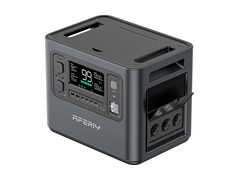
Aferiy P210
See price (7)
With 2048 Wh, 2400 W (up to 4800 W peak), a LiFePO4 battery and a 7-year warranty, the Aferiy P210 targets the best capacity-to-price ratio on the market.
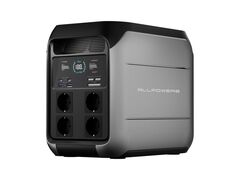
Allpowers P1800
£494.95 (6)
A 1 kWh LiFePO4 power station with plenty of punch, fast mains recharging and quiet running: a smart pick for campervans, camping trips and power cuts.
Published on 04/09/2026, updated on 01/10/2026