
What IATA has just taken out of the rulebook
To understand the news, you need to know that air safety rules come in two layers. At the top, ICAO (the International Civil Aviation Organisation) publishes the Technical Instructions, the legal foundation that states adopt. Below it, IATA (the airline association) publishes the Dangerous Goods Regulations (DGR) every year, and that is the manual your check-in agent actually works from. The DGR mirrors the Technical Instructions and may be stricter, never looser.
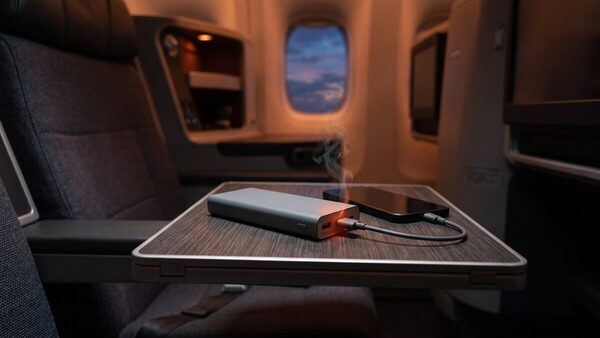
On 27 March 2026, ICAO issued an addendum that made plenty of noise: a maximum of two power banks per passenger, a ban on recharging them on board, and a recommendation not to use them in flight. We covered it in our article on the in-flight power bank use ban. What almost nobody picked up was what IATA wrote a few days later in its implementation guidance for operators, dated 31 March 2026.
That addendum, IATA notes, still allows 100 to 160 Wh batteries subject to operator approval. But the association adds one sentence about that exemption which changes everything:
“this provision will not be carried into the 68th edition of the DGRs”. IATA, guidance document for operators, 31 March 2026
The timeline is unambiguous. The 67th edition of the DGR, the one that still tolerates the 100-160 Wh window, stops applying on 31 December 2026. The 68th comes into force on 1 January 2027. On that date, the box marked “100 to 160 Wh with prior approval” simply disappears from the manual airlines apply. Two categories will be left for a passenger: up to 100 Wh, or nothing.
How many mAh is 100 Wh?
This is the question that trips everyone up, because manufacturers advertise in milliamp-hours (mAh) while regulations think in watt-hours (Wh). They do not measure the same thing: mAh count a quantity of charge, Wh count a quantity of energy. Converting between them requires the cell voltage.
The formula is a single line: Wh = mAh × V ÷ 1000. And that is where the trap hides. The nominal voltage of a lithium cell is not a universal constant: depending on the chemistry and on how a brand does its arithmetic, it is 3.6, 3.7 or 3.8 V. The same 30,000 mAh battery will therefore be marked 108 Wh by one brand, 111 Wh by another and 114 Wh by a third. Right on the 100 Wh line, that difference in convention decides who boards.
| Advertised capacity | Equivalent energy | After 1 January 2027 |
|---|---|---|
| 10,000 mAh | around 37 Wh | Cabin, no paperwork |
| 20,000 mAh | 72 Wh | Cabin, no paperwork |
| 25,000 mAh | 90 Wh | Cabin, no paperwork |
| 27,650 mAh | 99.54 Wh | Cabin, no paperwork (just under the line) |
| 30,000 to 43,000 mAh | 108 to 155 Wh | Banned: the exemption disappears |
| 44,000 mAh and above | more than 160 Wh | Already banned before 2027 |
Remember the order of magnitude: 100 Wh is roughly 27,000 mAh. Below that you are fine. Above it, from 2027, your battery stays at home. For more on the gap between advertised capacity and usable energy, our feature on the real capacity of a power bank works through the conversions.
What counts is the marking on the casing
Ten years of handling these products has taught us one thing: at the checkpoint, nobody opens the manufacturer’s datasheet or your order confirmation. The agent reads the marking printed on the shell and decides from that. It is precisely why serious manufacturers print the Wh figure right next to the mAh.
Two situations cause trouble. First, a battery that shows only mAh with no watt-hours. The agent then applies their own conversion, usually at 3.7 V, and a 27,600 mAh pack can come out at 102 Wh instead of the 99 Wh the brand claims. Second, a label worn away by years of rubbing inside a bag, which is very common on older units. With no legible marking, the default ruling does not favour the passenger.
Which power banks actually vanish from cabins
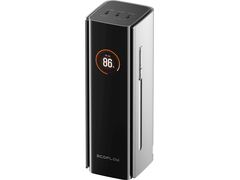
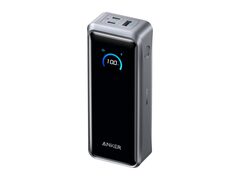
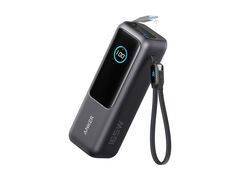
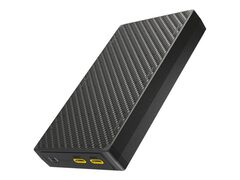
The good news first: if you travel with an ordinary power bank, nothing will happen to you. Look at the capacities of the best-selling travel models and a pattern emerges that is anything but accidental: 90 Wh, 99 Wh, 99.54 Wh, 99.75 Wh. Manufacturers have long designed their portable products to park just under the 100 Wh line, precisely because crossing it means leaving the travel market behind. That design choice shields them from the 68th edition.
The real casualties form a narrower but very real family:
- large 30,000 to 43,000 mAh packs, sold to recharge a laptop several times or to last a full weekend away from a socket;
- packs for videographers and photographers, often sized above 100 Wh to run cameras and lighting;
- very small power stations of 150 to 160 Wh, which some travellers used to bring into the cabin with prior approval.
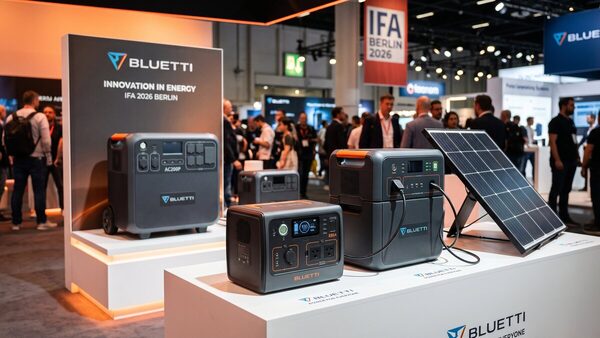
Above 160 Wh nothing changes: it was already banned for passengers, and the vast majority of power stations sit far above that. For air travel, the sub-100 Wh power banks are where to look, and the models below illustrate the top of the range that remains allowed.
Why IATA is closing this window now
The reasoning is set out in black and white in the IATA guidance, and it is more interesting than a simple safety reflex. The association first points to an industrial reality: building a power bank takes very little, and global oversight of non-conforming manufacturers is judged inadequate. In other words, the exemption rested on a level of trust IATA no longer considers reasonable to extend.
The document also flags a nuance few consumers know about: UN 38.3, the standard every product sheet cites, is a transport testing regime, designed to check that a cell survives shocks, pressure changes and short circuits. It is not a consumer product safety standard. A manufacturer who ignores it leaves no visible trace on the packaging.
A second, more recent reason: wireless power banks, the ones that charge a phone through magnetic contact. IATA describes them as an emerging concern, highly exposed to counterfeiting and to mass production without quality assurance, with several passenger reports of such devices going into thermal runaway. Our feature on thermal runaway explains what physically happens in those few seconds.
The third reason is the most technical: the March addendum already caps at 100 Wh the batteries that crew may use for their own operational duties on board. Letting a passenger board with 160 Wh while a crew member is limited to 100 Wh created an inconsistency that was hard to defend. IATA chose to align both downwards.
Careful: the real timeline depends on each country
Here is the nuance the alarmist articles always skip, and IATA underlines it itself. An international regulation does not become enforceable everywhere at the same moment: its applicability depends on each state’s adoption process. Some integrate it immediately, others need an administrative period, and others must go through a legislative amendment.
In practice that means two things for you. First, 1 January 2027 is the date in the airlines’ professional manual, not necessarily the date in the law of your departure or arrival country. Second, and this matters more, airlines are not waiting: several moved ahead in 2026 with rules stricter than the regulation itself, such as Emirates, which allows only one power bank of under 100 Wh. There is only one direction of travel here, and it points towards more restriction.
So the practical rule is simple: count on no leniency from 2027 onwards, and always check your airline’s baggage page before you fly. Our complete guide to air travel rules covers the current thresholds and how to calculate them.
What it changes for your actual trips
If you take five habits away from this article, here they are, valid today and well beyond the switch to the 68th edition.
- Check the Wh marking on your current batteries. Under 100 Wh, nothing to do. Between 100 and 160 Wh, use 2026 to plan ahead: you can still board with operator approval, and not at all afterwards.
- Two power banks maximum per passenger, carry-on only. That limit has already applied since March 2026.
- Never in the hold, whatever the capacity. A fire starting down there would go unnoticed until it was too late.
- No use and no recharging in flight. Keep the battery within reach, on you or in the seat pocket in front of you, and plug your phone straight into the seat socket if there is one.
- If you are buying now with 2027 in mind, aim for the 20,000 to 27,000 mAh band: it is the best compromise between runtime and peace of mind at security, and that range will never be challenged.
As a footnote, this decision will have an interesting side effect on the market: it permanently closes the door on “giant” power banks for air travel, and it will probably accelerate the race for density and efficiency below the 100 Wh line. A regulatory constraint that pushes towards better rather than bigger is not something you see every day.