
What happened on 17 September 2026 over the Atlantic
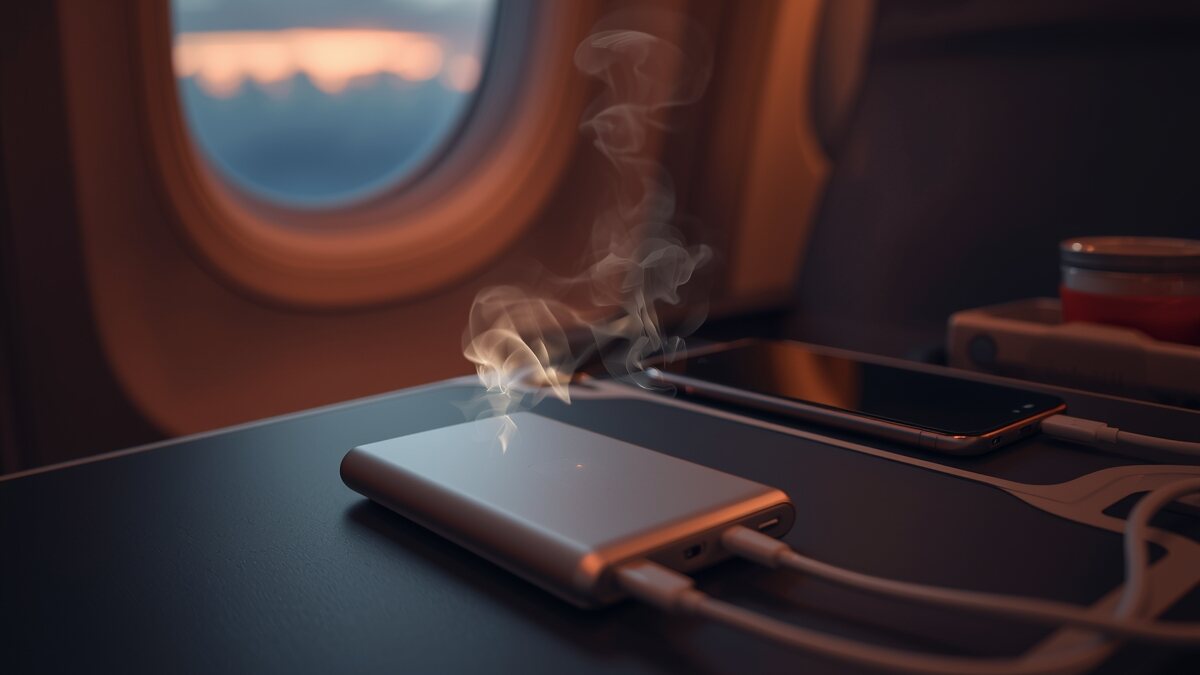
On 17 September 2026, KLM flight KL735, a Boeing 777-300ER flying from Amsterdam Schiphol to Curaçao, turned back roughly five and a half hours after take-off, while cruising over the Atlantic Ocean. The cause: a power bank that caught fire in the business class cabin, with witnesses describing a loud bang followed by visible flames.
Cabin crew reacted quickly and extinguished the fire, but the captain chose, as a precaution, to divert back to Schiphol rather than continue to the Caribbean. The aircraft landed safely after roughly eleven hours in the air in total. Visible damage was reported to the seat, the sidewall and the window area. KLM covered overnight hotel stays for all 322 passengers in Amsterdam and arranged a replacement flight the following day.
According to the airline, no passenger sustained serious injuries. One source cited by Dutch media did report minor injuries to the power bank's own owner. KLM said it had opened an internal investigation into the exact circumstances.
Why even the airline's own former CEO broke the rule
KLM's policy is unambiguous: passengers may carry up to two power banks in the cabin, provided they stay in hand luggage, visible and within reach. What's explicitly banned is using or charging them during the flight, as well as storing them in the overhead bins. We already covered this rule, which took effect earlier this year, in our article on power banks on planes: you are no longer allowed to use one.
The most striking part of this incident is exactly who broke the rule: the airline's own former chief executive, arguably the person best placed to know it. This wasn't a confused first-time flyer. It was a routine, almost automatic habit, plugging in a power bank before falling asleep, just as one might at home, that was enough to trigger an emergency turnaround over the Atlantic. The lesson applies to everyone: this isn't a rule you can afford to relax on, no matter how frequently you fly.
Why you should never charge or use a power bank in flight
A lithium-ion power bank can, in rare cases, enter thermal runaway: a vicious cycle in which a damaged, poorly manufactured or overstressed cell heats up, releases energy, heats up further, and eventually ignites or explodes. This can happen without charging, but active charging raises the risk further: it stresses the cell electrically at the very moment it's also exposed to vibration, cabin pressure changes and the temperature swings typical of a flight. That combination of factors is precisely why in-flight charging and use are banned, even though simply carrying the device is allowed.
Airlines take an in-flight lithium battery fire very seriously: cabin crews are trained to use dedicated fire-containment bags and water, never a standard dry-powder extinguisher, which is ineffective on this type of fire, to contain it until landing. The number of these incidents has been rising year over year as electronic devices multiply on board, which explains why several carriers, KLM included, have recently tightened their rules.
Calculating your power bank's Wh before you fly: the formula to know
Beyond the in-flight usage ban, a second rule governs the transport of power banks themselves: a 100 Wh (watt-hour) limit per battery, generally accepted without any paperwork by most airlines. Many power banks only advertise their capacity in mAh (milliamp-hours), a unit that says nothing on its own about the actual energy stored. To convert, the formula is simple:
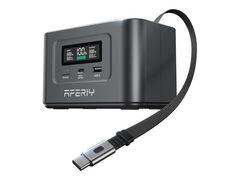
This is far from a minor detail: makers of very large power banks (above roughly 25,000-30,000 mAh) know this well, and deliberately design their products to stay just under the 100 Wh mark, even if that means capping the advertised capacity. That's exactly the case with the Aferiy Nano100 mentioned above: its 31,000 mAh of LiFePO4 cells (which run at a lower nominal voltage than conventional lithium-ion) deliberately cap out at 99 Wh, keeping it eligible for cabin travel without any special approval. The 100 Wh threshold isn't set in stone forever, either: we cover its planned evolution in our dedicated article, power banks on planes: anything above 100 Wh is out from 2027.
The pre-flight checklist: what's allowed, and what isn't
| Situation | Allowed? |
|---|---|
| Carrying a power bank under 100 Wh in cabin baggage | Yes, typically up to two |
| Packing a power bank in checked luggage | Never |
| Storing a power bank in the overhead bin | No |
| Charging a power bank in flight | No |
| Using a power bank to charge another device in flight | No, under KLM's rules |
| Power banks between 100 and 160 Wh | Only with prior airline approval, in limited numbers |
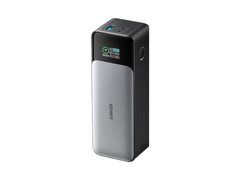
The core rule to remember: a power bank always travels in your carry-on, never in the hold, never in an overhead bin, and it stays switched off for the entire flight. Looking for a compact model comfortably under the 100 Wh limit? Our power banks section lists options built for travel, from the most pocketable to the most versatile.