
What the new rule actually says
On 27 March 2026, the Council of ICAO, the International Civil Aviation Organisation, approved Addendum No. 1 to the 2025-2026 edition of the Technical Instructions for the Safe Transport of Dangerous Goods by Air, known as Doc 9284. It took effect the same day and applies across the organisation’s 193 member states, which then translate it into national rules and airline policies.
The text comes down to five obligations, all concerning power banks carried by passengers:
- the power bank travels in cabin baggage only;
- it must not be recharged on board, neither from a seat socket nor from a USB port;
- it must not be used to charge a device during the flight;
- two power banks maximum per person;
- each one must be individually protected against short circuits when not in use.
Two of those points already existed as widely followed recommendations: cabin-only carriage and terminal protection. The genuine novelty is the hard numerical cap of two units, and above all the ban on use. Until now, plugging your phone into your power bank mid-flight was left to each passenger’s common sense. It is now an international rule.
No, your power bank is not banned from the plane
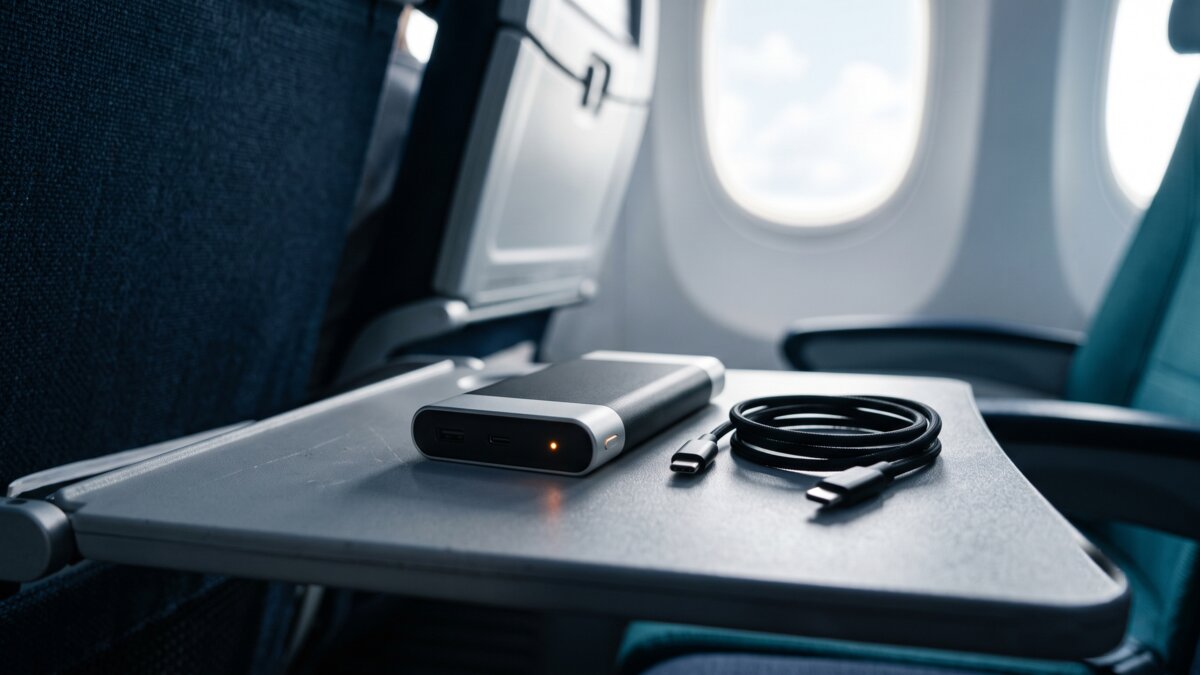
This is the misunderstanding doing the rounds since the start of the summer, and it is worth correcting: no airline forbids you to bring a power bank. What is forbidden is using it once the doors are closed. That distinction changes everything when you pack.
The carriage thresholds have not moved by a single watt-hour. They remain the ones we detail in our guide to lithium battery rules for air travel:
- up to 100 Wh: allowed in the cabin, no paperwork;
- 100 to 160 Wh: allowed with prior airline approval;
- above 160 Wh: not allowed on a commercial passenger aircraft;
- checked baggage: never, whatever the capacity.
To place those figures on a real product label: at a 3.7 V cell voltage, 100 Wh works out at roughly 27,000 mAh, and 160 Wh at about 43,000 mAh. A 20,000 mAh unit therefore sits near 74 Wh, nowhere near the ceiling. In other words, virtually every power bank on the market passes without discussion, and it really is in-flight use, not capacity, that has just changed. If the gap between advertised mAh and the energy you actually get puzzles you, we took it apart in what those advertised mAh are really worth.
Which airlines already enforce it, and since when
ICAO did not start this, it harmonised it. A large share of Asian carriers tightened their policies back in 2025, and the first European group followed in January 2026. Here is where things stand as we write.
| Airline | Since | What is banned on board |
|---|---|---|
| Singapore Airlines and Scoot | 1 April 2025 | Using and recharging a power bank |
| Emirates | 8 August 2025 | Using and recharging, plus a single unit under 100 Wh per passenger |
| Lufthansa Group (Lufthansa, Swiss, Austrian, Eurowings, Edelweiss, Brussels Airlines) | 15 January 2026 | Using and recharging, two units maximum, must stay within reach, overhead bin banned |
| Air France | January 2026 | Using and recharging, power bank accessible at all times |
| East Asian carriers (Korean Air, Asiana, Cathay Pacific, EVA Air, China Airlines, STARLUX, Thai Airways, ANA, Japan Airlines) | During 2025 | Using and recharging |
| American Airlines | 1 May 2026 | Aligned on the ICAO baseline |
The Lufthansa Group went furthest, with one requirement the others have not adopted yet: the power bank must not be stored in the overhead bin. It stays on you, in the seat pocket, or in the bag under the seat in front of you. Within that same group, recharging a power bank from the aircraft USB port had already been prohibited since May 2025.
One practical warning before you pack: these policies are moving fast, and they apply flight by flight. The rule that counts is the one set by the airline operating the flight, not the one whose ticket you bought. A codeshare leg can therefore follow policies you were not expecting.
Why the rule is arriving now
There is a before and after 28 January 2025. That day, at Gimhae International Airport near Busan in South Korea, an Air Busan Airbus A321 caught fire as it prepared to taxi. All 176 people on board were evacuated, seven were injured, and the fire destroyed close to half of the fuselage. On 14 March 2025, investigators concluded that the cause was a short circuit inside a power bank stowed in a piece of hand luggage in an overhead bin, following a failure of the cell’s internal insulation.
South Korea reacted within weeks: no power banks or e-cigarettes in overhead bins, and no charging them from the aircraft’s USB ports. Asian carriers followed over the following months, EASA published its own recommendations to airlines and passengers, and ICAO eventually wrote the whole thing into its Technical Instructions.
The underlying logic has always been the same, and it explains the exact shape of the rule. A lithium cell going into thermal runaway goes from merely feeling warm to open flames in a matter of tens of seconds. Such a fire is entirely manageable in the cabin: crews are trained, they carry extinguishers and containment bags, and above all they can see it. Inside a closed bin above your head, or worse in the hold, they cannot. Every one of these rules follows from that single difference.
What it changes for your next flight
In practice, the old habit of leaving home with a half-empty phone and topping it up during the flight no longer works. You have to reverse the order of operations.
- Charge before, not during. Phone, headphones, e-reader: everything leaves home or the departure gate at 100 %. The power bank goes back to being what it always was, a reserve for landing, transit and the day that follows.
- Use the seat socket. On aircraft fitted with them, plugging your phone straight into the seat socket or USB port is still allowed. It is the power bank that is targeted, not charging as such.
- Count your units. Two maximum, and that total includes the one that has been sleeping in your camera bag for six months. It is exactly the kind of oversight that ends badly at security.
- Protect the terminals. Original packaging, a pouch or simply tape over the contacts: the goal is that no coin or key can close a circuit inside your bag.
- Keep it within reach. Seat pocket, bag under the seat, or on you. Several airlines explicitly rule out the overhead bin.
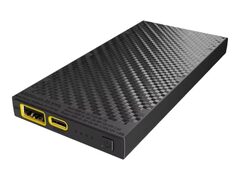
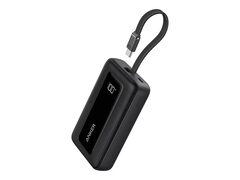
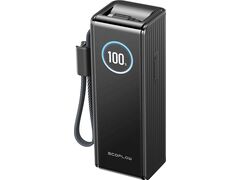
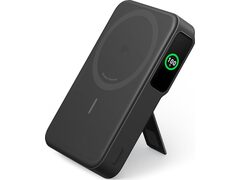
On the hardware side, nothing forces you to change kit, but two criteria carry more weight than before. The first is capacity: staying under 100 Wh, roughly 27,000 mAh, avoids any approval request. The second is format: since the power bank has to stay accessible and will only be used on the ground, a compact, light unit is often a better fit than a 300 Wh brick you would have stowed in the bin anyway. Our roundup of the best power banks for travel still holds, with one shift: fast recharging on the ground now matters more than raw capacity, because you will have less time between flights to refill it.