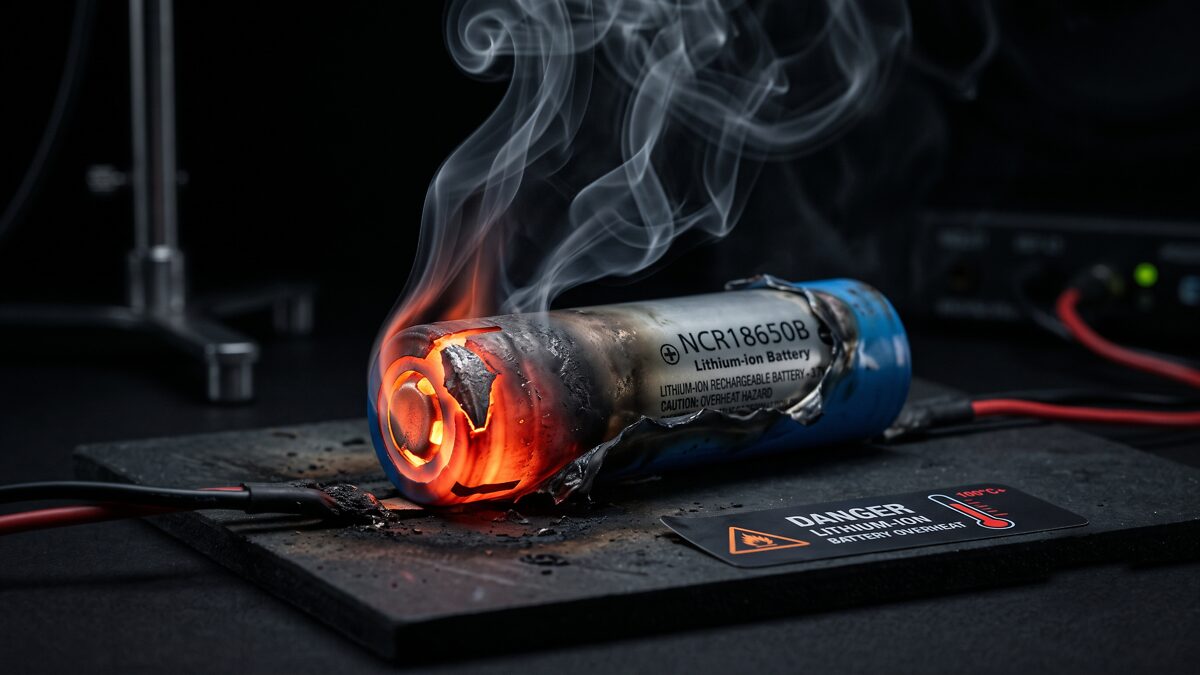
Thermal runaway: what is it?
A lithium battery stores a lot of energy in a very small volume: that is exactly what makes it handy, and potentially dangerous. Thermal runaway is the name of the worst-case scenario: a self-sustaining chain reaction that suddenly releases all that energy as heat and fire.
The mechanism is a vicious circle. A cell that reaches a critical temperature sees its electrolyte and materials begin to break down. That breakdown gives off heat, which raises the temperature further, which speeds up the breakdown, and so on. Once started, the reaction no longer stops on its own.
The good news: this scenario stays rare. Branded batteries, well designed and well used, almost never run away. You just have to understand what can light the fuse.
What triggers it?
Four broad families of causes can start the vicious circle.
An internal fault. An impurity or a manufacturing defect can create a micro short circuit inside the cell. This is the most insidious scenario, invisible from the outside, and behind several major product recalls in the past.
Physical damage. A punctured, crushed or badly dropped battery can see its internal layers touch and short. That is why a scooter or e-bike battery damaged in a shock must be watched closely.
Overcharging or bad charging. Charging beyond the intended voltage, with an unsuitable or counterfeit charger, forces the cell past its limits. It is a frequent trigger with low-end gear.
Excessive heat. A battery left in full sun, near a heat source or in an overheated cabin can reach the critical threshold with no other cause. Heat is both a trigger and an accelerator.
Why it is so hard to put out
A lithium battery fire is not an ordinary fire. Once the runaway starts, the cell produces its own heat and releases flammable gases: it partly feeds itself, which makes it especially stubborn.
Worse, a fire of this type can reignite several times, even after seeming out, as long as the internal heat has not fully dissipated. And in a multi-cell battery, one cell's runaway can spread step by step to its neighbours: the domino effect.
It is precisely for this reason that lithium batteries are so tightly controlled in transport. Our guide on power banks on planes explains why they always travel in the cabin, never in the hold: there, an incipient incident can be spotted and contained at once.
How makers protect against it
Faced with this risk, the industry has multiplied safeguards. A quality battery is a safety system as much as an energy tank.
The BMS (Battery Management System) is the brain that constantly monitors voltage, current and temperature, and cuts charging or discharging in case of an anomaly. It is the first line of defence. Inside the cells, a special separator isolates the electrodes and can shut down in case of overheating to stop the reaction.
It is also the whole point of solid-electrolyte batteries, which we cover in our article on solid-state technology: by removing the flammable liquid electrolyte, they promise to drastically cut this risk.
The right habits to avoid it
The vast majority of serious incidents involve low-end, counterfeit or damaged gear. A few simple rules bring the risk down to almost nothing.
- Buy recognised brands and steer clear of counterfeits and prices too good to be true, especially for batteries and chargers.
- Use the right charger, the maker's or a certified compatible model. A poor-quality charger is a classic trigger.
- Avoid heat: no charging in full sun, under a pillow or in an overheated car.
- Never puncture, crush or dismantle a battery. After a violent impact, keep an eye on it.
- Charge large devices under supervision (scooter, e-bike), preferably not overnight or on an escape route.
These reflexes apply to all your power banks as much as to your everyday devices.
Warning signs and what to do if there is a problem
A battery going wrong often sends signals before the accident. Learn to recognise them.
Swelling is the most telling sign: a battery or device that swells, whose shell deforms or whose screen lifts, must be taken out of service immediately. Add to that abnormal heat at rest, a sweetish chemical smell, a hissing or a weeping.
Faced with a swollen battery, do not puncture it, do not charge it any more, and place it somewhere safe, away from anything that can burn, until you can have it recycled properly. In case of a fire, a battery fire is cooled with large amounts of water, but your safety remains the absolute priority: move away and alert the emergency services.
Finally, a battery at the end of its life is not ordinary waste: it goes back to a collection point to be recycled safely. Well treated from the first day to the last, a lithium battery remains a reliable companion, of which thermal runaway is only the extreme, avoidable risk.