Step 1: how many watt-hours do you use each day?
Before sizing any panel or battery, you need the one figure that drives everything else: daily consumption in watt-hours (Wh). A Wh is simply an appliance's power (in watts) multiplied by how many hours a day it actually runs. A compressor fridge rated at 40 W but that only actually runs around 40 % of the time (its compressor cycles on and off) uses roughly 40 x 24 x 0.4 = 384 Wh a day, not 960 Wh.
List every appliance, add them up, and you get your daily energy budget. A typical example for a weekend in a camper van with two people:
| Appliance | Power | Daily use | Wh/day |
|---|---|---|---|
| 12 V compressor fridge | 40 W (40 % duty cycle) | 24 h | ~380 Wh |
| Laptop | 60 W | 1 h charging | ~60 Wh |
| LED lighting | 10 W | 3 h | ~30 Wh |
| Smartphones (x2) | 10 W | 2 h charging | ~20 Wh |
| Water pump | 60 W | 10 min | ~10 Wh |
| Total | ~500 Wh/day |
Step 2: how much battery capacity for how many days of autonomy?
Once you know your daily need, decide how many days of autonomy you want without any solar recharge, to cover a cloudy spell or a shaded stop. Two days is a common choice for van life or bivouacking; three to five days for home backup during a longer power cut.
The formula: gross need (Wh) = daily consumption (Wh) x autonomy days wanted. But you can't actually use 100 % of a battery's capacity: the recommended depth of discharge (DoD) sets the nominal capacity you really need.
| Battery chemistry | Recommended DoD | Nominal capacity for 1,000 Wh usable |
|---|---|---|
| LiFePO4 (lithium iron phosphate) | 90 to 100 % | ~1,100 Wh |
| Lithium NMC | 80 to 90 % | ~1,200 Wh |
| Lead-acid AGM/gel | 50 % | ~2,000 Wh |
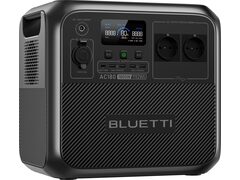
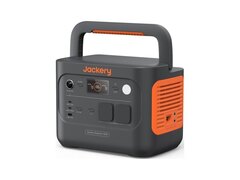
Back to the example: 500 Wh/day x 2 autonomy days = 1,000 Wh gross need. With a LiFePO4 battery (DoD ~90 %), that maps to a nominal capacity of roughly 1,100 to 1,200 Wh, matching a power station like the Jackery Explorer 1000 or Bluetti AC180. With lead-acid, you'd need to roughly double the nominal capacity for the same real-world use, which is why those batteries are so much heavier for equivalent service.
Step 3: how much solar wattage do you need to recharge that energy?
The panel doesn't need to recharge your entire autonomy buffer every day: it just needs to recharge your daily consumption during the available sunlight hours, so the buffer tops back up on sunny days. The formula: panel wattage (W) = daily consumption (Wh) / (effective sun hours x real-world efficiency).
Two key concepts:
- Effective sun hours (or “peak sun hours”) aren't daylight hours, but the equivalent number of hours at maximum panel output. They range from 2 to 3 hours in winter in northern Europe up to 6 to 7 hours in high summer further south. The European Commission's PVGIS tool (linked in the sources below) gives a precise estimate by location and month.
- Real-world efficiency for a portable panel typically runs at 60 to 70 % of its advertised nominal rating, due to imperfect orientation, passing clouds, and heat. Our deep dive on solar charging in real conditions breaks these losses down in detail.
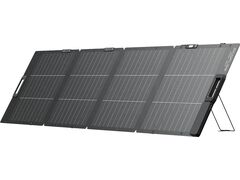
For the van example (500 Wh/day), with 4 hours of effective sun on average and 65 % real-world efficiency: panel wattage = 500 / (4 x 0.65) ≈ 192 W. Rounding up with a safety margin for less sunny days, a 220 W panel comfortably covers this need for most of the year in nomadic use.
Which charge controller should you pick for your panel and battery?
A charge controller isn't a minor accessory: undersized, it caps the power actually transferred from the panel to the battery, or worse, it gets damaged. Two technologies:
- PWM (Pulse Width Modulation): simple and inexpensive, but with bigger efficiency losses, especially when the panel's voltage sits well above the battery's. Fine for a small nomadic panel under 100 W.
- MPPT (Maximum Power Point Tracking): constantly hunts for the panel's optimal operating point and converts excess voltage into extra current. The efficiency gain, 20 to 30 % in some conditions, easily justifies the extra cost above 100 W of installed power.
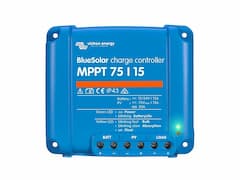
To pick the right model, check three values on the panel's datasheet: open-circuit voltage (Voc), short-circuit current (Isc), and the total power if several panels are wired in series or parallel. The controller must accept an input voltage above the total Voc (with margin, since open-circuit voltage rises in cold weather) and a current above the total Isc. A model like the Victron SmartSolar MPPT 75/15 typically suits a 100 to 220 W panel on a 12 V battery. The full wiring sequence (controller first, panel second, never the other way around) is covered in our step-by-step installation guide.
Worked example: sizing a complete kit for a weekend in a van
Walking through every step for our scenario (500 Wh/day, 2 autonomy days wanted):
- Daily consumption: ~500 Wh/day (fridge, lighting, electronics).
- Battery capacity: 500 x 2 = 1,000 Wh gross need, so roughly 1,100 to 1,200 Wh nominal in LiFePO4, matching a Jackery Explorer 1000 or a Bluetti AC180.
- Panel wattage: ~192 W calculated, rounded up to a 220 W panel, such as the EcoFlow 220 W solar panel, with the safety margin.
- Charge controller: built into the station (no separate wiring) if you go with an all-in-one model; otherwise a Victron MPPT 75/15 for a separate battery-and-controller setup.
This kit comfortably covers a three-day weekend even without any mains top-up in between, with real margin for a rainy day. For heavier use (a bigger fridge, portable AC, remote work), redo the calculation with your own energy budget: the method stays the same, only the numbers change.
The most common sizing mistakes
A few pitfalls come up again and again for newcomers:
- Relying on the panel's nominal rating with no margin. A 200 W panel never actually outputs 200 W continuously all day: always calculate with real-world efficiency, not the number printed on the label.
- Forgetting the station's own idle draw. An inverter left switched on continuously can burn through dozens of Wh a day even with nothing plugged in.
- Applying a lithium depth of discharge to a lead-acid battery. Repeatedly discharging a lead-acid battery past 50 % drastically shortens its lifespan, unlike LiFePO4, which tolerates a near-full discharge.
- Not planning any margin for sunless days. Sizing right at the edge, with no autonomy buffer, leaves you flat after the very first extended cloudy spell.
- Overlooking wiring losses. Cables that are too long or too thin between the panel and the controller drop voltage and reduce the power actually delivered, especially over longer runs.