

Power bank or solar panel: the wrong question
The question comes up before every trek: pack a power bank, a foldable solar panel, or both? After a decade testing this gear in the field, the honest answer is that there is no universal best choice, only the best choice for your specific trek.
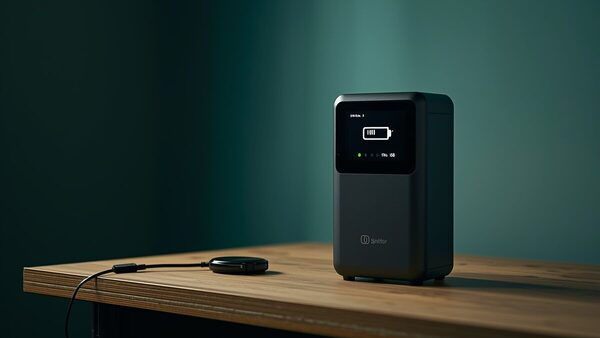
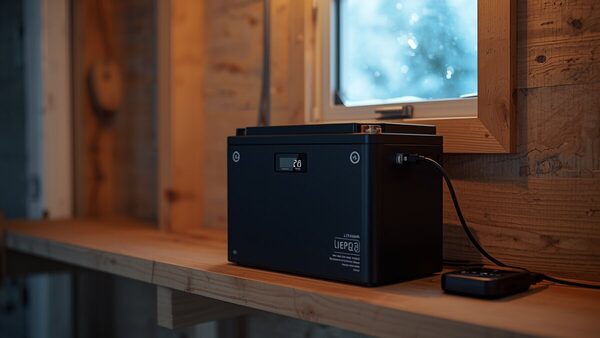
A power bank stores a fixed, known amount of energy: whatever it holds when you leave is all you will ever have. A foldable solar panel, by contrast, stores nothing (with rare exceptions): it turns whatever light is available right now into current, either to power a device directly or to recharge a power bank. One is a reserve, the other is a source. Confusing the two roles is the first planning mistake.
Three concrete criteria settle the choice reliably: how long the trek lasts, how much real sunlight your route actually gets, and how much weight you are willing to add to your pack. The sections below walk through each, followed by real numbers from real gear.
First criterion: how many days without mains power?
A power bank has a fixed capacity, measured in mAh or Wh (our mAh to Wh conversion guide breaks down the math). To cover more days, there are only two options: bring a bigger power bank, or recharge it during the trek.
- A weekend or 2 to 4 days: a power bank alone almost always covers the need. A smartphone uses roughly 16 Wh per full charge; a 10,000 mAh power bank (around 38 Wh usable) already delivers 2 to 3 charges, comfortably enough without a single hour of sun.
- 5 to 10 days: the grey zone. A power bank alone gets heavy if you want real margin (GPS, headlamp, camera on top of your phone), but it still works without a panel if your electronics use stays modest.
- More than a week, self sufficient trek with no electrical resupply: this is where a solar panel changes the equation, since it lets you replenish energy day after day instead of stacking mAh in your pack from the start.
Second criterion: what does your trek actually look like, sun wise?
A foldable solar panel only produces what the sky gives it, and real world output is noticeably lower than the nominal wattage printed on the box. In full sun and properly angled, expect roughly 50 to 65% of the rated power as usable output; under hazy skies or a poor angle, output drops further, sometimes by half again. The European Commission's Photovoltaic Geographical Information System (PVGIS), which models the real solar radiation available by location and season, confirms this large gap between theoretical sunshine and usable output in the field.
Before deciding, ask yourself these questions about your route:
- Open terrain (ridgelines, alpine meadows, desert, coastline) or dense forest? A panel strapped to the back of your pack produces almost nothing under a closed canopy.
- What season and latitude? A summer trek in a Mediterranean or high alpine zone sees far more radiation than an autumn trek in a northern or temperate region.
- How many daylight hiking hours outside the tent? A panel clipped to your pack produces while you walk, unlike charging only at camp, which is often limited to a few hours at the end of the day.
Without at least some of these conditions, a solar panel becomes dead weight. In that case, put your weight budget into a higher capacity power bank instead.
Third criterion: how much weight are you willing to carry?
For multi day hiking, a commonly cited guideline from hiking federations is to keep the whole loaded pack, water and food included, under roughly 20% of your own body weight (French Hiking Federation, FFRandonnée). Inside that already tight budget, the power gear should stay marginal: aim for no more than 300 to 500 g of charging equipment for a week long trek.
Two real, ultralight examples to put this in perspective:
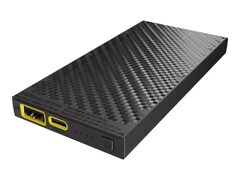
- A 10,000 mAh carbon fiber power bank weighs only about 150 g (such as the Nitecore NB10000), delivering around 38 Wh usable, good for 2 to 3 smartphone charges.
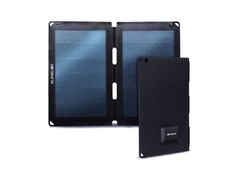
- A 12 W foldable panel with flexible CIGS cells weighs about 240 g (such as the Sunslice Fusion Flex), folding down to an A4 sheet, which stays reasonable even for ultralight setups.
For comparison, doubling a standard power bank's capacity (from 10,000 to 20,000 mAh) roughly adds another 150 to 180 g. A lightweight 240 g panel, on the other hand, can potentially produce the equivalent of several charges every sunny day, without ever getting heavier as the trek goes on.
The real numbers: energy produced versus energy used
Let's run the numbers on two real products, assuming an average real world yield of 55% in full sun (within the range mentioned above).
| Gear | Rated power / capacity | Weight | Real output or reserve |
|---|---|---|---|
| 12 W foldable panel (Sunslice Fusion Flex) | 12 W nominal | 240 g | ~6.5 W usable in full sun, or ~30 to 35 Wh over a sunny hiking day (5 to 6 h of output) |
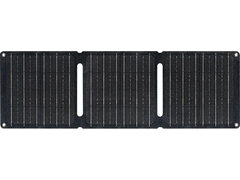
| 21 W foldable panel (Allpowers SP001) | 21 W nominal | 610 g | ~11.5 W usable in full sun, or ~55 to 65 Wh over the same day |
| 10,000 mAh power bank (Nitecore NB10000) | ~38 Wh usable | 150 g | Fixed reserve, independent of weather |
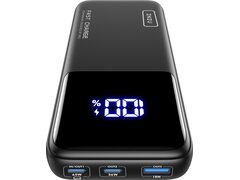
| 20,000 mAh 65 W power bank (INIU) | ~74 Wh usable | 324 g | Fixed reserve, also fast charges a light laptop |
With these numbers, an 240 g panel producing 30 to 35 Wh on a sunny day covers, by itself and indefinitely, a smartphone's needs (~16 Wh per charge) plus a watch or earbuds. For the same autonomy spread over ten days without a single ray of sun, you would need roughly 160 Wh of power bank capacity, or over 600 g of battery alone. That tipping point, around a solid week of trekking with decent sun exposure, is what pushes the decision toward a solar panel rather than a giant power bank.
Three trek profiles, three different answers
Weekend or short trek (1 to 4 days), uncertain weather
A power bank alone, light and reliable. A 10,000 mAh unit (~150 g) covers a smartphone and a few small accessories without depending on a single hour of sunshine. Maximum simplicity: nothing to angle, nothing to clip to your pack.
One to two week trek, open terrain and decent sun (ridgelines, high summer mountains, desert, coastline)
The combo of a light foldable panel (12 to 21 W) clipped to your pack while walking, plus a small buffer power bank (10,000 mAh) to store the surplus and recharge overnight. This is the most efficient weight to autonomy balance over the long run.
Trek through dense forest, northern climate, autumn or winter
A solar panel loses almost all its value here: go for a higher capacity power bank (20,000 mAh) instead and cut electronics use (airplane mode, lower screen brightness) rather than hauling a panel that will barely produce anything.
The winning combo: why the two often work best together
Once a trek runs past a week with decent sun exposure, the real question stops being 'power bank or panel' and becomes 'panel and power bank, in what proportions'. The panel produces unevenly, depending on the weather and the daylight hiking hours; the power bank smooths out those swings by storing the midday surplus and releasing it in the evening, at camp, when your phone doubles as a flashlight or GPS.
To dig into device by device battery math, our mAh and Wh guide breaks down how many charges each power bank size delivers depending on the device (smartphone, GPS, camera, drone).
The quick decision table
| Your trek | Recommended solution |
|---|---|
| 1 to 4 days, any weather | Power bank alone, lightweight (10,000 mAh) |
| 5 to 10 days, decent sun | Higher capacity power bank alone (20,000 mAh), panel optional |
| More than a week, open terrain and good sun | Light foldable panel (12 to 21 W) + small buffer power bank |
| Dense forest, overcast climate, autumn/winter | Power bank alone, maximum capacity within your weight budget |
The bottom line
- A power bank stores a fixed, reliable amount of energy; a solar panel produces a variable amount, dependent on the real sunlight your route gets.
- For 1 to 4 days, a lightweight power bank (10,000 mAh, ~150 g) is almost always enough, with no dependence on the sky.
- Beyond a week, with real sun exposure, a light foldable panel (12 to 21 W) paired with a small power bank ends up lighter than a giant power bank.
- In dense forest or overcast climates, skip the panel and put everything into power bank capacity.
- Respect your overall weight budget (roughly 20% of body weight for the whole pack): the power gear should stay marginal, 300 to 500 g is plenty.