What the claimed 299 Wh is really worth
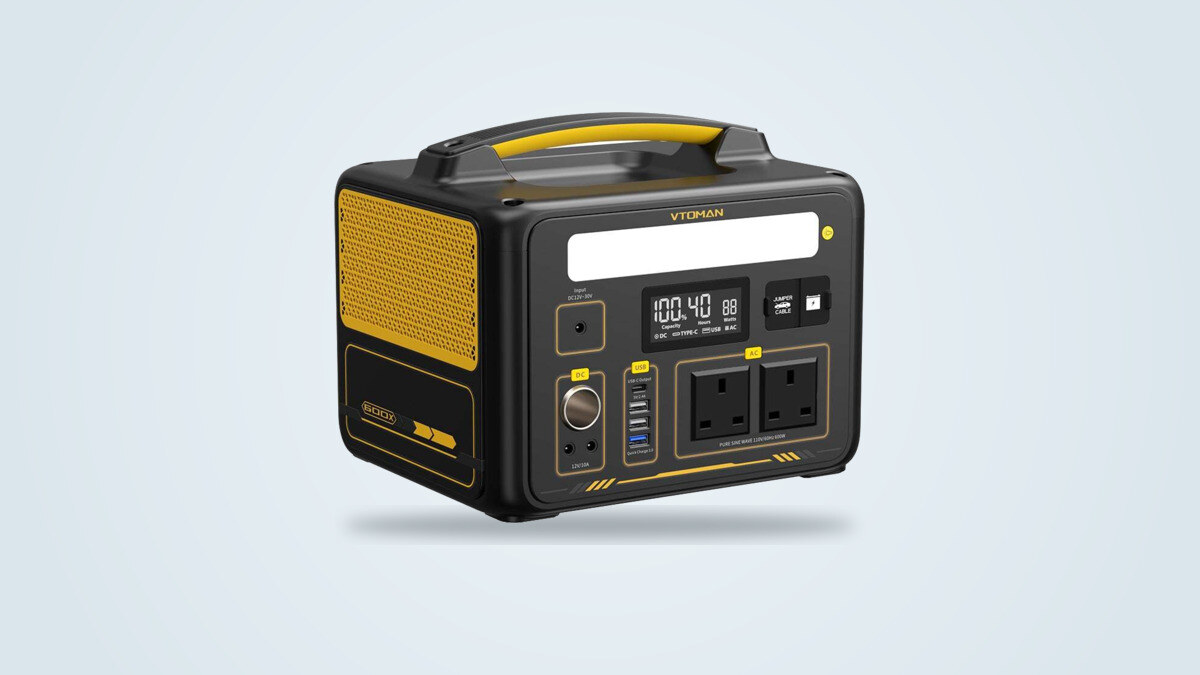
The Jump 600X is rated at 299 Wh. The cylindrical LiFePO4 cells that make up its pack, arranged in a 4S4P configuration, actually add up to 307.2 Wh: the station starts out with a small margin rather than a shortfall, a favourable starting point that isn't the norm on this segment.
What matters is what actually reaches a socket or a port once conversion losses are paid. Three discharge paths give three different results, and the gap between them tells its own story.
The gap between 273 and 292 Wh isn't an inconsistency, it's a well-known physical mechanism: the mains output goes through the inverter, which takes its own cut of energy along the way, while the DC and USB-C outputs skip that conversion. On this station the gap between the two paths stays modest, which puts its delivered capacity among the best in its price class: it's therefore worth favouring the DC or USB-C output for extended use, and saving the mains sockets for the devices that actually need them.
600 W continuous, 1200 W peak: V-Beyond technology put to the test
The Jump 600X is rated at 600 W continuous and 1200 W peak thanks to its in-house V-Beyond technology, designed to absorb a brief overload rather than cut the power. The principle holds up on concrete cases: a combined load pairing a roughly 450 W coffee maker with a 55 W laptop charger runs without a cutout, and starting a roughly 550 W fridge compressor doesn't trip any protection. Faced with a 750 W heating appliance, well above the 600 W rating, the station still doesn't cut out: it slightly lowers its output voltage to hold a stable 600 W, with the appliance continuing to run at a somewhat reduced power rather than switching off outright.
Two mains sockets on the output side, a waveform sold as pure sine, and a frequency close to 50 Hz round out the picture. An independent measurement puts the real output voltage at 220 V rather than the advertised 230 V on that particular unit, a common gap for this type of inverter and one with no real consequence for the vast majority of electronics, which tolerate a wide voltage range. The waveform itself stays clean, with harmonics measured about 45 dB below the fundamental, a solid result for the category.
Mains charging: a single 100 W input, slower than promised
The manufacturer claims 80% charge in 2 h 40 and a full charge in about 3 hours, through the single DC5521 input capped at 100 W. In practice, a full charge from an empty battery, using the supplied mains charger, takes about 3 h 50, a clear gap from the promise.
Charging efficiency from the mains to the battery sits around 81%, and the full round-trip efficiency (charging then discharging back out through the mains sockets) around 73.6%, a consistent figure for a station whose energy passes through conversion electronics twice. Charging through the 12 V input (car socket or solar panel) takes about 4 h 06 for a full charge; on a 30 V input, closer to what a capable solar panel provides, power stays capped at about 98 W and a full charge takes about 3 h 29.
The single input, shared between mains, 12 V and solar, caps out at 100 W in every case: a modest ceiling next to the most recent compacts on the market, which now offer 300 W or more of fast input. One more thing worth knowing: if a solar charge gets interrupted, the station doesn't automatically resume charging once power reappears, you have to unplug and replug the input to restart it, a detail that matters for van life or extended off-grid use. Pass-through charging remains available throughout: the station keeps powering its outputs while it charges itself.
Nine outputs, but a USB-C weak spot
The port count is generous for a compact of this capacity: nine simultaneous outputs in total.
| Output | Detail |
|---|---|
| Mains | 2 sockets, pure sine wave, 600 W continuous (1200 W peak) |
| USB-C | 1 PD port at 60 W (fixed 5/9/12/15/20 V, no PPS) |
| USB-A | 3 ports including one 18 W Quick Charge 3.0, the other two at 12 W |
| 12 V DC | 2 regulated 12 V/10 A DC5521 outputs plus a car socket, 120 W combined |
| Lighting | built-in LED torch, around 10 W |
Output electrical quality is a genuine strength: ripple measured on the USB ports stays very low, around 19 mV peak-to-peak at 5 V and 76 mV at 20 V, a result that beats most stock chargers bundled with a smartphone or laptop.
The weak spot lies elsewhere: the single USB-C port caps out at 60 W and is limited to fixed voltages (5, 9, 12, 15, 20 V), without the PPS protocol that some recent phones need to reach their fastest charging speed. A direct rival in the same capacity class, the Anker SOLIX C300, offers a bidirectional 140 W USB-C port, more than double. Both DC5521 outputs are advertised and used up to 10 A, while the connector itself is only rated for 5 A: a gap between the advertised power and the component's own rating, with no incident to date, but worth knowing. Finally, there's no mobile app, Bluetooth or Wi-Fi: control is limited to the LCD screen and physical buttons.
The built-in jump starter: a rare selling point, unverified on this model
This is the rarest feature at this price point on a 299 Wh compact: a dedicated connector lets you jump-start a vehicle with a flat battery, without reaching for a separate booster. The function targets petrol engines up to 8 litres and diesel engines up to 6 litres, and the EC5 jump-start cable is sold separately rather than included in the standard box.
For this specific compact model, no verifiable, detailed account (vehicle type, battery condition, cable used) turned up to confirm a successful jump start: the only claims available stay general, without enough detail to cross-check. The Jump 600X's bigger sibling, the Vtoman Jump 2200, relies on the same electrical principle and successfully started a petrol engine on its first attempt, cable connected to the terminals. That success on a related model doesn't guarantee anything on this specific compact one, but it does confirm the mechanism isn't just a marketing line from this brand. The jump start itself only draws on the battery for a few seconds, a very different load from a sustained discharge, which in theory limits any impact on its lifespan.
The 939 Wh expansion: a promise dented by the add-on battery
The Jump 600X can be paired with a separately sold add-on battery, rated at 640 Wh, to bring total capacity to 939 Wh. On paper, the sum checks out. In practice, the add-on battery doesn't keep its promise as well as the main unit does.
A gap of this size contrasts sharply with the main unit, which keeps its own promise almost in full. Three further concerns sit on top of that shortfall for this add-on battery specifically: the positive connecting cable has a very tight bend radius at its exit point, a design flaw that exposes the sheath to wear; the internal cells carry a manufacturing date roughly three years earlier than the product's market release; and the handover between the main and add-on battery isn't always seamless, with the station able to shut down completely mid-discharge and require a manual restart, including a specific scenario where slow solar charging combined with a low add-on battery triggers repeated shutdowns until the input is unplugged and replugged.
Components, build quality and brand reliability
The main battery uses cylindrical LiFePO4 cells from HT Power in the 32700 format, arranged 4S4P, a chemistry and format common at this price point. The battery management system relies on three 40 A fuses under resin protection, a fairly careful design choice for the category. The inverter electronics, on the other hand, use power transistors and capacitors from brands less familiar to the sector's major manufacturers, without that translating into any reported incident on the unit examined.
The operating temperature range, from minus 20 °C to 55 °C on discharge and 0 °C to 55 °C on charge, covers most outdoor uses short of polar conditions. No safety issue or recall is on record for this model to date.
This is a less established brand than the sector's reference names, with an inconsistent track record on after-sales support: one unit stopped charging within a year of use, with follow-up messages left unanswered for a long stretch, and another arrived faulty straight out of the box. A signal of the same kind shows up on another model from the same brand in this catalogue, which points to a brand-wide trait rather than an incident isolated to this one product. That doesn't call the product's actual operation into question for the vast majority of users, but it's a reason not to count on flawless after-sales support if something goes wrong.
Against the direct competition
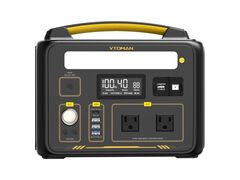
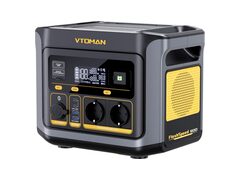
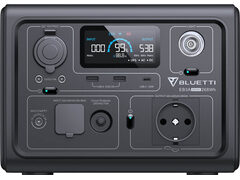
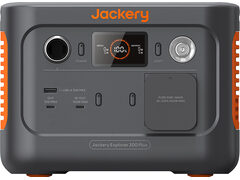
In this segment of compacts around 300 Wh, four names stand out. The table below places the Jump 600X against them on the most telling criteria.
| Criterion | Vtoman Jump 600X | Vtoman FlashSpeed 600 | Bluetti EB3A | Anker SOLIX C300 |
|---|---|---|---|---|
| Capacity | 299 Wh (expandable to 939 Wh) | 499 Wh | 268 Wh | 288 Wh |
| Continuous / peak power | 600 W / 1200 W | 600 W / 1200 W | 600 W / 1200 W | 300 W / 600 W |
| Main USB-C port | 1 x PD 60 W | 1 x 100 W (12 W real-world on a phone) | 1 x PD 100 W | 1 x PD 140 W bidirectional |
| Built-in jump starter | Yes | No | No | No |
| Mobile app | No | No | Not specified | Yes (Bluetooth and Wi-Fi) |
Against its cousin the FlashSpeed 600, the Jump 600X gives up a good half of the capacity in exchange for a more compact size, a lower price, and above all the jump-starter function that its bigger sibling lacks. Against the Bluetti EB3A, the only other name that shares its exact power class (600 W continuous, 1200 W peak), the Jump 600X wins out thanks to that same jump-start connector, an argument the EB3A can't match. Against the Anker SOLIX C300, more polished on connectivity, app control and likely noise levels, the Jump 600X keeps the upper hand with double the output power (600 W versus 300 W) and its automotive rescue function, two arguments that carry real weight for nomadic or road-trip use.
Camping, road trips, home backup: where it shines
For camping, its 299 Wh and 600 W output cover the essentials of a weekend away: charging phones, a laptop and a tablet, running an electric cooler or a fan, with its built-in LED torch doubling as backup lighting in the evening. On a road trip, it's the jump-start connector that changes the equation: two safety nets in one box for anyone who fears a dead car battery as much as a dead device, with plenty left over to keep a cooler cold and recharge a camera, phone and laptop between stops.
For nomadic remote work, its 60 W USB-C PD port charges a laptop, and its 600 W output also handles an external monitor or a 4G router, enough for a good chunk of a working day before it needs topping up. As backup during a power cut, it keeps the essentials running (internet router, phones, LED lighting) for several hours, best reserved for essential devices: it won't keep a fridge running over time in its base configuration. On a small off-grid job site, the headroom provided by V-Beyond technology absorbs the startup surge of a light power tool, with its 299 Wh in reserve for occasional rather than continuous use.
Who it's for, and who it isn't
The Vtoman Jump 600X targets a specific profile, and it serves that profile well.
It suits anyone looking for a compact whose claimed capacity genuinely shows up in use, anyone who really values a built-in automotive rescue function over carrying a separate booster, and anyone who doesn't need lightning-fast mains charging for their use case.
It's less suited to anyone counting on its USB-C port to fast-charge a recent laptop or a PPS-compatible phone, anyone basing a purchase decision on the 939 Wh expansion living up to its promise in full, and anyone who needs total peace of mind on after-sales support should something go wrong.