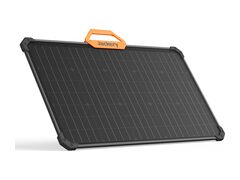

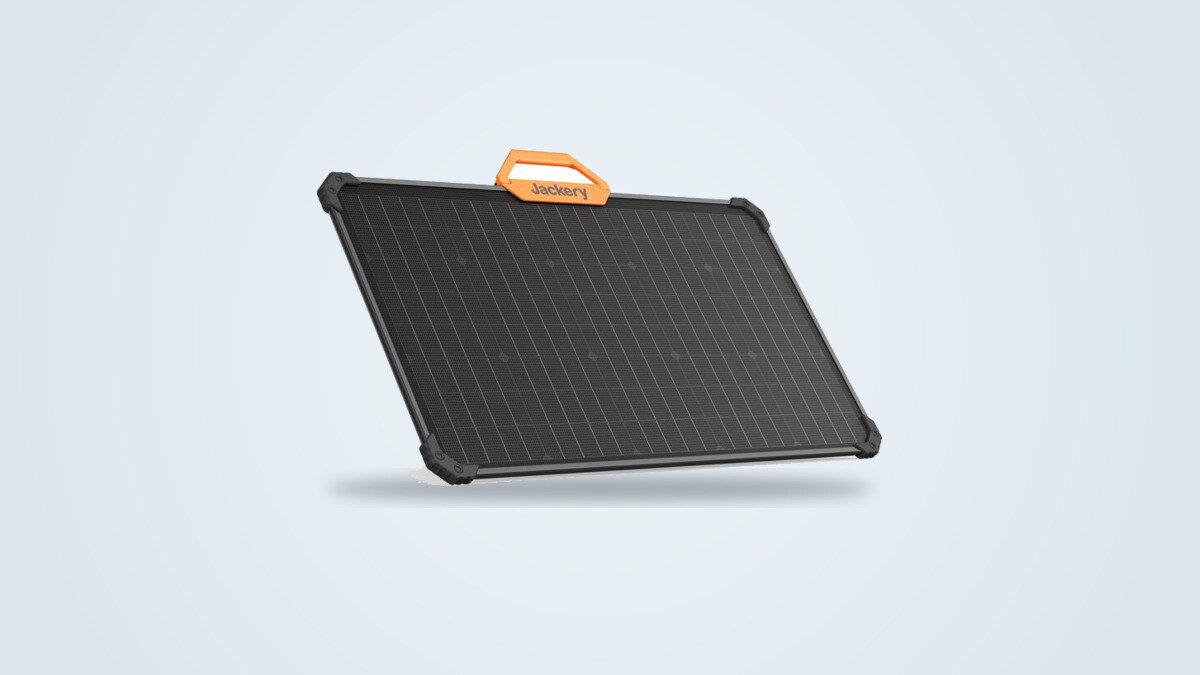
The advertised 80W and 25% efficiency, out in real conditions
The SolarSaga 80W runs on monocrystalline cells advertised at 25% conversion efficiency, among the best figures in its category of portable panels. As with any solar panel, that figure corresponds to a standardised value (1000 W/m² of irradiance, a 25 °C cell temperature) that's never quite matched outdoors. The advertised electrical specs are a 28.5V open-circuit voltage (Voc) and a 3.71A short-circuit current (Isc), with a maximum-power point at 22V and 3.64A.
Two separate protocols, run under different sunlight conditions, place real-world output in a comparable range: between 30 and 70W depending on time of day and tilt, with a peak reaching 65 to 70W in full, well-aimed sun, or 81 to 87% of the advertised 80W. Under overcast skies, output drops to 0-20W.
This spread comes down to the same physics as on any portable solar panel: angle of incidence, the thickness of atmosphere the light crosses, and a fairly modest cell surface (around 0.48 m²) that leaves little margin once conditions drift from ideal. As a rough order of magnitude, ignoring conversion losses: recharging a small Explorer 300 Plus station (288 Wh) from empty takes roughly 4 to 5 hours in the best conditions, and noticeably longer once output falls below 40W.
What the dual-sided rear face actually adds
The SolarSaga 80W's standout feature is its active rear face, in extra-white glass advertised at 92% transmittance: it picks up some of the light reflected off the ground (light sand, concrete, snow) to add output without making the panel any bigger. The manufacturer states, in its own technical documentation, a precise bifaciality figure: rear-face output alone exceeds 70% of the front face's, and its open-circuit voltage exceeds 97% of the front face's, numbers that speak to real cell quality on a technical level.
That technical coefficient doesn't guarantee an equivalent gain in real use, though, where few surfaces are as reflective as a dedicated lab protocol. Aimed rear-face-first at the sun instead of front-first, the panel loses about 5W compared with the front face alone under the same conditions, which illustrates the gap between the two faces taken in isolation. The included carry pouch, with a reflective inner lining, can be laid on the ground under the panel to bounce a little extra light onto the rear face: a boost measured at around 1 to 2W in that setup, far from doubling output the way the marketing pitch around dual-sided generation might suggest.
A panel that doesn't fold: the format that sets the 80W apart in Jackery's range
Unlike the SolarSaga 100W and 200W, built from ETFE-coated fabric and folding in half or accordion-style, the SolarSaga 80W is a rigid slab with 2.8mm toughened glass on both faces. That change of material, needed to fit a genuine bifacial glass rear face, has a direct consequence: the panel doesn't fold. Once deployed, it keeps the exact same full dimensions (906 x 528 x 27mm) for storage and transport, with only its rear kickstand folding away.
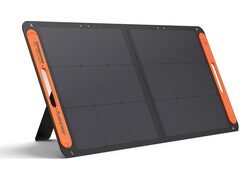
That rigidity comes at a real portability cost against the rest of the range: the SolarSaga 100W, despite delivering more power, weighs 3.6 kg (1.5 kg less) and folds down to 61 x 55.2cm along its centre hinge. The SolarSaga 80W is, as things stand, the only member of the SolarSaga range where advertised power and weight move in opposite directions from each other.
| Panel | SolarSaga 100W | SolarSaga 80W | SolarSaga 200W |
|---|---|---|---|
| Rated power | 100W | 80W | 200W |
| Weight | 3.6 kg | 5.1 kg | About 8 kg |
| Folds? | Yes, in half | No, rigid slab | Yes, accordion-style |
| Packed size | 61 x 55.2cm | 90.6 x 52.8cm (unchanged, deployed) | 61.5 x 55cm |
It still keeps some real portability strengths: a handle built into the frame, a slim 27mm thickness, and a weight well under the SolarSaga 200W's 8 kg. It carries fine flat, on a car seat or in a dedicated sleeve, but it won't slide into a bag as easily as a folding panel.
IP68: an immersion figure stated by the manufacturer, and a real nuance
The SolarSaga 80W carries an IP68 rating, the best common protection against water and dust. The manufacturer even states the exact threshold behind this rating: immersion at 1.2m deep for 24 hours, with no fault once back in service. That's a level of detail rarely spelled out this precisely on this kind of product, where many manufacturers settle for the IP68 badge alone without stating the conditions behind it.
This rating covers the panel itself, built from 2.8mm toughened glass on both faces. The output port itself, though, isn't built for immersion and deserves its own protection whenever it's exposed, plugged in or not: a cap or a dry storage spot for the connector is still worth using, regardless of the panel's own rating. The advertised operating range runs from -10 °C to 65 °C, with corners shielded by rubber bumpers that cushion knocks during transport and setup on the ground.
The built-in rear kickstand, with reinforced rubber feet, allows a stable setup with no extra accessory. There's no hinge to report a fault on here, since the panel doesn't have one; on the handle and frame, no recurring manufacturing defect turned up for this product so far, worth keeping in mind as a fair reservation rather than a proven flaw, given the still-limited time since its late-2022 launch.
Output connectors: DC only, and a parallel-connection limit worth knowing
The SolarSaga 80W offers exactly one output: a proprietary Jackery DC8020 connector, with no built-in USB-A or USB-C port at all. That means there's no way to charge a phone or tablet straight from the panel itself, unlike its smaller sibling the SolarSaga 100W, which builds in both. A roughly 1m cable is built into the panel, backed up by a 2m extension cable included in the box for more flexible placement.
Worth knowing before combining panels: the official manual caps real-world parallel combinations at 3 SolarSaga 80W panels on a single solar input, while the manufacturer's own site promotes combining up to 12 panels in total on its largest stations. These two figures don't necessarily contradict each other: reaching 12 panels means owning a station with several separate solar inputs, not stacking 12 units on one cable. On a station with just one or two inputs, the practical ceiling stays much closer to 3 or 6 panels than to 12.
This proprietary DC output also rules out any direct connection to a third-party station or charge controller: an adapter to MC4, not supplied by Jackery, is needed to step outside the Explorer ecosystem. For anyone already inside it, that's no real obstacle; for anyone comparing several station brands, it deserves a place in that comparison.
Build quality, awards and warranty
The SolarSaga 80W picked up a Red Dot Design Award in 2022, a rare distinction for a portable solar panel and one that sets it apart from the rest of the SolarSaga range: no other Jackery panel reviewed on this site so far has picked up a comparable design award. It's also the first consumer photovoltaic product certified by TÜV SÜD under the IEC TS63163 standard, an industrial certification that goes beyond simple marketing copy.
Jackery states a 3 year manufacturer warranty, with no mention of an extension through online registration for this specific model, unlike some other SolarSaga panels that offer 5 years total once registered. That's a fair warranty but not one that stands out particularly against the rest of the segment.
On the material side, the all-glass build and rubber-reinforced corners give an impression of sturdiness beyond that of a coated-fabric panel, at the cost of the weight and rigidity already covered above. No recurring manufacturing defect turned up for this product, though the available track record is naturally shorter than for references sold for far longer.
Against other panels in Jackery's range and the direct competition
Within the SolarSaga range itself, the 80W sits in an odd spot: pricier per watt than the 100W, heavier than it despite lower power, and worse equipped on connectors. Its only real edge over its smaller sibling comes down to the glass build (versus ETFE-coated fabric) and the Red Dot Design Award recognition. Against direct bifacial competition, the gap widens further.
| Criterion | Jackery SolarSaga 80W | Anker Solix PS200 |
|---|---|---|
| Rated power | 80W | 200W |
| Weight | 5.1 kg | 4.8 kg |
| Bifacial rear face | Yes (rigid glass) | Yes (folding fabric) |
| Folds? | No | Yes |
| Station output | Proprietary DC | Native MC4 + included adapter |
| Warranty | 3 years | 5 years |
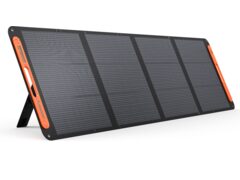
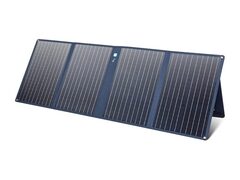
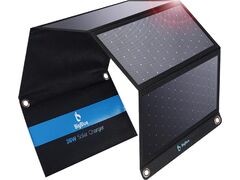
The Anker Solix PS200 delivers two and a half times the rated power for less weight than the SolarSaga 80W, while folding flat and offering an MC4 output open to any third-party controller or station. Against a more modest add-on panel like the BigBlue 28W, which has no station-compatible output at all, the SolarSaga 80W still makes sense for anyone needing to feed a Jackery station at an intermediate power level, but sitting between the more versatile 100W and lighter bifacial rivals leaves it a narrow niche to fill.
Price and real availability, in the UK and beyond
The SolarSaga 80W is listed at £219 through Jackery's own EU/UK store, a price also matched by several mainstream retailers that carry it new. A cheaper refurbished version is separately offered direct from the manufacturer.
Contrary to a common assumption about this panel, launched in late 2022, it remains genuinely sold new across Europe and the UK through official channels, rather than being a model reserved for the North American market. If anything, the trend looks to be running the other way: several specialist North American resellers no longer list it new at all, with Jackery's current push leaning toward newer panels instead. Checking live stock before buying is always worth doing on this kind of product.
Who it's for, and who should look elsewhere
The SolarSaga 80W suits, first and foremost, anyone who already owns a Jackery Explorer station and wants a robustly built solar add-on for semi-fixed use (a converted van, a terrace, a garden) where weight and folding matter less than sturdiness and weatherproofing. Its built-in kickstand and toughened glass also make it a reassuring pick for anyone leaving the panel unattended for hours at a time.
By contrast, anyone who values light weight and a compact packed size should look at the SolarSaga 100W instead: more powerful, lighter, and equipped with USB ports, often at a similar price. Anyone after universal compatibility with any station should look at an MC4-output panel like the Anker Solix PS200. And anyone who just needs to top up a phone on a hike will do better with a lighter, cheaper add-on panel such as the BigBlue 28W, without needing the SolarSaga 80W's extra power or weight.