
How we chose
A portable solar panel is not just a watt figure. For this selection, we weighed five criteria:
- Real power: in full sun, a panel rarely delivers more than 60 to 80 % of its rated power.
- Cell efficiency: monocrystalline dominates, sometimes in a bifacial version that also catches reflected light.
- Weight and folded size: decisive when hiking, secondary near the van.
- Connectors: DC plug, MC4 or USB, and above all compatibility with your power station.
- Ruggedness: rating against water and dust, quality of hinges and carry case.
A useful reminder before comparing: the rated power is measured in the lab, under conditions rarely met in the field. We detail that gap in our feature on the reality of solar charging. The result: five panels for five profiles.
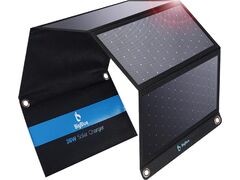
1. The ultralight for trekking: BigBlue 28 W
For hikers who just want to keep their phone, GPS and headlamp alive, there is no need for a panel weighing several kilos. The BigBlue 28 W folds down to the size of a book, weighs a few hundred grams and charges your devices directly through its USB ports.
It is not made to feed a power station, but for direct charging on the move it is unbeatable in weight-to-efficiency terms. You clip it to your backpack as you walk, and it works while you move forward. The ideal companion for a small power bank on a lightweight bivouac.
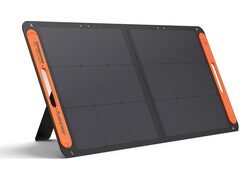
2. The station companion: Jackery SolarSaga 100 W
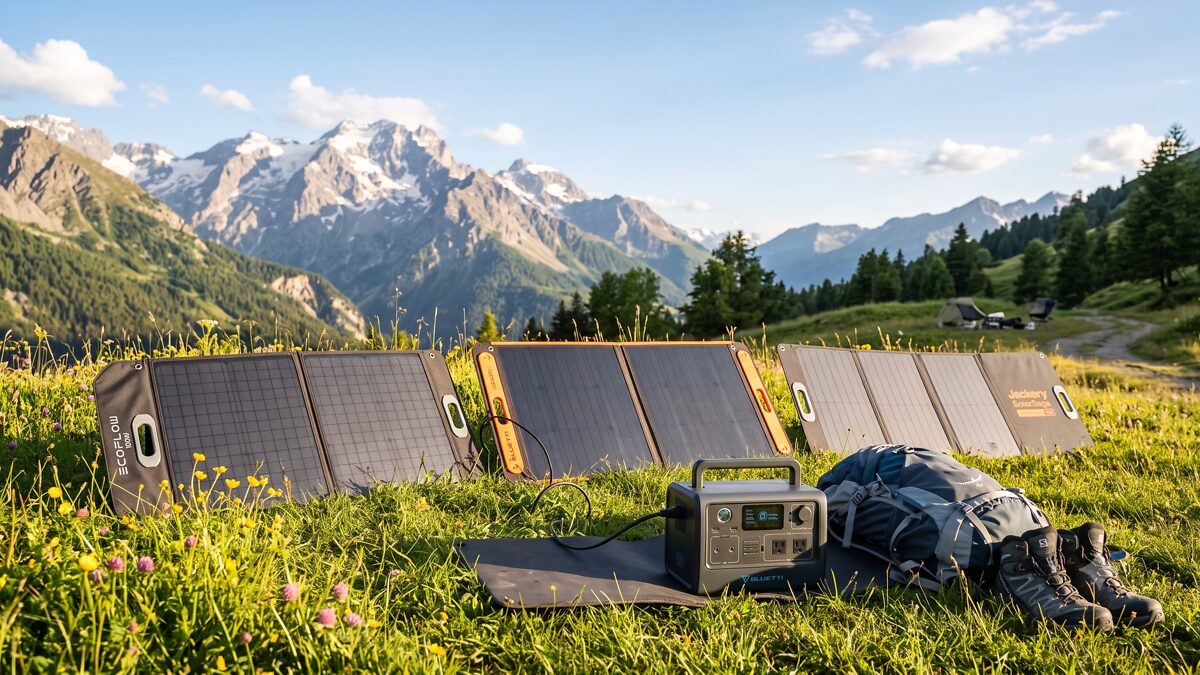
This is the market standard, and for good reason. With its 100 W of monocrystalline cells, the SolarSaga 100 W efficiently recharges a mid-size power station. It folds in two like a briefcase, includes a kickstand and adds USB outputs to top up a phone.
Its native compatibility with Jackery stations makes it an obvious pick if you are already in that ecosystem, but an adapter lets you use it with most brands. An excellent, reliable and versatile starting point for anyone new to nomadic solar charging.
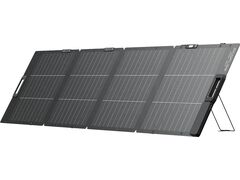
3. The best efficiency: EcoFlow 220 W bifacial
Our versatile favourite. EcoFlow's bifacial panel catches light on its front face (220 W) and picks up a bonus on its rear face from light reflected off the ground. In practice it produces more than a conventional panel of the same rating, while staying portable.
Its case doubles as a tilt stand, and its certification against water and dust makes it reassuring for prolonged outdoor use. It is the ideal compromise between power, efficiency and portability to recharge a power station when camping or in a van.
4. The heavyweight for big needs: Bluetti PV350
When you have to recharge a large 1,000 Wh station or more within the day, power becomes king. With its 350 W spread over four folding sections, Bluetti's PV350 swallows energy and fills a station in a few hours of good sunshine.
The logical trade-off: it is heavier and bulkier, clearly designed for the converted van, the motorhome or a fixed base rather than the backpack. If your station powers a motorhome or a small setup, this is the partner you need.
5. The best value for money: Anker 531 200 W
Anker has a reputation for reliable products that do not blow the budget, and its 200 W panel is no exception. Monocrystalline, folding in three, rugged and supplied with a carry-stand case, it offers solid efficiency for a contained price.
It is the smart pick for anyone who wants real station-charging power without aiming for the very top end. Its standard connectors make it compatible with many stations, including outside the Anker ecosystem. An excellent first big panel, durable and versatile.
Using your panel well: our tips
The best panel in the world will give nothing if it is used badly. Three habits change everything.
Orientation. A panel must face the sun, tilted toward it, and be readjusted through the day. A panel laid flat on the ground loses much of its potential.
Shade is the enemy. A single cell in shadow can collapse the whole panel's output. Avoid branches, railings and cables that cast a shadow, however thin.
Compatibility. Check three figures before buying: the input voltage accepted by your station, the maximum current and the connector. An overpowered panel poorly matched to your station's solar input will be useless. Find our selection in the nomadic solar section.
Recap: which panel for which profile?
| Profile | Recommended panel | Power | Typical use |
|---|---|---|---|
| Lightweight hiker | BigBlue 28 W | 28 W (USB) | Direct phone, GPS charging |
| Versatile beginner | Jackery SolarSaga 100 W | 100 W | Small or mid-size station |
| Best efficiency | EcoFlow 220 W bifacial | 220 W | Camping, van, mid-size station |
| Big needs | Bluetti PV350 | 350 W | Large station, motorhome |
| Value for money | Anker 531 | 200 W | Versatile station charging |
In short: start from your station's capacity and your mobility. A 100 W panel is enough for topping up, 200 to 220 W make the best compromise for most nomadic uses, and 350 W become useful for big setups. To match panel and station well, take a look at our power stations.