
245 Wh quoted, 211 delivered, and an efficiency that will not move
Of the 245 Wh printed on the spec sheet, 211 come out. The 14 % gap is nothing out of the ordinary: it is the price of conversion, which every station pays. The interesting figure is not that one, it is the next.
That efficiency of 86.1 % barely depends on what you plug in. At 15 W, 86.1 %. At 60 W, 86.1 %. At 260 W, right up against the machine's maximum, 85.7 %. Less than half a point between the most modest appliance and the heaviest load it accepts.
Why it matters. On a station of this size, the electronics' own consumption is a fixed load: it weighs enormously when you draw 15 W and vanishes into the mass when you draw 260. A flat efficiency curve therefore means that fixed consumption has been cut, and that is exactly what the gallium nitride electronics found inside allow.
The practical consequence is a pleasant one: on this machine, there is no wrong way to draw current. An 8 W lamp does not cost proportionally more than a laptop, contrary to what happens on most compact stations.
Round-trip efficiency: 75 %, seven points better
Delivering 211 Wh is one thing. Knowing what had to be paid to store them is another, and it is the calculation spec sheets never let you make. It takes 264 Wh drawn from the wall socket to get those 211 Wh back out, a round-trip efficiency of 75 %.
A quarter of the energy paid for therefore stays behind along the way, as heat, split between charging and discharging. It is the best score in its class among compact stations, and it still is not enough to justify using one for tariff arbitrage: at 75 %, the gap between peak and off-peak rates is eaten before it exists.
300 W, and what happens when you push
The 230 V socket delivers 300 W continuous, and it holds them. The interesting question is what happens just above, because that is where X-Boost mode is supposed to take over by raising the ceiling to 600 W.
It raises it badly. Beyond 300 W, the overcurrent protection steps in quickly. At 350 W, the supply lasts only ten seconds or so before the cut. And the start-up of a fridge compressor, which calls for a brief but violent peak, causes an immediate cut. The principle behind X-Boost explains these failures: it adds no power, it lowers the voltage delivered so as to keep the appliance inside the inverter's envelope. That works on a heating element, which simply heats less, and not on a motor, which demands its voltage in order to start. The manufacturer states, for that matter, that the mode is unsuited to appliances fitted with voltage protection, and that it works neither during charging nor in bypass mode.
| Demand | Behaviour |
|---|---|
| Up to 300 W | Held continuously |
| 350 W | Ten seconds or so, then a cut |
| Start-up peak of a compressor | Immediate cut |
| All outputs combined | 550 W, socket and ports together |
The 600 W of X-Boost should therefore be read as an occasional tolerance on purely resistive loads, not as a second rated output. In practice, the list of appliances this station will feed is the 300 W list, not the 600 W one.
Good news on the other hand, which the spec sheet does not put forward: the total power available when all the outputs are added together reaches 550 W. The 300 W of the mains socket are not the machine's ceiling, they are that socket's ceiling.
A single mains socket, and it changes a great deal
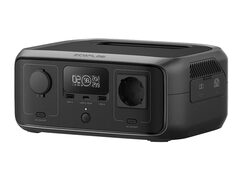
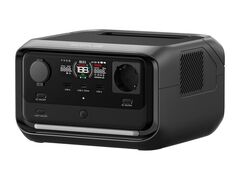
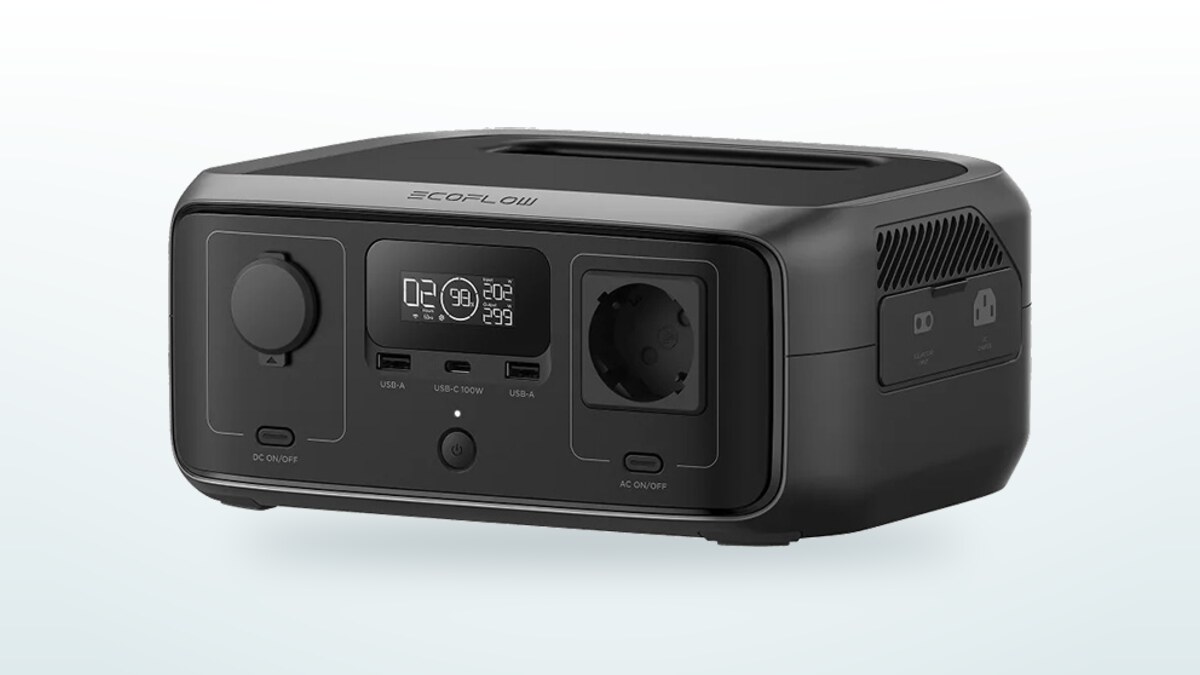
It is the easiest point to miss on a spec sheet, and one of the most structuring in use: the European version carries just one 230 V socket. The version sold in the United States has two, the Japanese version as well, but not the one that reaches Europe.
It does not show in the power figures, and yet it redefines what the machine can be used for. As a backup behind a power cut, you protect the modem or the computer, not both. To run two appliances on alternating current you have to add a power strip, which works electrically as long as you stay under 300 W, but which adds an object to carry to a station chosen precisely for its compactness.
The single USB-C port calls for the same remark, and it is the criticism that comes back most often among those who use it. It goes up to 100 W, which is excellent and enough for a demanding laptop, but there is only one. On a machine whose electronics we have seen to be efficient at every power level, one would gladly have traded a USB-A port for a second USB-C.
57 minutes for a full charge, except in the cold
A complete fill takes 57 minutes, with about 305 W on the input on the European grid. The one-hour promise is therefore kept, and even slightly beaten. It is a point on which this range stays constant from one generation to the next.
One seasonal caveat is worth knowing: on a cold battery, the same cycle takes 1 h 20 instead of 57 minutes. The difference is not a weakness but a safeguard, the management system deliberately limiting the current until the cells have reached an acceptable temperature. Below 0 °C, charging is refused outright. Discharging, on the other hand, stays possible down to −10 °C.
| Source | Maximum power | Time for a full charge |
|---|---|---|
| Mains socket | 305 W in Europe | 57 minutes |
| Mains socket, cold battery | limited by the system | 1 h 20 |
| Solar panel | 110 W, from 11 to 30 V | not recorded |
| Car socket | 100 W, 12 or 24 V | not recorded |
A detail that is not one for anyone buying on specifications: the 305 W apply to the European grid. The 320 W you sometimes read are the figure for the American, Japanese and Brazilian markets. The gap is small, but it shows how badly this category's specifications carry over from one continent to another.
Silence, established by the absence of a reading
The 50 mm fan is officially meant to start from 50 W. In practice, it was still not turning at 60 W in continuous operation. And when it does turn, the sound level stays below the floor a sound level metre can read, that is below 30 dB, including under load.
It is an unusual way of establishing a result: there is no value to hand, there is a bound, and the bound is low. The manufacturer quotes under 30 dB at fifty centimetres, and nothing contradicts it. For a station you are considering leaving switched on in a living room or a bedroom, that is the decisive argument, and it stands in sharp contrast with the previous generation, whose fan made itself known from a hundred watts or so.
What is inside, and why it shows on the outside
The teardown explains the electrical behaviour described above. Six Gotion cylindrical cells of 12.8 Ah are wired in series, 32 by 135 millimetre formats taken from the automotive world, at 3.2 V and 41 Wh each, for a 19.2 V pack with an internal resistance of about 11.8 milliohms. These are serious cells, not salvaged ones.
Battery management is entrusted to a Texas Instruments circuit, protected by two 30 A fuses wired in parallel. The power stage mixes gallium nitride components with a conventional power transistor, which is exactly the recipe that gives flat efficiency at low load. The radio, finally, is a recent ESP32-C6 module, handling Wi-Fi 6 and Bluetooth Low Energy.
On lifespan, the manufacturer quotes 3000 cycles before dropping to 80 % of the original capacity, with a qualification worth reading: that figure is established at a charge and discharge rate of 0.5C and at 25 °C. In other words, in temperate laboratory conditions and without jolts. Harsher or hotter use will mechanically shorten the trajectory. The European warranty, for its part, runs to five years.
Twenty milliseconds, and the variant that does ten
Plugged in between the wall socket and an appliance, the station passes the mains straight through and switches to its battery the moment the mains disappears. How long that switch takes decides what you can protect, and this is where a trap awaits the buyer.
EcoFlow's marketing puts forward a 10 millisecond switchover on the River 3 range. It does not apply to this model. The base River 3 is quoted at under 20 milliseconds, the 10 milliseconds applying to the Plus and Max versions, as well as to a separate reference sold as the River 3 UPS through professional channels. Same capacity, same output, only the switchover changes, and the name gives no warning.
Twenty milliseconds are amply enough for a laptop, a modem, a router, a television. They are not enough for a server or a workstation demanding an uninterrupted transfer, and the manufacturer itself writes, for this range, that it is a basic backup function which makes no claim to instantaneous switching.
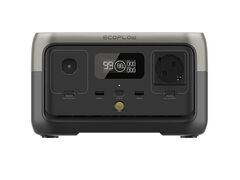
River 3 or River 2: what the premium buys
The question is a fair one, since the two sell side by side, and the newer one is both smaller and dearer. Here is what the money buys.
| Criterion | River 3 | River 2 |
|---|---|---|
| Quoted capacity | 245 Wh | 256 Wh |
| Energy delivered | 211 Wh | 217 Wh |
| Round-trip efficiency | 75 % | 67.8 % |
| Mains output | 300 W | 300 W |
| USB-C output | 100 W | 60 W |
| 12 V output | 126 W | 100 W |
| 230 V sockets in Europe | 1 | 1 |
| Full charge from the mains | 57 min | about 60 min |
| Height | 113 mm | 145 mm |
| Fan | Silent up to 60 W | Active from about 100 W |
The River 2 keeps six watt-hours of lead on what it delivers, and it costs less. Everything else tips the other way. Round-trip efficiency gains seven points, which counts for anyone recharging from a solar panel or running the machine every day. USB-C goes from 60 to 100 W, the 12 V output from 100 to 126 W. Height loses thirty-two millimetres at equal weight. And the fan, the main complaint made about the previous generation, falls silent.
The reasoning therefore boils down to this. For occasional, backup use, where the machine spends most of its time charged in a cupboard, the River 2 offers a little more energy for a little less money, and nothing that changed gets noticed. For regular use, solar, on the move, or simply in a room where you want silence, the River 3 is worth its difference without hesitation.
Who it suits, and who it does not
It suits solar use on the move first of all. An efficiency that does not collapse at low power is precisely what is needed when the energy source is irregular, and the full loop at 75 % turns every hour of doubtful sunshine into runtime genuinely recovered.
It suits next anyone who wants silence. Silent up to 60 W and below the measurement floor beyond that, it lets itself be forgotten in a bedroom or behind a workstation, which the previous generation did not allow.
It suits, finally, laptop work on the move, thanks to a 100 W USB-C port that feeds almost every current machine by the most efficient route through the device.
It does not suit anyone who has to protect several appliances from an outage: with a single 230 V socket, you have to choose. Nor does it suit anyone hoping to exceed 300 W, even briefly, since X-Boost does not keep that promise on motor-driven appliances. Nor anyone who needs an uninterrupted transfer for a server, the twenty milliseconds of this model not being the ten milliseconds of the professional reference. And no more does it suit anyone looking for a main source in a campervan: at 211 Wh genuinely available, it covers the computer and the phone, not a fridge over time.