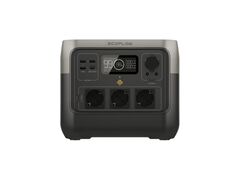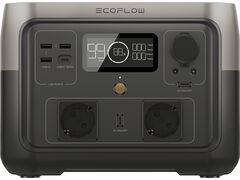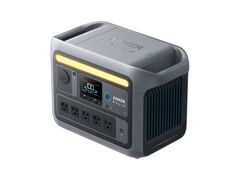

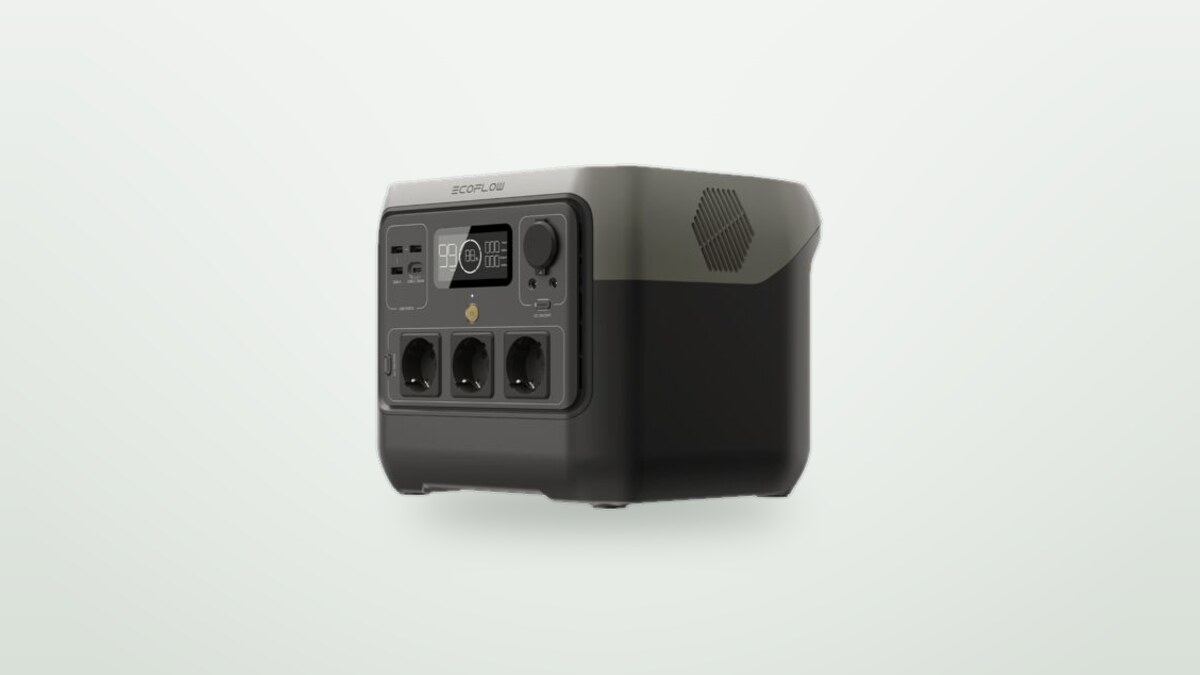
768 Wh claimed, between 621 and 691 Wh actually available
The 768 Wh printed on the case is a LiFePO4 cell capacity, measured upstream of the inverter. That is not what comes out of the 230 V socket, and the gap depends directly on the power drawn.
The range is clear despite the different power levels involved: 621 to 691 Wh returned through the AC socket depending on whether the connected appliance draws around a hundred watts or several hundred. Counter to intuition, efficiency here improves as the load increases, before it levels off: it climbs from around 81 % of nominal capacity near 100 W to over 90 % near 800 W. That is the opposite of the pattern on smaller models from the same brand, where too light a load hurts efficiency instead of improving it.
This 90 % figure should not be confused with efficiency: it is the ratio between energy returned and nominal capacity, not between energy returned and the energy consumed to charge the unit. The real wall-to-socket efficiency is markedly lower, and is the subject of the next section.
922 Wh at the wall for a full charge: the real efficiency
The figure that matters for the electricity bill is not the pack's capacity, it is the full round-trip efficiency: how much has to be drawn at the metre to get one usable watt hour back out of the socket?
It takes around 922 to 930 Wh drawn at the metre to fully recharge the 768 Wh pack, a figure that stays stable regardless of charging power. Set against a return of 691 Wh at 800 W, full wall-to-socket efficiency settles between 67 and 75 % depending on the power of the load plugged in.
70 minutes announced: true up to 80 %, not beyond
The most repeated selling point holds up only halfway. The charge reaches 80 % in 51 minutes, even faster than the 56 minutes announced for that point. But the last twenty points of charge need around 28 more minutes, pushing the real full charge to 78 to 79 minutes, against the 70 announced.
This slowdown right at the end of the charge is a normal protective behavior of LiFePO4 chemistry, not a flaw. The condition for getting close to these figures, on the other hand, is rarely spelled out in bold print: the manual calls for a wall socket rated at least 10 A, plugged in directly, with no power strip or extension lead, and no other appliance on the same circuit.
On the solar side, the input accepts up to 220 W, and a panel of that rating typically delivers 190 to 220 W in full sun, which brings a full solar charge close to the 3 h 30 announced under good conditions. Below 0 °C, charging stops entirely: a normal chemistry protection that resumes above 3 °C.
What it draws while powering nothing
With the AC output switched on but nothing plugged in, the station keeps drawing power to keep its inverter ready to go. Two regimes coexist, and the gap between them comes down to a single setting.
3.2 W drawn continuously works out to around 77 Wh a day, a tenth of the nominal capacity evaporating every day while powering nothing at all. That is probably the simplest explanation for something that can be surprising: a station left full the evening before and found badly depleted, even empty, the next morning, with nothing plugged in during the interval.
The fan, the main drawback, and a free lever to reduce it
The fan has less to do with the raw noise level than with its all-or-nothing character: the fan jumps to full speed as soon as a power threshold is crossed, with no gradual ramp-up.
At full charging or discharging power, the noise level settles around 47 dB(A): clearly audible without being deafening. The trigger point, though, comes very early, as soon as around sixty watts pass through the unit, which is why the fan can be heard even on small loads.
The 62 dB figure found in the documentation is a maximum declared by the manufacturer, not a measurement taken under conditions comparable to those above: it should not be read as the unit's typical noise level, which stays noticeably lower in everyday use.
800 W continuous, 1600 W with X-Boost: what that really means
Output power remains this station's real strength: 800 W continuous, a figure no other model in the River line reaches today, generation 3 included, which caps out at 600 W across the board. That is what makes it possible to plug in a kettle, a small space heater, or power tools without the station struggling.
X-Boost, which takes the unit up to 1600 W, deserves an explanation the spec sheet does not give. The feature does not add available power: it lowers the output voltage to allow a resistive appliance hungrier than normal to be plugged in, which then runs at reduced output rather than at its rated power. That is not a flaw, it is the very principle behind the feature, but an appliance labelled 1600 W will not actually draw 1600 W once plugged in.
Thermal behavior: no external overheating, but real cold sensitivity
On the surface, the unit does not heat up worryingly even during fast charging: around 27 to 28 °C at the case, up to 41 °C right at the fan outlet. Nothing that sets this station apart from ordinary power electronics.
One detail contradicts the impression of coolness given by the case, though: EcoFlow's own support documentation states that the unit can remain in a state of high internal temperature after an extended charge, and recommends letting it cool for more than an hour before any further handling. The heat is therefore concentrated inside, in the conversion electronics, more than it shows on the case.
Cold, on the other hand, slows charging markedly, a normal protective behavior of LiFePO4 chemistry. The station goes by the actual temperature of the cells, not the surrounding air: at an internal temperature of around 7 °C, AC input can drop to around 250 W instead of the usual 900 W, stretching the announced charge time out to several hours. Once the internal temperature climbs back above 15 °C, charging power returns to normal. This is worth keeping in mind for winter use outdoors or in an unheated vehicle.
Reliability: what recurs, what is not proven
No public failure-rate statistics exist for this station, and that needs to be said clearly before anything else: what follows describes identified fault patterns, not a measured frequency.
One pattern involves the charge gauge and cell balancing: a percentage readout that can jump abruptly from one value to another, or a premature cutoff before reaching 0 %. EcoFlow acknowledges the issue to the point of having developed an official recalibration procedure, issued through its support team: a full discharge followed by a full charge, repeated one to three times. The procedure restores the unit's full capacity when carried out, which points to a balancing issue rather than genuine cell degradation.
A second pattern involves charge refusal paired with a false overload message: the unit stops accepting current, whether AC or solar, and displays an error even though the upstream setup is working normally. This pattern is generally resolved with a full restart or, more rarely, a warranty replacement.
A third pattern, rarer but with a very recognizable signature, combines the simultaneous loss of the screen, the USB-C port, and the Bluetooth or Wi-Fi connection, while the AC and USB-A outputs stay functional. Finally, certain firmware updates have introduced temporary regressions, including one, relatively recent, that switched the AC output back off on its own a few seconds after activation, since fixed by a newer version.
The 5-year warranty, and its real conditions
EcoFlow advertises five years of warranty on this station, a figure written into the official text of its warranty policy. That text, however, carries several concrete conditions, rarely read to the end, that are worth knowing before buying rather than at the moment they are needed.
Standard exchange is only possible within 30 calendar days of receiving the unit. Past that window, only repair remains on offer, with turnaround that generally stretches over several weeks. More surprising still: repair itself can be refused if the fault is reported more than 30 days after it actually occurred, not after the purchase date. A defect that shows up but is left unreported for a few weeks before being declared can therefore, in theory, fall outside the warranty's scope.
Return shipping is not systematically covered: a purchase made directly from EcoFlow comes with a prepaid return label, which is not always guaranteed for a purchase from a third-party reseller. The warranty, moreover, only covers a single designated regional repair centre, with no automatic portability from one region to another.
None of this calls into question the existence of the five-year warranty, spelled out in writing by the manufacturer. But getting the full benefit of it means keeping proof of purchase, registering the unit as soon as it arrives, reporting any fault without delay, and recharging it periodically even while it is in storage.
River 2 Pro or the River 3 line: the trade-off in 2026
At the current price of 549 €, the comparison most often searched for pits the River 2 Pro against rivals that have become hard to find new on the French market. The more useful comparison today plays out within EcoFlow's own line instead, against the newer River 3 generation.
| Criterion | River 2 Pro | River 3 Plus | River 3 Max Plus |
|---|---|---|---|
| Capacity | 768 Wh | 286 Wh | 858 Wh |
| Continuous power | 800 W | 600 W | 600 W |
| Declared noise (maximum) | up to 62 dB | under 30 dB | under 30 dB |
| Inverter changeover | under 30 ms | under 10 ms | under 10 ms |
| Current price | 549 € | 299 € | 549 € |
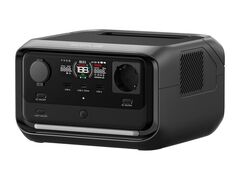
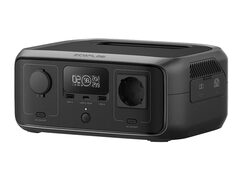
The picture is clear: at the same price, the River 3 Max Plus offers more capacity and runs noticeably quieter. Its higher capacity, however, comes from stacking several battery blocks rather than a single compact case like the River 2 Pro, and it caps out at 600 W, against 800 W here. It is also unavailable in France at the time of writing, as is the intermediate River 3 Max.
The River 2 Pro itself is currently only available for preorder from the manufacturer, with shipping announced for early September. Its price has fluctuated between 459 and 549 € over the past three months, with the recent trend heading upward; a one-off promotion even pushed it down to around 367 € in spring, with no guarantee that level will return.
In short: for anyone who needs 800 W continuous in a single compact case, the River 2 Pro remains without equivalent in EcoFlow's current line. For lighter use, or wherever quiet matters most, the River 3 Plus, notably cheaper and available right away, deserves to be compared first.
CPAP use, and who it is for
For a continuous positive airway pressure (CPAP) machine without a heated humidifier, no measurement carried out directly on this specific model could be reliably established. A cautious estimate, based on the 621 to 691 Wh actually available at 230 V and a typical draw of 30 to 60 W excluding the humidifier, puts runtime at around 1.5 to 2.5 nights of eight hours. A direct 12 V feed, more efficient, brings that figure up to 2.5 to 2.8 nights.
One point of caution specific to sensitive medical equipment: the automatic changeover in the event of a power cut is announced at under 30 ms, a figure that falls short of the 10 ms standard sought for this type of use. For a vital dependence on nighttime treatment, a dedicated medical UPS solution remains preferable to a general-purpose station.
It suits anyone who needs high output power in a compact, portable format: power tools, small kitchen appliances, occasional home backup, or demanding off-grid use. Its fast recharge across the first four-fifths of its capacity remains a genuine everyday advantage.
It suits less anyone looking for quiet operation, wanting to leave it as an unattended solar reserve and forget about it for months, or needing capacity that can be expanded over time. The fan, the standby draw, and the warranty's real conditions are three points to factor in before buying, not after.