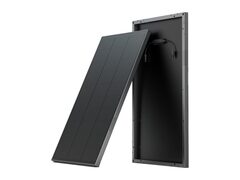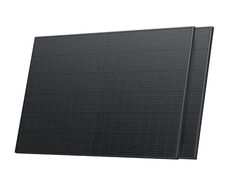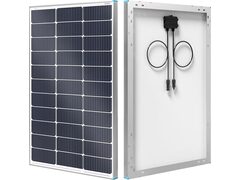


A 23% efficiency rating among the best in its category
EcoFlow states 23% efficiency for this rigid panel, the figure generally quoted for the whole module (cells, glass and frame included), matching the EcoFlow 400W rigid panel in the same line and above the 20% module efficiency posted by the Renogy 100W N-type compared later in this review. The cells are monocrystalline, the most common technology on rigid panels built for a fixed install.
Per the official spec sheet, each panel delivers an operating voltage of 17.1V at 5.9A, for a rated output of 100W (plus or minus 5W) under standardised STC test conditions (1000 W/m², 25 °C). As with any solar panel, that figure only shows up in full sun at a near-perpendicular angle: overcast skies, an imperfect mounting angle or a high cell temperature all cut into the power actually available.
No independent measurement of this panel's real-world output turns up online at the time of writing: the only figures available come from EcoFlow's own documentation. The EcoFlow 400W rigid panel in the same line claims the same 23% efficiency, a consistency that suggests a shared cell supply chain across the brand's rigid line-up, though that does not amount to an independent confirmation of the figure.
IP68: weatherproofing at the top of the fixed-panel category
EcoFlow states an IP68 rating for this rigid panel, a step above the IP65 or IP67 typically found on rival rigid panels (the Renogy 100W N-type compared later in this review, for instance, lists IP65 for its junction box and IP67 for its connectors). On the standardised IEC 60529 scale, the second IP68 digit denotes protection against prolonged immersion, which EcoFlow sets at 1 metre deep for 72 hours for this rigid panel line.
EcoFlow states, across its rigid panel line, resistance to extreme winds up to 130mph (209 km/h) as well as heavy snowfall; the EcoFlow 400W panel in the same line, for instance, lists a snow load of 551kg per square metre on its own spec sheet, an order of magnitude that illustrates the ruggedness the brand targets on this line, without that exact figure being guaranteed identically on the 100W format. These remain manufacturer figures: with no independent measurement available, there is no way to qualify them over time.
This high level of weatherproofing is precisely what allows a permanent, unprotected roof install, unlike a portable panel you put away after use. No weatherproofing defect or leak turns up in the information available for this panel, though the volume of feedback available online stays limited at the time of writing.
A 100W pair built for a permanent install
At 98 x 58.6cm and 3cm thick, each 6.2kg panel in this pack stays manageable for a solo install, even though the two panels combined add up to 12.4kg to hoist onto a roof. Mounting feet are included in the pack, a detail that matters: they let you angle the panels to optimise exposure to the sun rather than laying them strictly flat, which meaningfully improves output in winter or at northern latitudes. The Renogy 100W N-type compared later in this review is lighter per unit (5.9kg) but sells its mounting brackets separately.
Once mounted, the chosen angle stops moving with the seasons: the spec sheet lists a non-adjustable mount, unlike a portable panel you can re-angle at will. That is a limitation inherent to any fixed panel, not something specific to this product.
This partner sells the pack only as a pair, with no option for a single 100W panel: a choice that simplifies equipping a 200W install from the start, but forces buying both panels even for anyone who only needs half that output.
MC4 connectivity: compatible out of the box with third-party controllers
Both panels use MC4 connectors, the near-universal standard across the solar industry. EcoFlow explicitly states compatibility with third-party systems and 48V setups, in addition to its own power stations. In practice, this panel plugs directly, with no adapter, into virtually every 12/24/48V MPPT charge controller on the market, EcoFlow-branded or otherwise.
The stated maximum system voltage is 600V DC (UL certified) with a maximum fuse current of 15A, a wide margin that leaves room to wire several panels in series or parallel depending on the input range of the controller used.
To connect this panel directly to an EcoFlow power station (River or Delta ranges), an MC4-to-proprietary adapter cable (typically an XT60i-type connector) is still needed: the solar input on these stations is not native MC4. Per the product page, this adapter ships with the station rather than the panel itself, a detail worth checking before buying depending on the station you already own.
Build quality, warranty and the brand's track record
Construction combines an anti-corrosive aluminium frame, tempered glass and reinforced lamination, with integrated bypass diodes meant to limit hot spots forming under partial shading on part of the panel. Those diodes ease the effect without removing it: shade falling across a meaningful part of a series-wired panel still drags down its output, as on most classic rigid panels.
The stated warranty runs 5 years, a figure worth putting in perspective against the Renogy 100W N-type compared later in this review, which splits a 10-year materials warranty from a power output warranty extended to 25 years. EcoFlow does not publish, for this panel, a temperature coefficient or an annual degradation path comparable to what Renogy details for its own panel, which limits any direct comparison of how the two products behave over time.
On the brand's track record, research turns up no recall against this rigid panel line. The only notable recall found for EcoFlow concerns an unrelated product, the Delta Max 2000 power station, subject to a US safety recall (overheating risk, fixed via a firmware update, 2025): neither the technology nor the product category overlaps with this solar panel.
Against the competition: Renogy 100W N-type and the EcoFlow 400W rigid
At around £139 for the pack (price checked on the product page), this EcoFlow rigid panel compares directly with two references already covered on the site: the Renogy 100W N-type, sold individually, and the EcoFlow 400W rigid, also sold as a pair but aimed at far bigger installations.
| Panel | Output | Efficiency | Rating | Weight | Checked price |
|---|---|---|---|---|---|
| EcoFlow 100W rigid (x2) | 200W | 23% | IP68 | 6.2kg/panel | £139 the pack |
| Renogy 100W N-type | 100W | 20% (module) | IP65 / IP67 | 5.9kg | £65.99 each |
| EcoFlow 400W rigid (x2) | 800W | 23% | IP68 | 21.8kg/panel | £299 the pack |
To reach an equivalent 200W with Renogy 100W N-type panels, two units bought separately would come to roughly £132 at the checked unit price of £65.99, actually a touch less than the £139 EcoFlow pair, even though that pair throws in the mounting feet Renogy sells separately, which narrows the practical gap. Renogy also keeps the edge on warranty length. The EcoFlow 400W rigid, for its part, is not really a direct rival: its 21.8kg panels target a far more ambitious install (800W), not a first solar base.
This comparison stays indicative: prices shift regularly at retailers, and the choice between these options mostly comes down to the total output you are after and the mount your roof can support.
Who this pack suits, and who it does not
This 2-pack suits, first, anyone equipping a van, motorhome, cabin or garden shed roof for the first time with a fixed, durable solar setup, and who values the best weatherproofing in this comparison (IP68) along with the included mounting feet. Aiming for 200W from the outset, in one coherent purchase, is also simpler than piecing together two different references.
It suits less well anyone who needs a panel they can carry and re-angle through the day (a portable format serves that need better), anyone dealing with recurring partial shade at the install site (the bypass diodes limit hot spots but do not remove the output loss shade causes on a series-wired panel), anyone chasing the longest warranty on the market in this format (the Renogy 100W N-type does better on that specific point), or anyone who only needs a single 100W panel rather than a pair.