
What the claimed 512Wh are really worth
DJI rates the Power 500 at 512Wh, the smallest capacity in the entire Power range. That figure is the chemical energy stored in the cells, not what actually comes out of an AC outlet once the inverter has taken its share.
Two independent measurements, carried out on two continents with different protocols, place the real-world output between 405 and 425Wh. The first relies on a comparative protocol applied to dozens of stations under the same conditions, which puts the genuinely available capacity at 425Wh. The second, carried out at a higher output power (905W), gets an efficiency of about 79%, or roughly 405Wh. The gap between the two, a handful of percentage points, comes down to a simple mechanism: the higher the power drawn, the more the inverter's fixed overhead weighs proportionally on the final result.
In practical terms, this usable 400 to 425Wh translates, depending on the device, into dozens of smartphone charges, a handful of full laptop charges, or a few hours running an electric cool box. This level of output places the Power 500 in the same territory as its bigger sibling, the Power 1000 V2, which returns 80 to 86% of its own claimed 1024Wh: neither a poor performer nor an exception, but a station paying the price of an inverter built to deliver far more than its capacity alone would suggest.
1000W continuous, and beyond for short bursts
The Power 500 is rated at 1000W continuous across its two AC outlets, through a pure sine wave inverter running on 230V at 50Hz. For a 512Wh station, that is a generous output: enough to run a laptop, a secondary monitor, an electric cool box, small kitchen appliances or several pieces of creator gear at once without tripping. Devices with a heavy resistive load, such as a hairdryer or a space heater, often above 1200W, stay out of reach, as with most stations of this size.
Over very short bursts, the unit accepts a load well above its continuous threshold: one measured case involving a large inrush current puts the momentary limit at 1300W, while another, with a device plugged in directly, pushed the load to 1500W for a few seconds with no cut-off or protection trip. No case of the unit failing to hold its claimed continuous output turned up in this research: on this front, the Power 500 does more than meet its own spec sheet.
| Use case | Compatible |
|---|---|
| Laptop, monitor, photo/video gear | Yes, several devices at once |
| Electric cool box, small kitchen appliances | Yes, within a combined 1000W |
| Brief inrush current (compressor or tool start-up) | Yes, up to 1300 to 1500W for a few seconds |
| Hairdryer, space heater, large appliances | No, beyond the continuous power on tap |
540W charging: the condition few people notice
DJI claims a mains charge from 0 to 80% in 50 minutes, and a full charge in 70 minutes. That figure relies on a fast-charging mode capped at 540W, distinct from a standard mode capped at 270W. One detail rarely highlighted: DJI itself sets a precise ambient temperature window, 20 to 35 °C, to reach the full 540W. Outside that window, the station still charges, just at a reduced rate.
| Mode | Power | Condition |
|---|---|---|
| Fast charging | 540W maximum | Ambient temperature between 20 and 35 °C |
| Standard charging | 270W | None, quieter default mode |
| 12V charging (vehicle) | About 100W | Optional cable, not included |
| Solar charging (SDC Lite) | 300W maximum | Optional MPPT adapter, not included |
In the field, one measured full mains charge, from empty to 100%, took 83 minutes, thirteen minutes more than the claimed 70. That gap is nothing alarming, but it is a reminder that the fastest figure applies to specific conditions, not to any outlet in any room. Solar charging tops out at 300W through the optional adapter: enough to rebuild a full charge in around 1 hour 48 minutes under good sunlight, a result close to the theoretical calculation and therefore credible. Vehicle charging, at around 100W from a 12V socket, takes several hours and remains a backup option rather than a main charging method.
The SDC Lite port: DJI's own trump card, with a real limitation
The Power 500 stands out for its proprietary SDC Lite port, capable of delivering up to 240W out and accepting up to 300W in. A single connector covers five functions: fast-charging DJI drone and gimbal batteries (Mavic 3, Air 3 and 3S, Inspire 3 TB51, Matrice 30 TB30), powering 12V accessories through an optional cable, charging RC hobby batteries through a balance charger, solar input through DJI's MPPT adapter, and vehicle input.
For a pilot or creator already invested in DJI gear, the speed gap against a standard mains drone-battery charger is significant: recharging in half an hour genuinely changes how a shoot or a scouting trip is organised. That is the product's central selling point, and it holds up.
The trade-off, less obvious on the spec sheet: this single port covers several roles, but only one at a time. It cannot charge a solar panel and a drone battery simultaneously, since both functions share the same physical connector. There is no native 12V or cigarette-lighter output either: an optional cable is needed to turn the SDC Lite port into a 12V socket for a cool box or a car vacuum. The same applies to solar: as already noted, the MPPT adapter is sold separately, an extra cost and item to remember before heading out.
Noise: a genuine, well-documented strength
DJI claims 25dB at one metre in standard charging mode (270W), a figure measured at 25 °C ambient. In everyday use, the fan stays off below roughly 200W of load, which keeps the station silent for charging small devices or moderate output.
A harder-working case, on fast charging or at high output power, gives 32dB: the fan spins up, but stays far from bothersome. The difference against the DJI Power 1000 V2, already reviewed on this site, is clear: that unit climbs to 50 to 52dB on fast charging, against 25 to 32dB here. The fan itself, a ball-bearing model identified on teardown, is built for longevity rather than absolute silence at any cost, a trade-off that seems well judged at this power level.
A full screen, but no app and no wireless connectivity
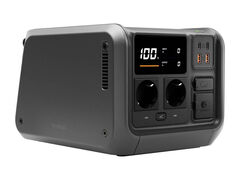
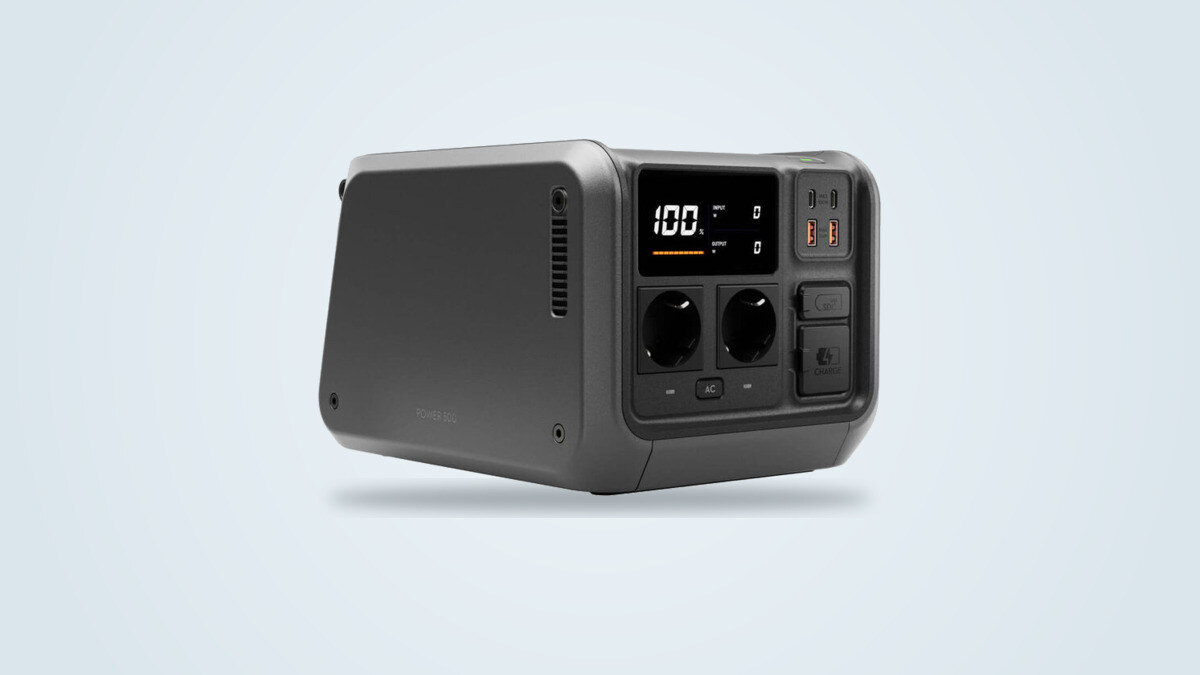
The front panel houses a screen showing the charge percentage in large digits, a level bar, and the input and output power in watts. Icons for active ports light up above it, a genuinely complete and legible display for a station that nonetheless offers no app, no Wi-Fi and no Bluetooth. That is a real difference against DJI's own Power 1000 V2, which adds remote monitoring through the DJI Home app: here, the built-in screen is the only window onto the station's status.
DJI also builds in an automatic transfer function when devices stay plugged in while mains power is present: if the mains cuts out, the manufacturer states a switchover time under 0.02 seconds. No independent test has confirmed that figure under real conditions, but the feature itself is worth knowing about before buying, especially for any use sensitive to power cuts.
Build and reliability: what the teardown reveals
Inside, the Power 500 uses cylindrical LiFePO4 cells rated at 3.2V and 20Ah, made by a Chinese automotive-grade cell manufacturer that specialises in stationary storage. The cooling fan, a ball-bearing model, is identified on teardown as coming from a well-known name in electronic components. This build matches the standards expected at this price point, with no obviously cut-price parts.
On durability, DJI claims 4000 charge cycles before dropping below 70% of original capacity, and a manufacturer warranty of up to 5 years, a generous span for the category. The unit has also passed a series of certification tests with SGS, the Swiss testing and certification body, including on noise level. No recall or documented safety incident turned up for this model at the time of writing, a positive result worth stating plainly.
Two minor points are worth flagging: the AC sockets need a fair amount of force to plug into on first use, and the matte, textured finish shows fingerprints easily. Neither calls the unit's overall solidity into question, but both are real details worth knowing before buying.
Against its own range and the direct competition
Within the DJI Power range itself, the Power 500 occupies a niche: the smallest, lightest and quietest, but also the only one without an app or wireless connectivity. Against the Power 1000 Mini, already more versatile, and especially against the Power 1000, 1000 V2 and 2000, all far more powerful and expandable, it fully embraces the role of a light nomadic companion rather than a home backup solution.
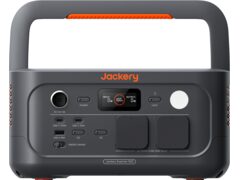
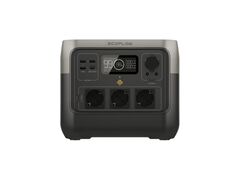
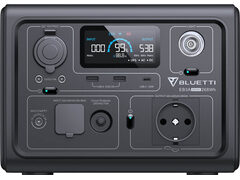
| Criterion | DJI Power 500 | Jackery Explorer 500 v2 | EcoFlow River 2 Pro | Bluetti EB3A |
|---|---|---|---|---|
| Continuous power | 1000W | 500W | 800W | 600W |
| Claimed capacity | 512Wh | 512Wh | 768Wh | 268Wh |
| Weight | 7.3kg | 5.7kg | 7.8kg | 4.6kg |
| App / connectivity | None | Not disclosed | EcoFlow app | Bluetooth and app |
At near-identical capacity, the Power 500 delivers twice the power of the Jackery Explorer 500 v2, and stays more powerful than the more capacious EcoFlow River 2 Pro. Against the lighter but far less capacious Bluetti EB3A, it offers a better capacity-to-power trade-off. Its real relative weakness against these three direct rivals: the total absence of remote monitoring, when most of them offer at least an app or Bluetooth to check the charge from a distance.
Who it suits, and who it does not
This station targets a specific profile, and serves it well.
It is a strong fit for a creator or pilot already invested in DJI gear, who will get full value from fast charging through the SDC Lite port. It also suits anyone after a compact, quiet nomadic station for computing, photo or video work, or light electrical backup, without needing remote monitoring or a large energy reserve.
It suits three profiles less well. Anyone after backup for an entire home should look at a far more capacious station: 512Wh, even at full power, only covers modest, short-lived use. Anyone wanting to monitor their station remotely through an app should turn to the DJI Power 1000 V2 or a rival fitted with Wi-Fi or Bluetooth. And anyone who camps or travels frequently in the rain will have to work around the total lack of an IP rating, protecting the unit by their own means.