
1024 Wh claimed, 771 to 932 Wh returned depending on use
Sixteen prismatic Penghui LiFePO4 cells, model IFR40135, are wired in series (16S1P): 3.2 V and 20 Ah each, for 64 Wh per cell and 1024 Wh in total. The published figure matches the pack's physical architecture exactly, with no optimistic rounding.
The energy actually returned at different output levels follows a curve rather than a single number: 767 Wh at 200 W (75 %), 885 Wh at 500 W (86 %), a peak of 932 Wh around 900 W (91 %), then back down to 771 Wh at 2200 W at full power (75 %).
This shape is not unusual: at low power, the control electronics draw a fixed share of energy that weighs proportionally heavier; at full power, conduction losses take back over. The midpoint, around 900 W, is where the unit returns the most of what it stores.
One apparent discrepancy is worth explaining rather than ignoring: a continuous figure of 2400 W also circulates, against the official 2200 W rating. Both numbers are accurate, just under different conditions. The 2200 W is guaranteed all the way to full battery discharge; the 2400 W is only reachable while the charge level stays above 20 %. A reading taken early in the discharge cycle would land on the second condition without that distinction being obvious.
This curve guides the choice of use more than it limits it. For charging a smartphone or a laptop, the station sits far from its optimal point, and the effective efficiency will be closer to 75 % than to 91 %. For powering a power tool, a compressor, or any appliance drawing several hundred watts over a short to medium stretch, it instead runs close to its best efficiency.
2200 W that genuinely hold, all the way
This is the station's real strength: 2200 W continuous, all the way to full battery discharge. At full power, the unit runs for 25 minutes before the 1024 Wh are exhausted, with no cutout and no drop in output along the way.
For a capacity of barely 1 kWh, that is a rare power-to-capacity ratio: most stations in this format cap noticeably lower in continuous mode, even if they print a more impressive peak figure on the box. Here, the rated power is the sustained power, not a number that lasts a few seconds.
A safeguard still exists: past roughly 3000 W drawn, the safety cutoff engages correctly, which is what you would expect from a well-designed device rather than a flaw.
In practical terms, this power level opens up appliances that a station capped at 1200 or 1800 W continuous cannot run properly: an electric kettle, a compact induction hob, or any power tool with a high inrush current at startup.
2600 W, 4400 W: two figures to read with their footnote
The maker's spec sheet highlights three power figures, and only one describes sustained use. The other two deserve to be read alongside their context, which is available but easy to miss.
The 2600 W, presented as the "max output power," is not an instant peak: it is a tier that holds, specifically, for 30 seconds on the 120 V model and 60 seconds on the 230 V model sold in Europe, at 25 °C and a 50 % charge level. That condition is stated in black and white in the maker's documentation, in a footnote.
The 4400 W peak figure, meanwhile, comes with no published time condition, and no independent measurement confirms it. It is a declared figure, and should be treated as one.
Neither figure is false. But confusing either with the 2200 W continuous rating would seriously overstate what this station can actually sustain over time.
Not to be confused with the V2: a trap our own listing fell into
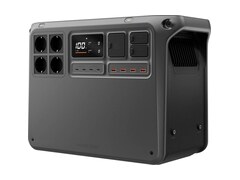
DJI sells two different products under the same "Power 1000" commercial name. The one covered in this review, released in April 2024, is the first generation. A second version, the Power 1000 V2, arrived in July 2025, sold separately and at a higher price.
| Criterion | Power 1000 (this one) | Power 1000 V2 |
|---|---|---|
| Continuous output | 2200 W | 2600 W |
| Weight | 13 kg | 14.2 kg |
| Connectivity | none, optional dongle | built-in WiFi and Bluetooth |
| Capacity expansion | yes, through the SDC port, after a firmware update | yes, with no preparation needed |
| Release date | April 2024 | July 2025 |
The two versions share exactly the same Penghui IFR40135 cells, but carry different power electronics: this is not just a cosmetic refresh, the V2's higher output corresponds to a genuine hardware change.
Before buying, check the exact model reference given by the seller rather than relying on the name "Power 1000" alone, and compare prices: a large gap between two listings carrying that same name almost always signals two different generations, not simply a discount.
70 minutes claimed, under one condition worth knowing
A full recharge is claimed at 70 minutes, or 80 % in 50 minutes. One condition, present in the maker's documentation but easy to miss, governs this speed.
One condition appears in the official documentation and is worth knowing: to reach the maximum 1200 W charge rate, the station's battery must already be at least 60 % charged, and the ambient temperature must sit between 20 and 35 °C. Outside that window, the actual charge speed will fall short of the headline figure.
On the solar side, the claimed 800 W runs through two proprietary DJI MPPT modules, 400 W each, connected to the unit's SDC port. No standard third-party panel plugs in directly.
This maximum-charge condition is not just a spec-sheet footnote: a station pulled from a cold vehicle in winter, or used after a near-complete discharge, will take noticeably longer than 70 minutes to recharge, until the temperature or the charge level moves back into the required window.
The SDC port: fast for DJI drones, costly for everything else
Beyond the standard sockets, this station carries two proprietary DJI connectors, SDC and SDC Lite, built for the brand's ecosystem. The main SDC port accepts up to 42 A output, comfortably enough for dedicated fast charging.
That same SDC port is also the way in for capacity expansion, which its role as a fast-charging connector does not hint at. DJI lists the 2048 Wh Power Expansion Battery 2000 as compatible with this first generation, taking the pair to 3072 Wh with one battery. Two conditions come with that compatibility in the manufacturer's documentation: the battery cable goes into the SDC port and not the SDC Lite one, and the station's firmware must be updated with the DJI Assistant 2 utility before first use, a step the V2 and the Power 2000 are spared.
For owners of DJI drones, the benefit is real: a Mavic 3 recharges fully in around 58 minutes through this port, against a noticeably longer time on a standard charger; an Air 3 reaches 95 % in roughly thirty minutes. Anyone who already owns the DJI ecosystem recoups that value quickly.
For every other use, this proprietary connector comes at a cost. Each drone-model-specific cable is sold separately, at around 20 €, and a different one is needed per device family. The same logic applies to solar: without the DJI MPPT modules, the station simply cannot take in solar power, regardless of which panel is already owned.
The second port, SDC Lite, delivers a more modest output (9 to 27 V, 10 A): it targets lighter accessories in the DJI ecosystem rather than fast-charging a drone or a solar panel. Its presence, missing from the catalogue listing before the fix, does not change the overall picture: this connector setup remains closed to any equipment outside the brand.
Two mains sockets, a real limitation for this format
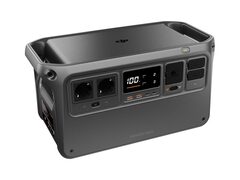
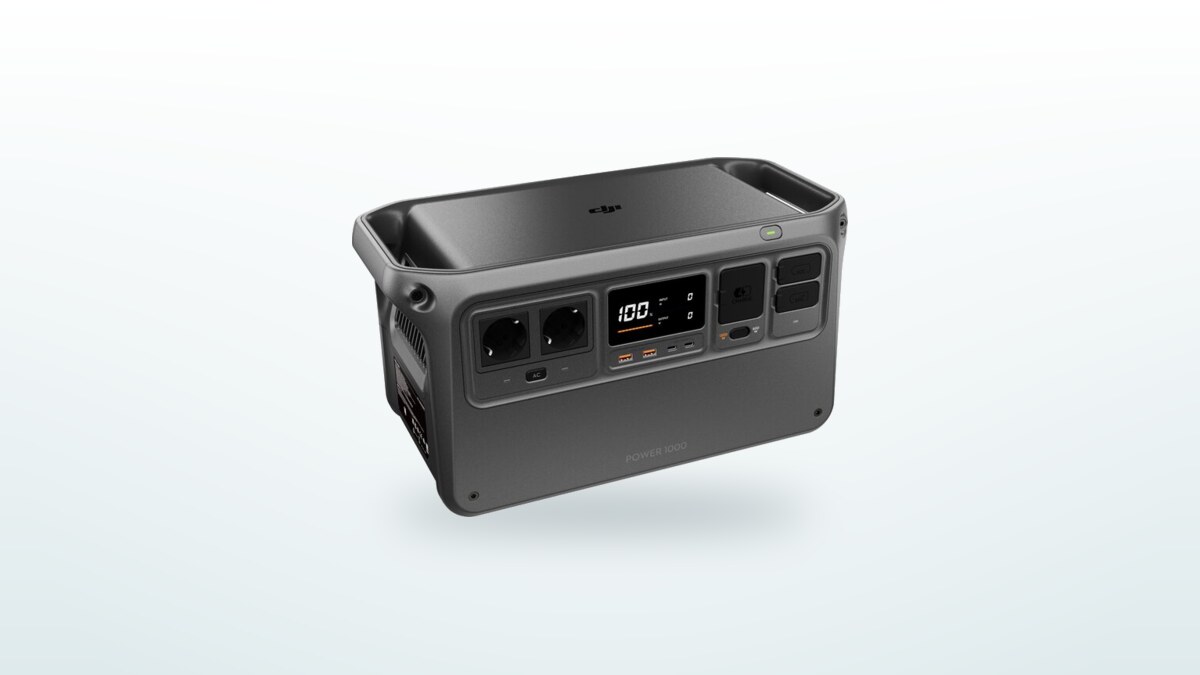
On standard outputs, the unit offers two mains sockets, two USB-C ports up to 140 W each, capable of fast-charging a demanding laptop at full speed, and two USB-A ports at 24 W.
| Output | Power |
|---|---|
| 230 V mains sockets | 2, 2200 W total |
| USB-C | 2 × 140 W |
| USB-A | 2 × 24 W |
| SDC / SDC Lite | 42 A / 10 A |
The socket count, just two, is a real limitation: with a use case combining several bulky appliances, a power strip quickly becomes necessary to draw on the full 2200 W available, as on other stations of this format.
The two USB-C ports, at 140 W each, cover a lot of ground, though: enough to charge two demanding laptops at once without going through the mains sockets, a split that makes sense on a building site or a film set where several workstations coexist.
23 dB claimed, never independently measured
The maker states 23 dB at one metre, a figure presented as a key selling point, particularly for filming or night-time use. Its own documentation specifies, however, that this value is measured while mains charging at 600 W, not while delivering output power.
No independently measured decibel figure, with instrument and distance specified, was found for either charging or full-power discharge, the situation placing the greatest demand on the fan.
For lack of verifiable data, this aspect is not scored in this review's numeric breakdown.
No built-in app, an optional dongle
Unlike more recent stations, this one has no built-in connectivity at all: no WiFi, no Bluetooth. Control happens strictly on the unit itself, through its screen and buttons.
DJI sells a separate optional dongle that adds Bluetooth and WiFi, enabling monitoring through the DJI Home app. Without that accessory, no remote control is possible.
Cells identified, 4000 cycles, a five-year warranty
The cells come from Penghui, an established supplier in the sector, wired in a simple series architecture. The maker states 4000 cycles before capacity drops to 70 % of its original value, a figure in the middle of the pack for LiFePO4 chemistry.
The manufacturer's warranty, confirmed in the official European documentation, runs for five years. No official recall targets this model, and no repeated reports of swelling or structural failure turn up beyond one isolated, uncorroborated case.
To put 4000 cycles into everyday perspective: at a rate of one full cycle per week, already a demanding pace for a station of this capacity, that works out to several decades before reaching the 70 % capacity threshold. The vast majority of owners will never come close to that limit.
Even at a more demanding professional pace, one full cycle every two to three days, the maths stays favourable: between two and three decades before reaching that same threshold, a lifespan that far outlasts the rest of the electronics built into the unit.
Who it suits, and who it does not
It suits anyone who needs high continuous power in a compact format, power tools, filming equipment, or demanding home use, and anyone who already owns DJI drones compatible with SDC fast charging.
It does not suit anyone looking for a universal, cost-controlled solar input, since the proprietary DJI ecosystem makes that option noticeably more expensive. Nor anyone who wants to control their station from a phone without buying an extra accessory.