
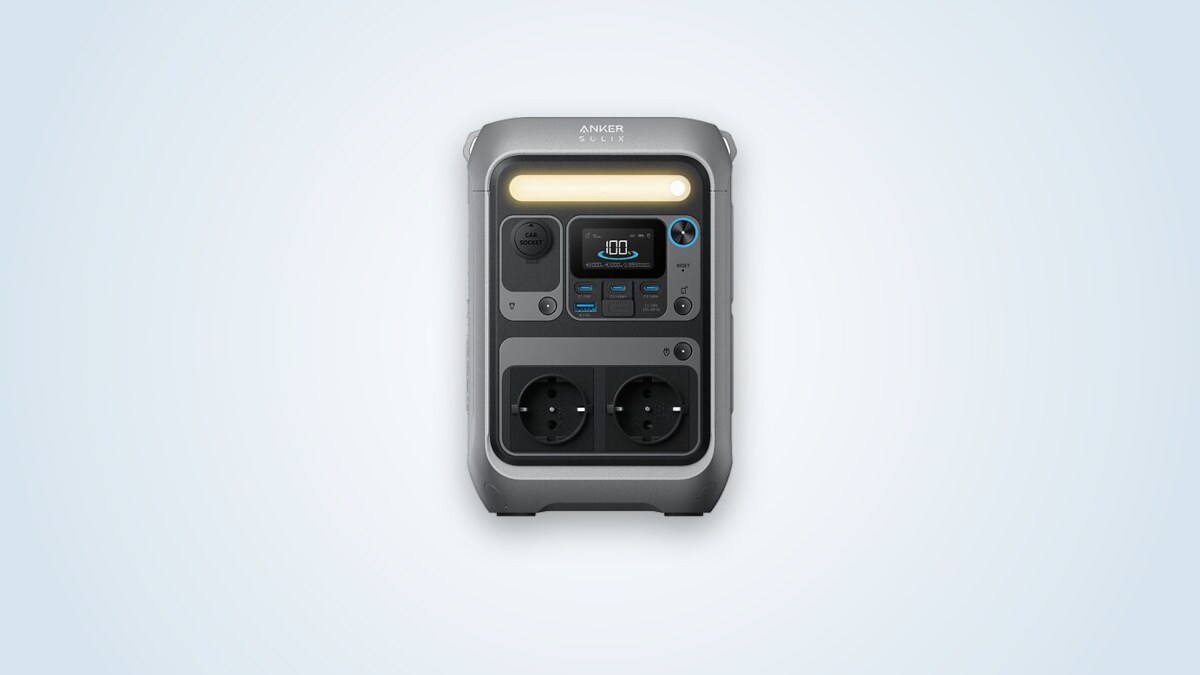
What the 288 Wh are really worth
The 288 Wh on the label are a cell capacity. What comes out of the outputs is always less, and the gap depends on the output chosen.
On average, 253.8 Wh are genuinely available, or 88 % of the claimed figure. That average hides a wide spread: depending on the output and the power drawn, the energy recovered ranges from 214 to 272 Wh. Put another way, the same battery can give back a quarter more or a quarter less depending on the way it is used.
The ranking is logical and holds for the whole category: every stage of conversion takes its share. USB-C starts from the direct current of the pack and transforms it very little; the 12 V output does a little more; the 230 V socket has to build a complete sine wave and costs the most. On a station of this size, that 26 Wh gap between the best and the worst case comes to nearly a tenth of the pack.
It also helps to understand where the 288 Wh themselves come from. The manufacturer also quotes 90,000 mAh, a figure that strikes harder but that means nothing without the voltage it refers to. Multiplied by the 3.2 V of a lithium iron phosphate cell, it does give 288 Wh back. The watt-hour is the only unit that allows two batteries to be compared with each other; the milliamp-hour, on its own, mainly allows two sales pitches to be compared.
Finally, that 88 % of usable capacity on average is a good result in absolute terms. It is the round-trip efficiency, set out further down, that disappoints. The two notions are distinct and often confused: the first says how much energy comes out of the pack, the second how much had to be put in to get it there.
69 % from wall to socket: the real price of small size
The figure that counts for the bill is not the one for capacity but the one for round-trip efficiency: how much has to go through the metre to get one watt-hour back out of the socket?
It takes 351 Wh to refill the pack from the mains, and 240 Wh come back out through the 230 V socket. Efficiency from the wall to the socket therefore comes to 69 %. Across all the outputs, it moves between 61 and 85 %.
Those 69 % sit clearly below what 1 kWh stations reach, which run around 85 to 88 %. This is not a manufacturing defect, it is a consequence of size. The conversion electronics draw a roughly fixed amount of power, whatever the capacity of the pack they serve. Set against 288 Wh, that levy weighs three to four times as heavily as it does against 1000 Wh.
12.6 W idle: the figure that changes everything
Here is the most useful piece of information in this review, and the one that appears nowhere on the packaging. Switched on but delivering nothing, with the 230 V sockets active, this station draws 12.6 W.
Set against the 240 Wh available at the mains output, those 12.6 W empty the pack in under twenty hours. With no appliance plugged in at all. A station left switched on on a Friday evening is flat by Saturday afternoon.
With the outputs switched off, the draw falls to 2.3 W, which leaves a little over four days before exhaustion. The gap between the two situations is therefore a factor of five, and it turns on a single button.
That draw has a direct consequence for backup use. A 288 Wh station left plugged in permanently to take over during a cut spends most of its time powering itself. On the mains it recharges continuously and the question does not arise; but as soon as it is unplugged in the belief that a reserve is being kept, the reserve melts away.
The mechanism is the same as the one behind the efficiency figure, and it has the same cause: the inverter draws power to exist, not to produce. Those 12.6 W are roughly what the inverter of a 1 kWh station draws, where they would pass unnoticed, since they would stand for three days of runtime instead of twenty hours. Miniaturisation does not reduce that levy; it only makes it far more visible.
One clarification, so as not to aim the criticism wrongly: this behaviour is not a design defect, and it presents no danger. It is a physical fact that no manufacturer publishes and that the buyer discovers alone, often after a disappointment. Knowing about it before the purchase is enough to neutralise it completely.
300 W held, and a clean cut-off at 310
The station delivers 300 W continuously without faltering, and cuts out beyond 310 W. The limit is therefore real and sharp: there is no hidden margin, no overload mode.
That frankness is preferable to the opposite. A station that accepts 400 W for thirty seconds before shutting down is more dangerous for the appliance plugged into it than a station that refuses outright. Here the behaviour is predictable.
The waveform stays clean even at full load, which counts for motor-driven appliances, switching chargers and small electronic tools. A peak of 600 W is allowed at start-up, enough to absorb the surge of a cool box compressor.
What 300 W allow, and what they rule out, is quickly summed up. They run a laptop, a monitor, a router, lighting, a compressor cool box, a fan, a small food processor. They run neither a kettle, nor a microwave, nor an induction hob, nor a hairdryer, nor a fan heater. Nothing that heats, in short.
Three inputs, and a full charge in an hour
This is the field where this station proves most convincing. It accepts three kinds of input, and all three genuinely work.
From the mains, the input draws around 330 W and a full charge takes 1 h 07. On USB-C, it accepts 138 W and finishes in 2 h 22. Through the XT60 solar input, it takes 96 W and needs 3 h 23.
The remarkable point is the second one. Recharging a power station with an ordinary laptop charger, with no dedicated brick and no proprietary cable, in a little over two hours, was unthinkable three years ago. That is what makes this format genuinely transportable: the same charger serves the laptop, the phone and the station.
Bidirectional 140 W, the real originality
Three USB-C ports, two of which reach 140 W, and above all able to work in both directions: they charge the station as readily as they power a device.
Bidirectional operation at 140 W is rare, and it changes the nature of the object. The 140 W match exactly what the hungriest laptops need, the ones whose original brick already weighs three hundred grams. A single cable then covers everything: filling the station at home, then running the machine at full speed on the move.
It is also the most efficient output on the unit, with 266 Wh recovered against 240 on the 230 V. Using USB-C rather than the mains socket, when the device allows it, therefore pays off in both runtime and simplicity.
The rest of the connectivity rounds things off well: a USB-A port, a 12 V output, two 230 V sockets, and app control over Bluetooth. For an object of this size, that is complete.
One caveat before counting on the 140 W: that power assumes the cable can carry it. An ordinary USB-C cord is limited to 60 W, and many cables sold for 100 W go no further than that value. Reaching 140 W calls for a cable certified for 5 amps, recognisable by its identification chip. With an unsuitable cord the charge still works, but throttled, and it takes twice as long for no obvious reason.
That detail applies to charging the station itself as well. The 138 W at the USB-C input assume the same certified cable and a charger able to supply them. With the brick from a phone the station will charge, but at the pace of a whole night rather than two hours.
4.1 kg for 288 Wh, and what that implies
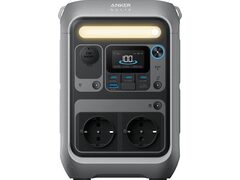
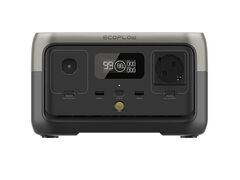
The case measures 164 by 161 by 240 millimetres and weighs 4.1 kg. That is the bulk of a small picnic cool box, and the weight of a fifteen-inch laptop with its bag.
Useful density, 59 Wh per kilo counting the energy genuinely available, is clearly below that of the big stations, which go past 80. That is the second effect of miniaturisation: the conversion components, the case and the ventilation do not shrink in proportion to the pack.
Still, the relevant comparison is not with a 1 kWh station, which is not carried in the same way. It is with a large power bank. And on that ground, two 230 V sockets and 300 W in four kilos remain a service no bag battery provides.
C300 or C300 DC: which one to take
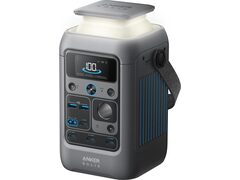
Anker offers this model in two versions that carry almost the same name and do not do the same job. The confusion is common at the point of purchase, and it is expensive.
A further confusion comes from the naming itself. On the European market, this mains version is sold under the name C300X, while the American market simply calls it the C300. The X therefore does not mark a more powerful variant, as the usual use of that letter would suggest: it is the same unit under a different label. The version without a mains socket, for its part, turns up written both as C300 DC and as C300X DC.
| Criterion | C300, mains version | C300 DC |
|---|---|---|
| 230 V sockets | 2 | None |
| Weight | 4.1 kg | 2.8 kg |
| Fan | Yes | None |
| Capacity | 288 Wh | 288 Wh |
| Efficiency | 69 % on the 230 V output | Better, with no inverter |
The reasoning is simple. If nothing but USB-C or 12 V devices is ever plugged in, the DC version is 1.3 kg lighter, completely silent since it has no fan, and more efficient since it does not carry the inverter that costs the most in efficiency.
The mains version is justified only if the two 230 V sockets are genuinely needed. Those 1.3 kg and those points of efficiency are the price of that possibility. It is a high price, and one to accept knowingly rather than by default.
Cycles, warranty, and real service life
The chemistry is lithium iron phosphate, rated for 3000 cycles before dropping to 80 % of initial capacity. The manufacturer warranty covers five years.
The threshold used deserves attention, because it varies from one brand to another and makes comparisons misleading. Claiming 3000 cycles down to 80 % is more demanding than claiming 4000 cycles down to 70 %: in the first case the battery still has four fifths of its capacity at the end of the count; in the second, a little over two thirds. Comparing the two numbers without looking at the thresholds amounts to comparing two different scales.
Translated into use, those 3000 cycles stand for more than eight years at one full cycle a day, and a good deal more on weekend duty. In this format it is therefore not the cycle count that will decide the end of the unit.
Lithium iron phosphate does impose one universal precaution, which is not specific to this model: it must never be recharged while frozen. Below zero, charging degrades the cells irreversibly, and the protection electronics generally block the operation. A station left in a vehicle over winter has to be brought back up to temperature before it accepts the slightest current.
Against the other 300 Wh stations
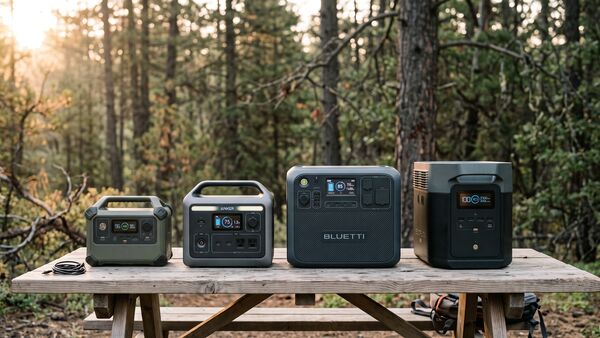
In this segment, capacities are almost identical from one brand to another. The differences lie elsewhere: charging speed, the power of the USB-C ports, efficiency and weight.
This C300 stands out clearly on two points. Its bidirectional 140 W USB-C ports are above what the direct competition offers, often limited to 100 W and sometimes only as an output. And its full charge in 1 h 07 from the mains is fast for the format.
It is penalised, on the other hand, by its efficiency on the 230 V output and by its idle draw. Those are two figures that spec sheets never publish, and they explain the difference between a station that looks good on paper and a station that still looks good after three months of use.
No battery expansion is provided for, which is the norm in this format: at this level of capacity, an expansion would cost more than the model above.
The real question in this format is not which 300 Wh station to choose, but whether a 300 Wh station is needed at all. Three options present themselves at the same budget: a large 25,000 mAh power bank, far lighter but with no 230 V socket; this station, which adds the sockets and 300 W; or a 500 to 600 Wh model, twice as heavy but appreciably more efficient, and whose idle draw weighs proportionally less.
The tipping point is the question of 230 V. If no appliance calls for it, the power bank is enough and costs less. If several do, or if they heat, it is worth moving up a class. This C300 occupies the narrow band in the middle: one or two undemanding mains appliances, and mobility.
Who it suits, and who it does not
It suits anyone who works on the move with a demanding laptop, anyone who camps light, anyone who wants a reserve for a weekend without carrying ten kilos. The bidirectional 140 W USB-C and the one-hour recharge make it a very accomplished bag companion.
It does not suit anyone planning to run appliances that heat, anyone looking for a backup reserve to leave plugged in and forgotten, nor anyone who will never use the 230 V sockets, in which case the DC version is objectively the better choice.
Two habits are enough to get the best from it, and they cost nothing. The first is to favour USB-C systematically whenever the device accepts it: that gains 26 Wh on every cycle, a tenth of the runtime, and avoids the double conversion. The second is to switch off the 230 V sockets at rest, which divides the idle draw by five and takes standby runtime from under a day to about five.
Applied together, those two reflexes transform the product. Without them, the buyer will find a battery that empties fast and gives back less than promised, and will be right. That is precisely what a page of this kind should serve to prevent.