
What the claimed 256 Wh are actually worth
The Volix P300 packs a 256 Wh LiFePO4 battery (12.8V, 20Ah), rated for over 4000 charge cycles. That label figure says nothing about what actually comes out of the ports, though, and the gap depends heavily on which output is used.
Through the mains socket, at 150W (roughly a power-hungry laptop or a small multi-device charger), the station delivers around 213 Wh, or 83% of its rated capacity. The difference comes down to DC/AC conversion: the inverter draws a fixed amount of power to run, regardless of what's plugged in.
That conversion doesn't exist on the DC outputs. The 12V socket delivers up to 241 Wh, or 94% of the rated figure, and the USB-C port tops 90% at 60W. Charging a phone, tablet or USB-C laptop therefore pulls noticeably more usable energy out of the Volix P300 than the mains socket does.
The gap becomes dramatic on a very light, continuous load: at just 3W, the level of a router or a small home gateway, barely 45 Wh out of the claimed 256 Wh remain usable before shutdown, or barely 17%, over more than fifteen hours. Most of the energy is absorbed by the inverter's own baseline power draw rather than by whatever is plugged in. This isn't unique to the Volix P300: it's a physical trait of every small inverter-based station, the lighter and longer the load, the worse the efficiency.
The practical takeaway: the Volix P300 is a strong choice for short, meaningful loads (charging a laptop, a camera, running a small appliance for a few dozen minutes), and a much weaker one for keeping a very low-draw device running continuously off its mains socket for hours.
300W continuous, 600W peak: power delivery that holds its promise
The spec sheet claims 300W continuous and 600W peak on the single mains socket. Both figures hold up under everyday loads (a laptop, a small multi-device charger, a fan, lighting), with no thermal throttling or shortfall against the claimed output. Housing temperature stays at or under 109 °F (43 °C) around the vents under a 150W mains load, with no sign of overheating.
The USB-C port actually beats its own promise: up to 105W available against the 100W claim, with PPS support alongside standard PD across six voltage profiles. Enough to fast-charge a recent laptop or a flagship phone at full speed, matching a dedicated mains charger.
The Volix P300's real limit isn't power, then, it's provisioning: a single mains socket. At this capacity tier (256 Wh), that's the class norm rather than a shortfall specific to this unit (most comparable stations only offer one too), but it does rule out running several mains-powered devices at once. The socket itself sits rotated 90° relative to the housing, a choice that makes room for bulky power bricks without them overhanging the other ports.
The one-hour full charge promise, and what it actually takes
The manufacturer claims a full 0-100% mains charge in one hour at the maximum 300W input. A partial charge to 80% in 40 minutes lines up with that claim. The rest doesn't: a full charge actually takes closer to 82 minutes, the final stretch slowing down noticeably as it nears 100%, as with nearly all lithium batteries.
The app offers several charging modes (fast, normal, quiet), adjusting input power between roughly 90W and 290W. The slowest mode isn't fully silent either: the fan keeps running, which, combined with the longer charge time, actually makes it slightly less efficient than the fast mode.
On solar, the XT60 input accepts up to 110W (11-30V). At close to maximum power (around 108W), a full charge takes just over three hours; at lower power (around 68W), nearly four and a half hours. Combined mains-and-solar charging works normally, letting both sources add up for a faster top-up.
UPS backup: a fast switchover, but not always a clean restart
The Volix P300 includes a UPS function: on a mains outage, it switches to its own battery to keep a sensitive device running (a desktop computer, a home gateway, a small home network). The manufacturer claims a 20ms switchover. In both directions, mains-to-battery and then battery-to-mains once power returns, the switchover actually sits closer to 16ms, slightly better than claimed.
One detail is worth knowing before trusting the station with a critical, unattended backup role: as mains power returns, output voltage briefly runs through an unstable waveform before settling, and a full restart after a long outage isn't always automatic. For a brief outage behind a computer or a gateway, the fast switchover is more than enough to prevent data loss. For a long, unattended home-backup role, it's worth checking the wake-up behavior yourself before making it your only line of defense.
Left plugged in permanently for this role, the Volix P300 draws very little power: around 3W on simple mains standby, up to 5W with the UPS function kept active continuously. Over a year, that draw is negligible next to the cost of an unprotected outage.
Ports and app control: a complete package for its size
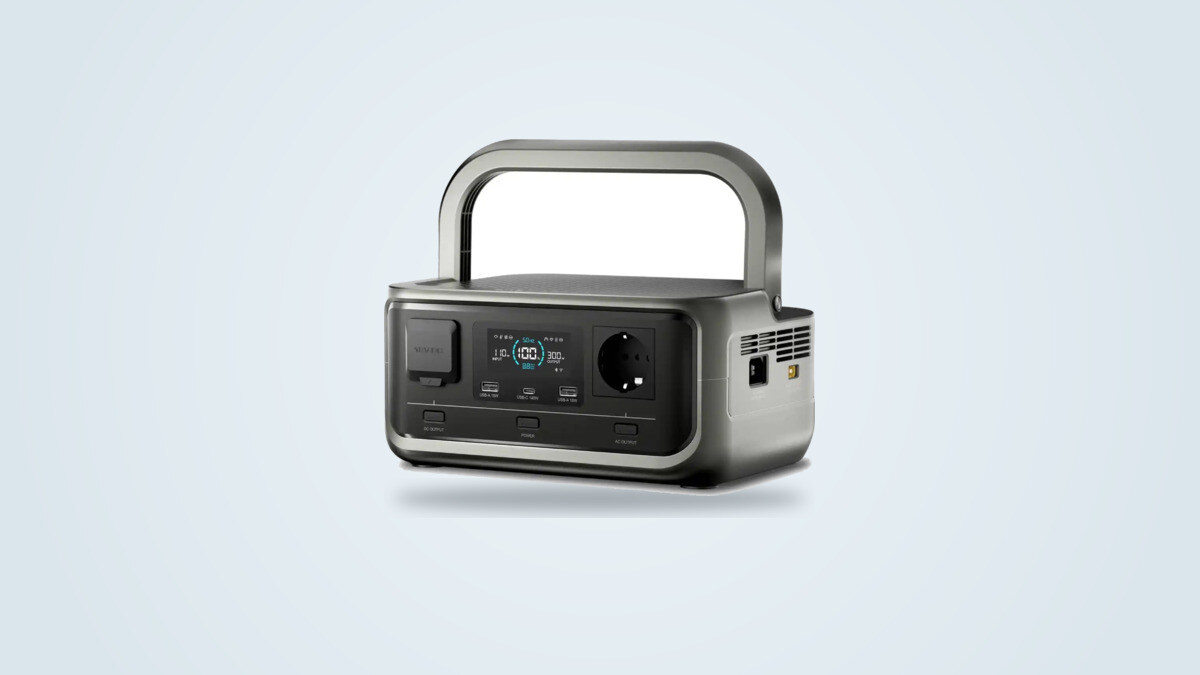
For a 256 Wh station, the port selection is complete: one mains socket, two USB-A ports (18W each), a USB-C port up to 105W, a 12V car-style output (120W, with a rubber cap) and the XT60 solar input. That lineup matches what direct competitors of similar capacity offer, no more, no less.
What sets the Volix P300 apart in its class is control: a local LCD screen, Bluetooth AND WiFi, and a full app to track charge level, adjust charging power or trigger the UPS function remotely. Several direct competitors of similar capacity are limited to Bluetooth only, or skip an app entirely. That control layer isn't flawless, though: early on, the Bluetooth connection had to be manually re-enabled at every power-up, a friction point since fixed through an app update.
The housing itself stays very compact: 10.2 x 8.3 x 4.9 in (26 x 21 x 12.5 cm) for 7.9 lb (3.57 kg), roughly the size of a large 2-liter bottle, small enough to tuck under a monitor or into a camera bag without getting in the way.
Fan noise, warranty and build: what's known and what isn't
The manufacturer claims a 30dB noise level under load, described as comparable to a light breeze. That figure hasn't been independently confirmed to date. The fan's behavior is better documented, though: it kicks in through short, not always smooth cycles as soon as the mains output or fast charging is active, more noticeable in practice than an "ultra-quiet" label suggests. Even the slowest charging mode doesn't fully silence the fan.
No teardown has turned up to identify the cell brand or BMS details, so that information stays out of this review rather than being guessed at.
On substance, no safety incident or recurring hardware fault is on record for this model to date: the drawbacks covered here concern software, ergonomics and commercial documentation, not the build itself.
Against the direct competition and the rest of the Allpowers range
In its capacity tier (250-290 Wh, 300W), several direct competitors already sit in the catalogue. The table below lines them up on the criteria that compare most directly.
| Model | Capacity | Continuous power | Weight | Real-world output |
|---|---|---|---|---|
| Allpowers Volix P300 | 256 Wh | 300W | 3.57 kg | 213 Wh (83%) |
| EcoFlow River 2 | 256 Wh | 300W | 3.5 kg | 217 Wh (85%) |
| EcoFlow River 3 | 245 Wh | 300W | 3.5 kg | 211 Wh (86%) |
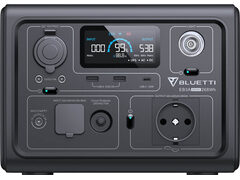
| Bluetti EB3A | 268 Wh | 600W | 4.6 kg | 225 Wh (84%) |
| Aferiy P040 | 256 Wh | 400W | 4.0 kg | 200 Wh (78%) |
Against these figures, the Volix P300 sits mid-pack on real-world mains output, clearly ahead on the 12V output, and among the best equipped for control: Bluetooth and WiFi combined, where several competitors settle for Bluetooth only or skip an app altogether. It does charge more slowly than the EcoFlow River 2 (a proven 60 minutes) and the River 3 (57 minutes), which remain the benchmarks for mains charge speed at this size.
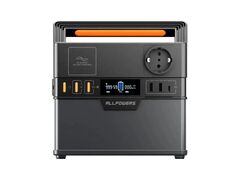
Against the Allpowers S300 Plus, a larger sibling (288 Wh against 256 Wh) sold in a neighbouring range from the same brand, the Volix P300 sticks with standard LiFePO4 chemistry rather than its sibling's NMC cells, and a spec sheet with no identified contradiction across its own official documents.
Reliability, software updates and warranty
Allpowers is now a well-represented brand in this comparison, with several other stations across different ranges already in the catalogue. No product recall or safety alert is on record for the Volix P300 to date.
The one documented software bug, a Bluetooth connection needing to be re-paired at every power-up, has since been fixed through an app update, a sign of active software support. The two faults mentioned above (the E302 solar undervoltage lock, and error code E209 missing from the manual) remain unresolved to date, however.
Technical support runs through the manufacturer's contact address. As with any recent release, there isn't yet enough track record to judge 5- or 10-year reliability. The claimed 4000 cycles, applied to a full charge every two days, work out to more than 20 years of use in theory: a useful order of magnitude to keep in mind, not a promise proven over time.
Camping, remote work, photo or backup: where it truly fits
At 7.9 lb (3.57 kg) and a compact footprint, it makes a credible camping companion: it powers lighting, charges phones and cameras, runs a small fan, and recharges in just over an hour on mains before heading out again. Rated for discharge from 14 °F to 104 °F (-10 °C to 40 °C), it tolerates cool outings, but charging needs to stay between 32 °F and 104 °F (0 °C to 40 °C). Large kitchen appliances (a kettle, a hot plate, an oven) stay out of reach of its 300W, an accepted limit of this size class.
For occasional remote work, it powers a laptop and a 4G hotspot for several hours, with a comfortable margin thanks to its 100W USB-C port that can fast-charge a second device at the same time. Its UPS function guards a workstation against micro-outages, with the caveats already covered for a long, unattended backup role.
For photo or video work in the field, its 256 Wh recharge several mirrorless camera batteries, a drone pack or mics, and its USB-C output runs a fill LED panel between takes. Its featherweight build makes it a discreet backup to slip into a camera bag.
On a road trip or in a van, charging from the car's 12V socket is the most efficient of the three input paths for topping up available energy, with the 110W solar option useful but slower, and the E302 lockout at dusk worth knowing about before relying on it unattended.
Who the Volix P300 suits, and who it doesn't
The Volix P300 suits anyone after a light energy reserve with complete control (screen, Bluetooth, WiFi, app) at an affordable price, for camping, occasional remote work, nomadic photo work or a first line of defense against home micro-outages. Its highly efficient 12V and USB-C outputs also make it a good pick for anyone mostly charging DC devices rather than mains-powered gear.
It suits fewer people looking to run a router or a home gateway continuously off its mains socket for hours on end, since efficiency collapses on that kind of light, sustained load, anyone after the fastest possible mains charge in its class (the EcoFlow River 2 or River 3 do better on that specific point), or anyone wanting to hand over a long, fully unattended home-backup role without ever checking its wake-up behavior.
Taken for what it is rather than what it doesn't claim to be, the Volix P300 remains an honest little station: it delivers on its power and weight promises, beats its own USB-C spec, and lays its real limits out plainly rather than hiding them.