
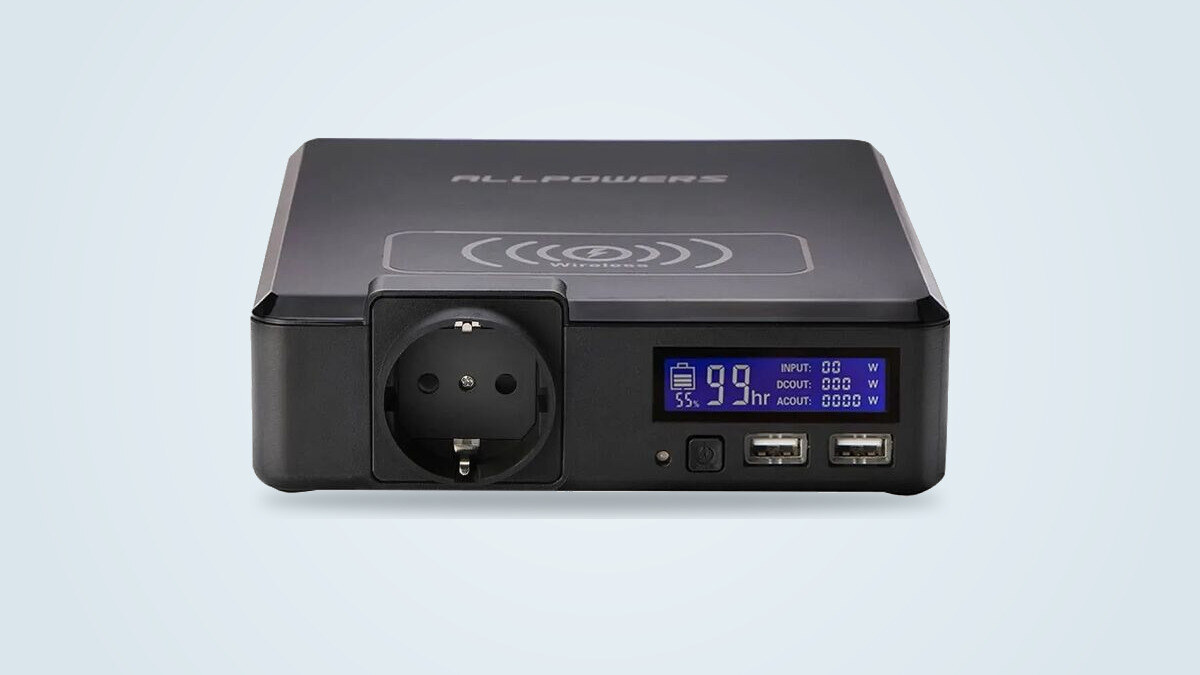
What the claimed 154Wh is really worth
The Allpowers S200 claims 154Wh, or 41600mAh at 3.7V in an NMC chemistry. That capacity is not delivered the same way depending on which output you use, and the gap is the single most important thing to understand before buying.
The gap comes down to how long the discharge lasts: at low power, it stretches over several hours, and the fixed conversion losses of the USB stage then weigh far more heavily on the total balance than during a fast mains discharge. For a use that leans mainly on charging small devices (phone, camera, e-reader) rather than the mains socket, this figure is worth keeping in mind.
Charging: the 1h30 promise holds
On USB-C alone (60W), expect around 2h30 to 3 hours. Solar input goes up to 99W through a DC5521 connector, compatible with the brand's folding panels (SP012 100W, SP020 and SP026 60W each); no dedicated MPPT controller equips the S200, though, a limit for making the most of changing light next to newer stations that include one.
A mains socket that isn't a true sine wave
The S200's mains socket puts out a modified (quasi-sine) waveform, not a true sine wave. For the vast majority of electronics (chargers, laptops, small switch-mode appliances), this makes no practical difference. It can, however, cause issues with a minority of devices that are sensitive to power quality: certain high-end audio gear, certain universal-motor tools, or certain medical equipment, which can run hotter, hum, or fail to work properly on a non-pure waveform. This point appears on no technical sheet published by the manufacturer, even though it directly affects compatibility with certain uses. Surface temperature climbs to 35 °C under full mains charging load, against a 20 °C ambient: nothing unusual, but reason enough to avoid storing the unit in a fully closed bag during that phase.
Built-in wireless charging: the feature that sets it apart
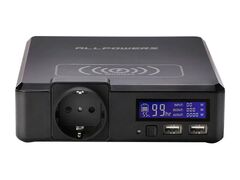
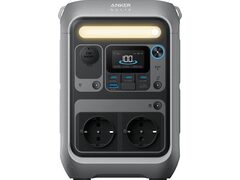
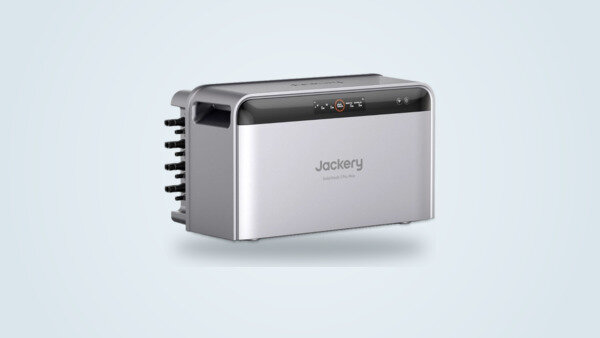
On top of the case, a Qi charging pad (5V, up to 2.4A) lets you drop a compatible smartphone on it without hunting for a cable. That's a rare feature at this price and this size: neither the Jackery Explorer 100 Plus, nor the EcoFlow River 3, nor the Anker Solix C300, its three closest direct rivals by size or price, include it. Paired with the 60W bidirectional USB-C port and the two USB-A ports, the S200 comfortably covers the charging needs of nomadic electronics without piling up cables.
Worth noting: the wireless charging pad needs the phone positioned fairly precisely for the charge to kick in, a shortcoming shared by most entry-level induction chargers.
Screen, ports and handling
The front panel brings together the essentials: the mains socket, the LCD screen, the power button and the two USB-A ports. The screen clearly shows the battery level as a percentage, the estimated remaining runtime, and the wattage on each of the three paths (input, USB output, mains output), a handy detail for keeping an eye on a charge in progress without an app or Bluetooth. The USB-C port and the charging input sit on the right edge of the case, with the wireless charging pad on top.
The case is plastic, with no remote control or remote management: all interaction happens through the single button, which suits simple use but limits the remote control that some rival stations offer through an app.
Runtime and real-world use
On a laptop whose power supply reaches 135W, runtime drops to around 110 minutes of office work (word processing, browsing, light photo editing) and around 75 minutes of gaming, a much heavier load. On a lighter laptop, around 45W, runtime climbs to around 3 hours. A small 120W ice maker runs for 57 minutes on a full charge.
These figures confirm the S200's positioning: a backup reserve for small electronics over a few hours, not a station for large appliances (fridge, kettle, hotplate) nor for a full day of heavy remote work.
NMC chemistry, entry-level pricing: what it means long term
The S200 uses an NMC (nickel-manganese-cobalt) battery rather than the LFP (lithium-iron-phosphate) chemistry now standard on newer stations. NMC offers better energy density for the same weight, which partly explains the S200's very compact size, but it typically ages faster: a few hundred full cycles before losing a meaningful share of capacity, against 2000 to 3000 cycles often claimed for a recent LFP station. It is also less thermally stable than LFP in the event of impact or puncture, a trade-off common on the market's smallest, lightest formats. The manufacturer discloses no cycle count for the S200, a figure now common on its own newer models: the S2000 Pro from the same brand, for instance, claims over 2500 cycles down to 80% capacity.
On price, the S200 sits at around £80 in the UK, an entry-level position in the mini-station-with-mains-socket segment. At that price, it undercuts most classic 250 to 300Wh stations in the catalogue, at the cost of noticeably lower capacity and power: the ratio between price and actually available watt-hours doesn't necessarily favour it against a higher-capacity station, unless weight and wireless charging matter more in the decision than the sheer cost of stored energy.
Build, reliability and after-sales support
The S200 has been on sale since April 2021 and remains in the manufacturer's catalogue in its main markets (France, Germany, the UK, Japan, the United States), including as a certified refurbished unit in some of them, a sign of sales volumes large enough to sustain a returns pipeline. The warranty runs to 2 years.
The brand's after-sales support shows real weaknesses across several other products in its catalogue: charging stalling around 85%, warranty replacements promised in writing then never carried through, very long response times once a sale is done. This point concerns the range as a whole rather than the S200 specifically: the S200 carries no safety incident of its own to date, but this pattern in after-sales support remains a cross-cutting point to keep in mind for any warranty claim.
Against the competition: inside the Allpowers range and beyond
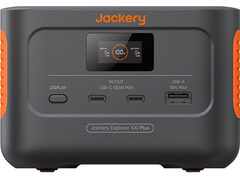
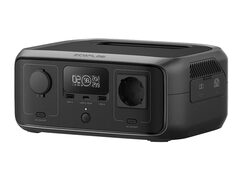
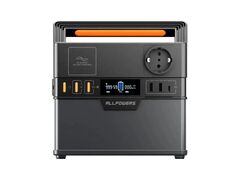
The S200's product page already compares it with the Jackery Explorer 100 Plus, the EcoFlow River 3 and the Anker Solix C300. Within the Allpowers catalogue itself, the question also looks different: stick with the S200, or step up to a higher-capacity station from the same brand?
| Criterion | Allpowers S200 | Allpowers S300 Plus | Allpowers R600 |
|---|---|---|---|
| Capacity | 154Wh | 288Wh | 299Wh |
| Mains power | 200W | 300W | 600W |
| Weight | 1.3kg | 3.4kg | 5.6kg |
| Wireless charging | Yes | No | No |
| Observed price | ≈ £80 | ≈ £162 | ≈ £202 |
The S300 Plus and the R600 share the same NMC chemistry and the same caveats over the lack of a published cycle count, but offer far higher power and capacity for 2.5 to 4 times the weight. The choice comes down to use: backpack or laptop bag for the S200, car boot or camping bag for the other two. For anyone who puts weight and wireless charging first, the S200 is the only one of the three that ticks both boxes. For anyone chasing the most watts and watt-hours per pound spent, the R600 is the most rational option of the trio, provided you're willing to carry 5.6kg.
Who the S200 suits, and who it doesn't
The S200 suits anyone after a compact energy reserve for small electronics on the move: phone, camera, tablet, small laptop, lighting, all in a case that fits in a laptop bag. Built-in wireless charging and the 60W USB-C port make it a practical companion for occasional remote work, a festival, a light camping weekend or a short power cut at home.
It doesn't suit anyone hoping to run large appliances (it tops out at 200W continuous), anyone who needs automatic switchover during an outage (no UPS function), anyone after a perfectly clean sine wave for a sensitive device, or anyone planning heavy daily use for years without regard for cycle count, which the manufacturer doesn't disclose for this model. In any of those cases, a higher-capacity, more powerful station, even at the cost of extra weight, will serve better over time.