On paper: a large capacity for a fixed installation
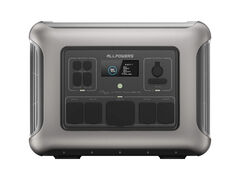
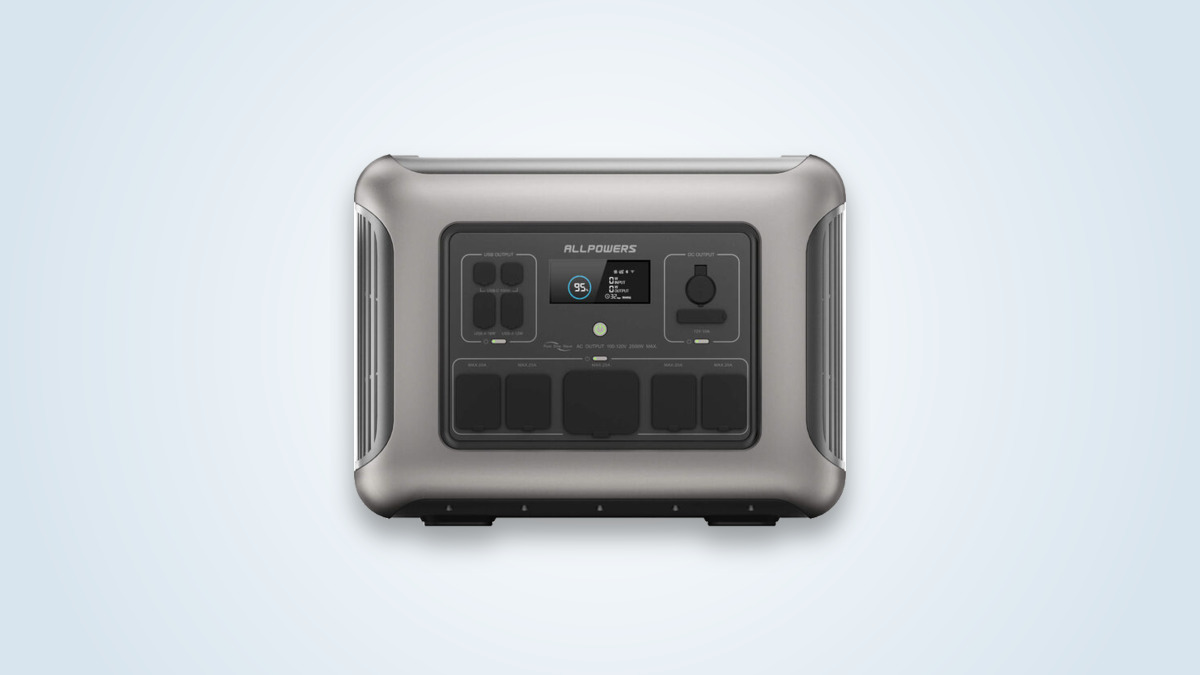
With 2016 Wh of LiFePO4 capacity, 2500 W of continuous output (4000 W peak) and a price typically seen around 1044 €, the Allpowers R2500 Plus targets home backup, job sites and semi-fixed installation in a vehicle. Its UPS function switches to battery in a claimed 15 ms during a mains outage. Unlike other models in the brand's range, it comes with Bluetooth, Wi-Fi and a control app.
29 kg with no wheels: built to stay put
The 29 kg weight is consistent with the official spec sheet. Allpowers fits neither wheels nor a telescopic handle on this model, only two side handles: transport is by hand, with two people advised beyond a few metres. This choice is not unique to this model: the R4000, higher up in the Allpowers range, does come with wheels, which points to a deliberate segmentation rather than an oversight on the R2500 Plus. Its low, wide format partly makes up for this: it slides easily under a motorhome or van bench seat, for an installation meant to stay put rather than daily nomadic use.
The B1000 expansion: the real flexibility promise, worth verifying before buying
The claimed 2016 Wh capacity rises to 3168 Wh with one B1000 battery (1152 Wh) and up to 4320 Wh with two, an expansion actively marketed by the manufacturer as combined kits. It is the station's main flexibility lever, since it is not meant to be moved around often in the first place. One point deserves caution, though: the manufacturer's own official product pages do not agree with each other on the maximum number of compatible B1000 batteries, with the main spec sheet capping it at two packs (4320 Wh) while other regional product pages from the same manufacturer mention up to three (5472 Wh). Before buying an expansion, it is best to check directly with the manufacturer the maximum capacity actually supported by a given unit.
Real efficiency: no measurement specific to this model, but a useful benchmark
No independent measurement of real-world efficiency was found specifically for the R2500 Plus. As a benchmark, the gap between claimed capacity and energy actually delivered at the mains output generally sits between 10 and 26 % for this station category, depending on the model and the load drawn. This gap comes from the inverter's conversion losses and the BMS's safety margins, not from an isolated flaw. This category-level benchmark does not substitute for a measurement specific to this model, which remains to be done.
Charging: fast, consistent with the claim
On mains power (input up to 1500 W), the Allpowers R2500 Plus reaches a full charge in 1h20 to 1h30, consistent with the manufacturer's claim. On solar power (up to a claimed 1000 W), expect around 2 hours in good sunlight. Five charging methods are available in total: mains, car, solar, generator, and combined dual-AC-plus-solar.
5-year warranty: conditional on registration, not automatic
The 5-year warranty used as a marketing highlight does not apply from the moment of purchase. The manufacturer's official warranty page states a baseline coverage of 24 months across its entire product range, with the R2500 explicitly listed among the models eligible for an extension up to 5 years, but only after registering the product on the official site. This pattern is common across the sector, but any failure occurring after 24 months on a product that was never registered would only fall under this baseline warranty, not the 5 years used in marketing. The mains power adapter is also explicitly excluded from the warranty, and refurbished units only get 2 years.
App, Wi-Fi and Bluetooth: reliability that falls short
The app has real connection issues: Wi-Fi sometimes gets stuck while loading, and Bluetooth pairing does not always hold, with automatic disconnections that do not reconnect on their own when the unit is powered back on. No figure is available to quantify how widespread this is, but it is worth knowing for anyone counting on daily remote control.
Solar input up to 1000 W: a current rating worth checking
Solar input is rated up to 1000 W, with a voltage range of 12 to 150 V. A discrepancy exists, however, on the maximum current accepted: the manufacturer's official documentation states 13 A, while some commercial spec sheets, including this site's own, state 20 A. This discrepancy changes nothing for a panel array running at a high voltage close to 150 V, where the 1000 W limit is reached before the current limit is, but it becomes relevant for a low-voltage setup: at 13 A, the power actually accepted caps out lower than expected. Best to check directly with the manufacturer before sizing a low-voltage solar setup.
Ports: comprehensive, built for several simultaneous uses
The R2500 Plus offers 4 mains sockets at 230 V pure sine wave, 2 USB-C ports up to 100 W, 4 USB-A ports (36 W combined), a 12 V car-style outlet and a DC5525 port, for a total capable of powering around ten devices at once. Enough to cover home backup with several devices running at the same time, a genuine advantage over competitors that are less generous with outputs.
Who it suits, who it does not
It suits anyone looking for a large home or job-site backup reserve meant to stay in a fixed spot, with a real need for high continuous power and the option to expand capacity over time.
It does not suit anyone who needs to move their station frequently (29 kg with no wheels), nor anyone counting firmly on the B1000 expansion or the 5-year warranty without having verified both points before buying.