
What the advertised 99Wh are really worth
The Nano100's rated 99.2Wh (31,000mAh) never fully reach the USB output. Actual efficiency sits at 88 to 90% of rated capacity, or about 87 to 89Wh usable. That is a very good score for a power bank: most standard lithium-ion models sit rather between 75 and 85%, a gap explained in part by the lower conversion losses typical of the LiFePO4 cells used here.
Two USB-C ports, only one true 100W output
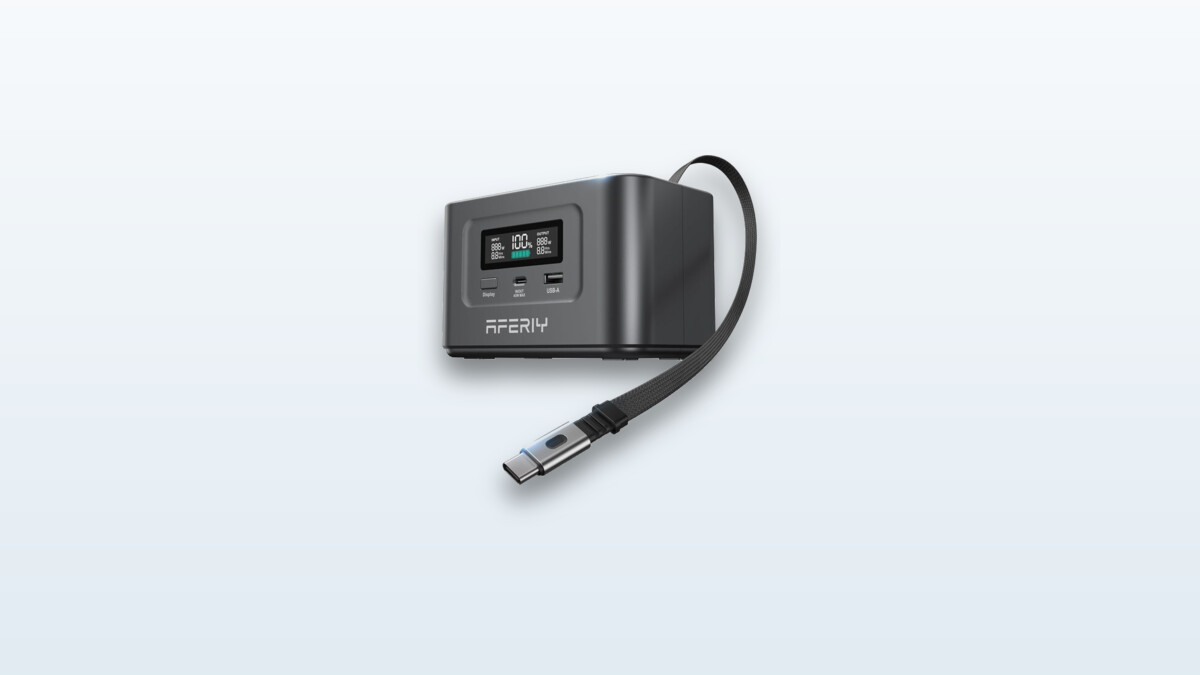
The case has two USB-C ports and one USB-A port, for a total of 145W advertised. In practice, only one of the two USB-C ports delivers up to 100W: the second is limited to 45W. This nuance does not always appear clearly in the product's presentation, which can suggest that the two USB-C ports are equivalent. To recharge a demanding laptop, the main port must therefore always be used, the second being suited to a smartphone or tablet but not to a power-hungry ultrabook.
The USB-A port rounds out the set at 18W, enough for an accessory or an older smartphone, without rivalling the two USB-C ports.
Recharging the battery: slower past 60%
Plugged into a 100W source, the Nano100 recharges its first half of capacity quickly, then slows markedly once past the 60% mark, a common behavior for LiFePO4 chemistries whose charge curve flattens toward the end of the cycle to protect the cells. In total, a full charge takes between 1h20 and 1h30 depending on the case, a figure that stays close to the 90 minutes advertised despite this mid-cycle slowdown. Pass-through mode, which lets the battery be used while it is itself charging, works with no reported issue.
A contact fault reported on the main port
An intermittent contact fault recurs repeatedly at the main USB-C port: charging stops for no apparent reason and resumes after repositioning the plug or cable. The number of cases reported remains limited, but their convergence on the same specific point, on a still-recent product, deserves to be taken seriously rather than dismissed as an isolated incident. Absent any recall or official statement from the manufacturer on the subject, this is a point of caution at purchase rather than a widespread defect.
Carry-on size and LiFePO4 chemistry
At 99.2Wh, the Nano100 stays just under the 100Wh limit generally allowed in carry-on luggage without special formalities, a concrete argument for travel use. LiFePO4 chemistry, for its part, promises more than 2000 full charge cycles, against 300 to 500 for a standard lithium-ion battery: in daily use, that represents several years of use before capacity actually starts to decline, where an ordinary power bank begins to fade after a year or two of intensive use.
The integrated retractable cable
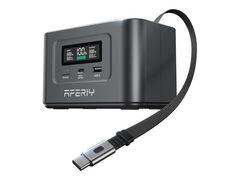
A USB-C cable about 80cm long is housed in the case and extends or retracts with a single motion. It delivers up to 100W, which avoids having to look for a compatible cord to make use of the maximum power. It is a genuine practical benefit day to day, provided the port it connects to stays reliable over time, a point the contact fault mentioned above calls into question.
The advertised solar charging, with no panel included
Some product listings present the Nano100 as compatible with solar recharging. In practice, this only means that its USB-C input accepts any USB PD source, including a solar panel fitted with a compatible output: no panel is included with the battery, and no dedicated MPPT regulation is built into the case. The term can suggest a specific feature, when it is really just plain input compatibility, common to most batteries with a USB-C input.
Weight, the trade-off of LiFePO4 chemistry
At 1.1kg for 145 x 87.9 x 87.1mm, the Nano100 is noticeably heavier and bulkier than a lithium-ion power bank of comparable capacity, a direct consequence of the lower energy density of the LiFePO4 cells. This is the deliberate trade-off of this chemistry: more life cycles, at the cost of a format less easily slipped into a pocket than a standard battery of the same capacity.
Reliability and actual price
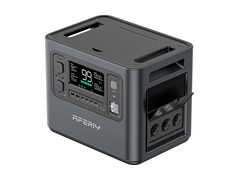
Aferiy remains a recent brand in this segment, with a track record still too limited to judge its long-term reliability. Another product from the brand, a more powerful power station, has separately been the subject of a documented fault in its voltage management under sustained load: a signal worth keeping in mind without carrying it over directly to the Nano100, whose operation relies on different electronics.
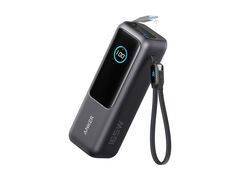
On price, the Nano100 is found around 92 euros, compared to the Anker 737 (86Wh, about 110 euros) or the Ugreen Nexode 145W 25000 (92.5Wh, about 90 euros), both standard lithium-ion. For higher capacity and longevity, the Nano100 remains competitive, provided the extra weight and the point of caution on the main port are accepted.