Prepping is no longer a fringe idea
For years, survivalism carried the image of a bunker dweller stockpiling ammunition, an image fed by reality shows like Doomsday Preppers. The actual picture is far more mainstream today. Emergency management researchers and journalists across Europe and the US have tracked a genuine broadening of everyday preparedness, moving well past the fringe caricature toward ordinary households simply looking for personal resilience against real, documented risks.
COVID-19 acted as a decisive accelerator. Empty shelves for basic goods, mask shortages and the visible fragility of just-in-time supply chains convinced a much wider share of the population that even a wealthy, developed country can be caught off guard. In the United States, where self-reliance already runs deep in the culture, mainstream retailers now stock ready-made emergency kits on regular shelves, and prepping content has moved from niche forums to mainstream YouTube and TikTok. The same shift, more muted but very real, has been documented in Germany and Spain, where prepper communities once dismissed as marginal are now the subject of serious academic and government study rather than ridicule.
What ties every scenario below together, from the mundane to the extreme, is total dependence on electricity in modern life: no power means no refrigeration, no communication, no water pumping, and no heating for most households. Energy independence is therefore the number one pillar of any serious preparedness plan, arguably ahead of food or water in practical priority, since it is what allows you to treat water and preserve food in the first place.
The fundamentals before any scenario
Before breaking down each scenario, a few principles apply to every serious prepper energy strategy.
The triad worth knowing: watt-hours (Wh) define how much reserve you have, watts (W) define what you can plug in at all, and cycle count defines how long the battery will last. A LiFePO4 (lithium iron phosphate) chemistry typically survives 3,000 to 6,000 cycles versus 500 to 1,000 for older NMC cells. For emergency gear that has to stay reliable for years without daily use, that gap matters enormously.
Extended power cut (grid-down)
This is by far the most statistically likely scenario, and paradoxically the least spectacular. A snowstorm, a violent thunderstorm, a cascading failure or badly planned maintenance can cut power to an entire district for several days. Winter Storm Uri in Texas in February 2021 left millions of homes without electricity for days in extreme cold, proof that a modern grid is never entirely safe.
For this scenario, keeping food cold is the top priority, and the orders of magnitude are widely misunderstood. With the door kept shut, a full freezer holds food safe for about 48 hours and a half-full one for about 24 hours. A plain refrigerator, by contrast, only lasts around 4 hours. In other words it is the fridge, not the freezer, that needs rescuing first, and the absolute rule is to keep the door closed: every opening costs hours of autonomy.
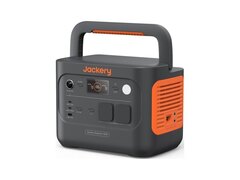
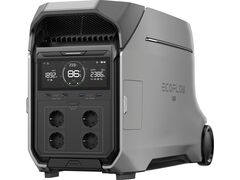
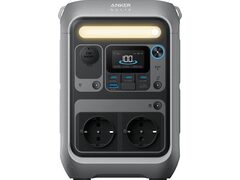
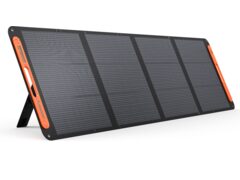
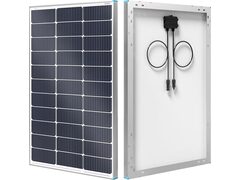
A 1,000 to 2,000 Wh power station paired with a small folding solar panel is plenty to keep a compressor cool box running and to recharge essential communications (router or 4G box, 15 to 30 W continuous) for several days. The second critical load is heating: a pellet stove draws only 30 to 100 W once running but demands a 300 to 500 W peak at ignition for its glow plug, which means checking your station's output rating before winter, not during the outage.
Major natural disaster
Earthquake, flood, storm or large-scale fire add a dimension a simple outage does not have: the infrastructure itself can be damaged, pushing the grid's return out to weeks rather than days. The experience of Hurricane Katrina, or more recently Helene in North Carolina, shows that isolated rural areas can go more than a month without power.
Here, autonomy has to be thought of in consecutive days of real solar output, not raw storage capacity. A 200 W panel recovers 700 to 900 Wh on a good summer day and a 400 W roughly double that, but those same panels fall to 150-300 Wh and 400-600 Wh respectively in December, and lower still under heavy cloud. It is that winter figure, not the summer one, that should anchor the calculation, with a safety margin of at least 40 per cent over the theoretical number.
Economic crisis and supply chain disruption
A far less dramatic but historically much more frequent scenario than full collapse: runaway inflation, a fuel shortage, or an electronics supply chain disruption. Here, stored energy is less about survival than about preserving an acceptable standard of living while prices or stock levels rebalance: keeping the ability to work remotely, keeping communications alive, and avoiding food waste from refrigeration loss.
The COVID lesson applies directly: households that kept even a modest reserve of energy and staple goods went through the first weeks of lockdowns and panic buying with far less logistical stress than those scrambling in cleaned-out stores.
Civil unrest and a WROL scenario
This is the most sensitive corner of prepping, frequently exaggerated by the media, yet it reflects a real and well-documented concern within the community: a prolonged breakdown of public order, sometimes described as WROL (Without Rule Of Law), where the grid itself may still be up but access to resources becomes uncertain or dangerous.
In this context, energy discretion becomes its own priority. A loud, visible petrol generator advertises to an entire neighbourhood that one household has power when others do not. A silent power station charged by an unobtrusive solar panel fits far better with the grey man philosophy, the idea of staying invisible rather than signalling that you are prepared, a principle widely shared across English-speaking prepper communities.
EMP and solar storms (CME)
This is the most technical and most debated scenario, but it rests on solid historical fact, not science fiction. In 1859, the Carrington Event, the most violent geomagnetic storm ever recorded, set entire telegraph stations on fire and produced auroras visible as far south as the Caribbean. More recently, the March 1989 geomagnetic storm knocked out the entire Hydro-Québec grid in under 90 seconds, leaving six million people without power for nine hours, as induced currents tripped grid protection in a cascading failure. Estimates discussed by NASA and the scientific press suggest a Carrington-scale storm today could leave tens of millions of Americans without power for anywhere from several weeks to well over a year, the time needed to rebuild the massive damaged transformers.
A high-altitude nuclear EMP, distinct from a solar event but comparable in its effect on the grid, remains an extreme geopolitical scenario that has driven real US government study, including the congressionally chartered EMP Commission. The solar storm, however, is the natural risk that is best documented and most consistently acknowledged by space weather agencies worldwide.
The COVID-19 lesson
COVID acted more as a wake-up call than a scenario in itself: the grid never went down, but trust in institutions to anticipate a crisis epidemiologists had warned about for years took a serious hit. That documented institutional failure directly fuelled a wider embrace of individual self-reliance: securing your own energy, your own food, your own communications, rather than depending entirely on supply chains that turned out to be more fragile than advertised.
On the strictly energy side, the lesson is that extended time at home, even without an outage, instantly reveals unexpected household consumption (remote work, continuous heating, devices left running around the clock) that is far better planned for in advance.
Bonus scenario: the zombie apocalypse
Let's treat this one with the humor it deserves while keeping the technical rigor intact, because the zombie apocalypse is really a fun stand-in for a total, long-term collapse of services: SHTF in its longest form, with no grid and no resupply for months on end. It is by far the most searched scenario in the entire prepping space in the US, and there is a real reason for that beyond entertainment.
The good news is that the optimal energy strategy against a horde of the undead is exactly the same as for a genuine extended grid-down event. Maximum discretion, since a loud generator is the single best way to attract attention, undead or otherwise, total solar self-sufficiency with zero dependence on fuel resupply, and full redundancy on every critical system since no replacement parts will ever be shipped. The scenario stays fictional, but the sizing discipline it forces, total and lasting autonomy with zero external maintenance, is genuinely excellent training for any real, long-lasting disruption.
The off-grid homestead concept, to go further
Popularised in France by authors such as Piero San Giorgio, the Base Autonome Durable or off-grid homestead describes a fallback location designed for total self-sufficiency over the long term: food production, water, and of course solar or wind energy sized to run in a closed loop for months or years. The energy dimension is central because it conditions everything else, from water pumping to workshops to food preservation.
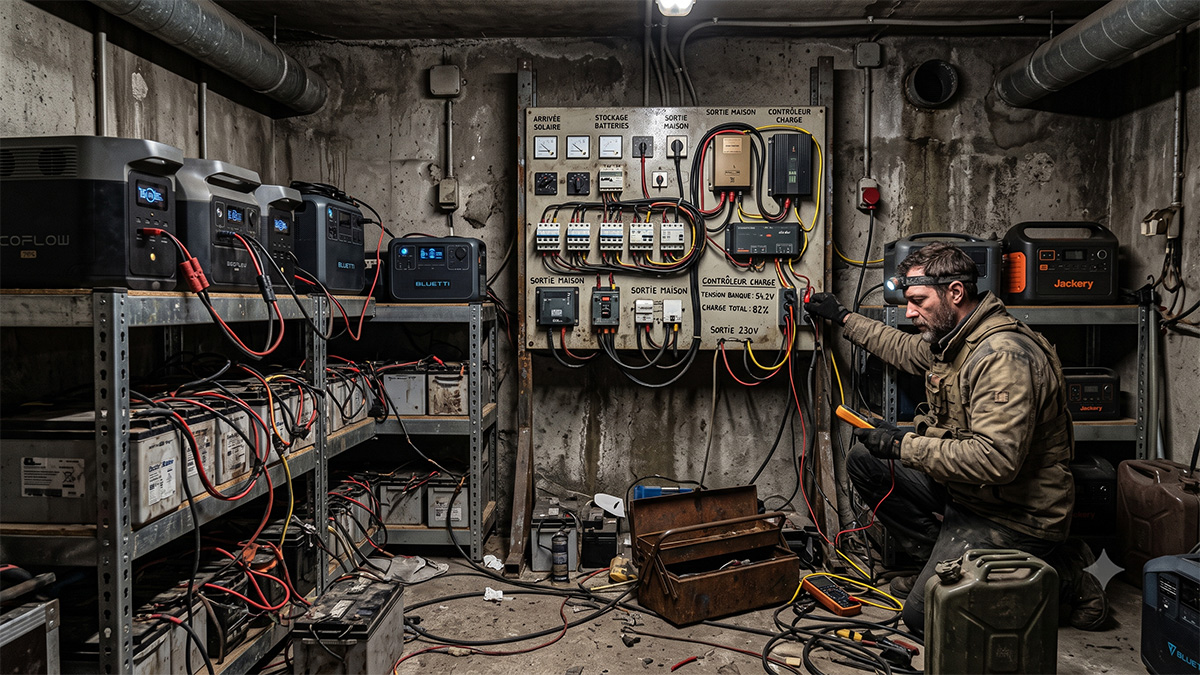
The logic is no longer that of a crisis kit: you are no longer trying to last a given number of days on a reserve, but to reproduce the energy you consume indefinitely. Our article on the energy design of an off-grid homestead details season-by-season sizing, the real cost comparison between an all-in-one station and a 12 V build, and the mistakes that doom an installation in its first winter.
The four-step method to size your setup
Whatever scenario you are planning for, the sizing method stays identical and runs in four steps.
- List every device you consider essential, not merely convenient, along with its running wattage.
- Identify your peak power need, meaning the single most demanding appliance at startup, often a compressor cooler or a pump, which determines which power station model you actually need.
- Calculate your daily watt-hour need by multiplying each wattage by its real daily runtime, then adding a 25 percent margin for conversion losses.
- Always add an independent recharge source, solar first for discretion and total independence, without which even the largest power station is just a tank that will eventually run empty.
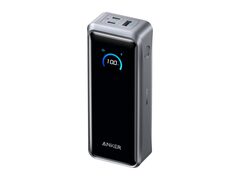
For lighter loads such as a bug out bag setup (charging, lighting, communications), a high-capacity power bank is often enough and costs a fraction of a full power station. To secure a household long-term, our power station lineup details output power and whether a UPS function is present, the deciding factor for this kind of use. Pairing it with a portable solar panel remains the best guarantee of long-term autonomy, whatever the scenario.