
The 30 second method: from the power bank's energy to your device's
Before jumping to the big numbers, remember one simple rule: how many charges a power bank gives you depends on two things, the energy it actually holds (in Wh, watt-hours) and the energy your device needs to go from 0 to 100 percent.
Converting mAh to Wh uses the formula Wh = (mAh × voltage) ÷ 1000. A power bank shows its mAh at cell voltage (3.7 V), so a 20,000 mAh unit holds around 74 Wh. But as we explain in our deep dive on real power bank capacity, you never recover 100 percent of that energy: expect 60 to 70 percent efficiency, due to voltage conversion and heat.
For the calculations in this article, we use an average efficiency of 65 percent. Here is what that means for the four most common power bank sizes:
| Power bank | Rated energy | Actually usable energy (~65 %) |
|---|---|---|
| 5,000 mAh | ~18.5 Wh | ~12 Wh |
| 10,000 mAh | ~37 Wh | ~24 Wh |
| 20,000 mAh | ~74 Wh | ~48 Wh |
| 27,000 mAh | ~100 Wh | ~65 Wh |
It is this last column, the actually usable energy, that we use below to calculate how many charges each device gets.
Smartphone, tablet, e-reader: the everyday trio
These are the three devices most often topped up from a power bank, and their needs differ a lot despite similar sizes.
- Smartphone: most recent models pack between 4,000 and 4,500 mAh at 3.8 to 3.9 V, roughly 16 Wh. The technical glossary from GSMArena notes that mAh measures stored electrical charge, not battery life directly, which also depends on voltage and the phone's power draw.
- Tablet: plan for closer to 28 Wh on average (around 7,500 mAh at 3.7 V for compact models, more for larger ones). A tablet drinks nearly twice as much as a smartphone.
- E-reader: at the other end, an e-reader sips almost nothing, ~7 Wh typically (around 1,500 to 2,000 mAh), which explains why it lasts weeks even topped up from a tiny power bank.
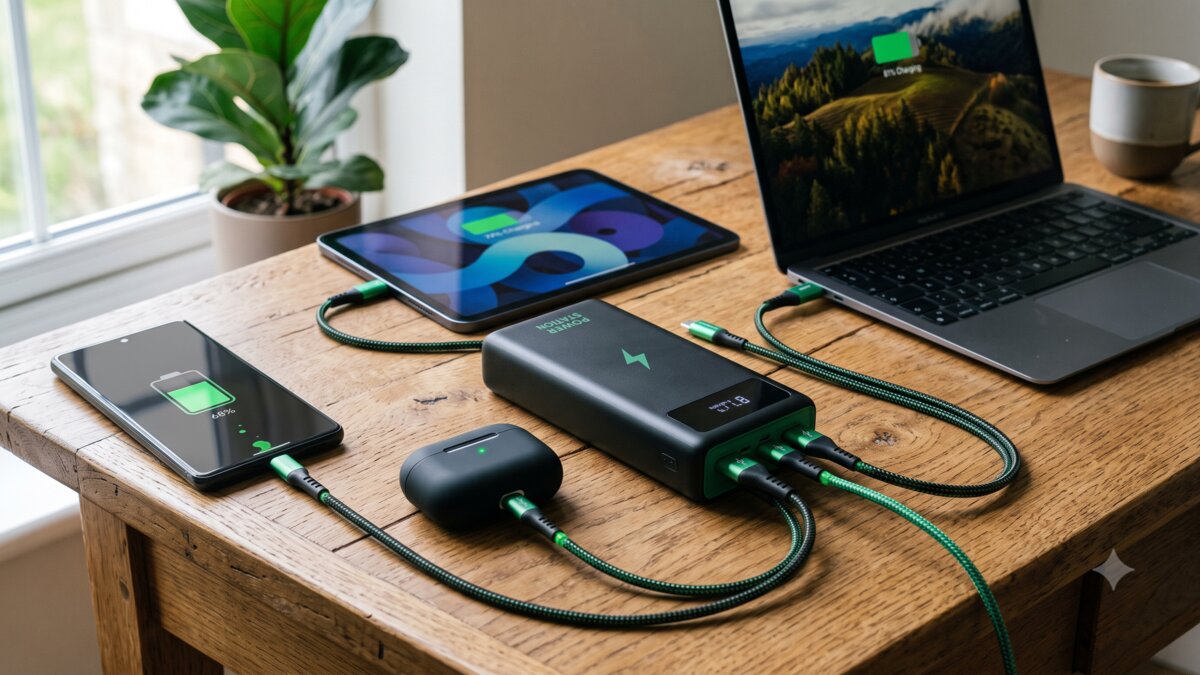
In practice, a 20,000 mAh power bank recharges roughly 3 smartphones, 1 to 2 tablets, or 6 to 7 e-readers from empty to full. For a phone on a daily basis, 10,000 mAh is plenty; for several days away with both tablet and phone, aim for at least 20,000 mAh. Our guide to choosing a power bank breaks down these capacity versus weight trade-offs.
Earbuds and smartwatches: tiny capacities that mislead
These are the most deceptive numbers. A true wireless earbuds case often stores only 1.5 to 2.5 Wh (both buds plus the case), and a smartwatch barely 1 to 1.5 Wh. Against a power bank's 74 Wh raw capacity, these figures look tiny, and they are: a small 5,000 mAh backup unit can recharge a smartwatch around twenty times, or a set of earbuds half a dozen times, before it runs dry.
Nintendo Switch, camera, GoPro: gaming and content on the go
Three devices of similar size, with one thing in common: nearly all of them now charge over USB-C, which makes life easier.
- Nintendo Switch (and Switch OLED): battery of about 4,300 mAh at 3.7 V, roughly ~16 Wh, very close to a smartphone. A 20,000 mAh power bank recharges it about 3 times, enough for a long train ride.
- Mirrorless camera: standard market batteries (such as NP-FZ100 or LP-E6 type cells) sit around 16 Wh as well, but watch out: many camera bodies only charge over USB-C while idle, not while shooting, and some older models only accept their dedicated mains charger. Check USB-C PD compatibility before relying on a power bank on assignment.
- GoPro-type action camera: more frugal, around 6 Wh per battery. A 20,000 mAh power bank recharges it around eight times, ideal for a full day of diving or multi-session mountain biking.
Drone: a deceptive capacity (and a trap to know about)
Hobby drone batteries (folding mini drone type) often show 2,500 to 2,600 mAh, but at a much higher voltage than other devices (7 to 15 V depending on the model), which works out to 17 to 20 Wh in real terms, more than a plain mAh figure would suggest.
Under these conditions, a 20,000 mAh power bank recharges around 2 drone batteries, a 27,000 mAh a bit over 3, plenty for stringing together several outdoor flights without a wall outlet.
Laptop: the one real limit of going portable
The laptop is where mAh math stops making sense: manufacturers state capacity directly in Wh (typically 50 to 60 Wh for an ultrabook, 80 to 99 Wh for a gaming machine or workstation), and it is this value you need to compare against the power bank's usable energy.
Two conditions have to be met, not just capacity:
- Power output: your laptop needs at least 60 W of USB-C Power Delivery, ideally 100 W, to charge at a normal pace. Below that, it charges slowly, or even keeps draining while you use it.
- Capacity: even with the 65 Wh usable from a 27,000 mAh power bank, you only get barely one full charge for an ultrabook (~55 Wh), and just a partial charge for a gaming machine (~90 Wh).
In short, for a laptop, a power bank mostly serves as a top-up (30 to 60 percent extra charge), not a full multi-day power solution. For heavier off-grid needs, our power stations category covers demands beyond what a power bank can offer.
The cheat sheet: charges by power bank size
Here is the summary of every calculation in this article, with an average efficiency of 65 percent applied to each power bank size. Values are rounded and given for reference: real-world results vary with battery age, temperature, and usage during charging.
| Device | Typical energy | 5,000 mAh | 10,000 mAh | 20,000 mAh | 27,000 mAh |
|---|---|---|---|---|---|
| Smartphone | ~16 Wh | ~1 | ~1 to 2 | ~3 | ~4 |
| Tablet | ~28 Wh | top-up | ~1 | ~1 to 2 | ~2 |
| E-reader | ~7 Wh | ~1 to 2 | ~3 | ~6 to 7 | ~9 |
| Earbuds (case) | ~2 Wh | ~6 | ~12 | ~24 | ~32 |
| Smartwatch | ~1.2 Wh | ~10 | ~20 | ~40 | ~54 |
| Nintendo Switch | ~16 Wh | ~1 | ~1 to 2 | ~3 | ~4 |
| Mirrorless camera | ~16 Wh | ~1 | ~1 to 2 | ~3 | ~4 |
| GoPro-type camera | ~6 Wh | ~2 | ~4 | ~8 | ~10 to 11 |
| Hobby drone | ~19 Wh | top-up | ~1 | ~2 | ~3 |
| Ultrabook laptop | ~55 Wh | top-up | top-up | ~1 (partial) | ~1 |
| Gaming/pro laptop | ~90 Wh | top-up | top-up | top-up | ~1 (partial) |
Number of charges estimated from a ~65 % conversion efficiency, on actually usable capacity. "Top-up" means less than one full charge.
Use the right tool: our calculator, product by product
These figures remain averages: your smartphone's actual capacity, your power bank's age, or your camera's exact voltage can shift the result by 10 to 20 percent. For a calculation tailored to your own gear, every product page in our power banks category includes a built-in charge calculator: pick your device from the list (or enter its capacity), and the estimated number of charges appears instantly for that specific power bank model.
It is the most reliable way to check, before buying, that a given capacity truly covers your use case (a weekend with phone and earbuds, a multi-day trek with a camera, a long-haul flight with a laptop), rather than trusting the raw mAh figure on the box.
What to remember
- Always convert to Wh (Wh = mAh × V ÷ 1000) to compare devices running at different voltages, and expect ~65 percent real-world efficiency from the power bank.
- Smartphone, Switch and mirrorless camera nearly overlap (~16 Wh): a 20,000 mAh power bank recharges each of them about 3 times.
- For a laptop, capacity alone is not enough: you also need at least 60 to 100 W of USB-C PD, and even 65 usable Wh covers only one charge, not several.
- For a result tailored to your own gear, use the charge calculator available on every product page.