
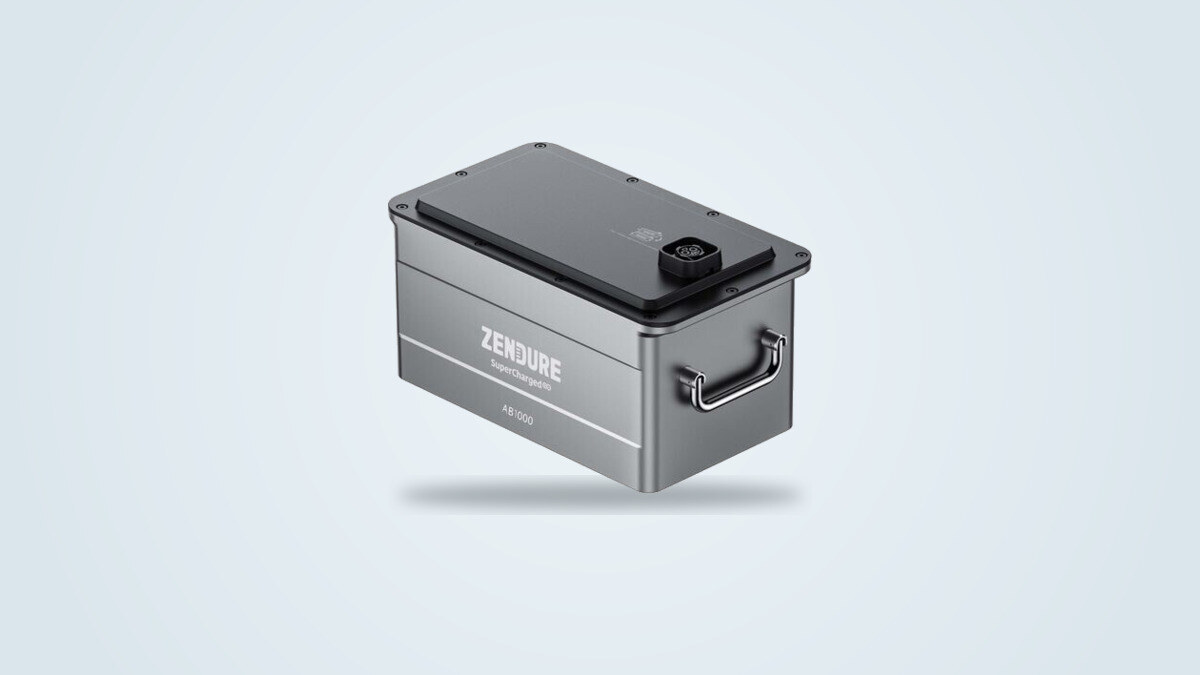
What the AB1000 really is: the smallest module, with no conversion electronics of its own
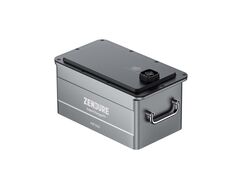
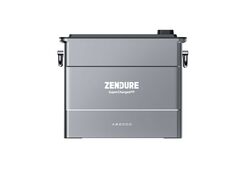
The AB1000 has no MPPT tracker, no inverter, and no output port usable on its own. It is a block of 960 Wh LiFePO4 cells (48V, 20Ah), a BMS and an aluminium shell with a built-in handle, nothing more. All the conversion work, whether capturing solar power or feeding current into the home, happens entirely on the hub side: the same architecture as the rest of the AB extension range.
Without a SolarFlow hub already installed, the AB1000 is useless on its own: no standalone mode, no direct output, no way to charge it straight from a panel. It is also, historically, the very first module in the AB range, launched in April 2023: it remains today the lightest and cheapest to buy in the whole Zendure extension battery family.
AB1000 or AB1000S: the nuance that changes cold-weather charging and fire safety
The AB1000 name actually covers two very close generations, sometimes sold at the same price on the manufacturer's own site. The original module, the one covered in this review, charges between 0 °C and 45 °C; discharging (everyday use) remains possible over a much wider range, from -20 °C to 45 °C. In practice, the battery can power devices in freezing weather, but refuses to accept a charge once the temperature drops below 0 °C, for lack of an active heating element.
The direct successor, the AB1000S, keeps exactly the same 960 Wh but adds two functions: active self-heating that extends charging down to -20 °C, and an aerosol fire suppression system that detects overheating or a short circuit and automatically puts out a starting fire. Launched at a price close to that of the AB1000 it replaces, the AB1000S does not cost more for these two extra functions. In other words, at much the same budget, checking which of the two modules is actually inside the box remains a useful habit before ordering.
System efficiency: the same conversion electronics as the rest of the range
Since the AB1000 converts nothing itself, real-world efficiency depends entirely on the hub it is connected to. Paired with a Hub 2000 or a Hyper 2000, two hubs also compatible with the range's AB2000 modules, the conversion electronics are exactly the same regardless of which storage module is plugged in: a 900W charge there delivers about 861W actually stored, a charging efficiency close to 95%, for a full round-trip efficiency that tops out around 80%.
This carries over honestly: the efficiency loss happens almost entirely in the hub's inverter and MPPT controllers, not in the storage module's own chemistry. Paired with the range's older, more compact hubs (the SolarFlow 800, for instance), however, no independent full-efficiency figure was found for that specific pairing: a reservation worth keeping in mind for anyone considering the AB1000 on this kind of entry-level hub rather than a Hub 2000 or Hyper 2000.
The real cost of storage: cheapest to buy, not cheapest per Wh
To buy, the AB1000 is unsurprisingly the cheapest module in the whole AB range: its listed price stays below all of its bigger siblings. But per Wh of capacity, the maths flips. At the price observed, the AB1000 works out to about 0.42 to 0.52 euro per Wh depending on the market, against 0.20 to 0.31 euro per Wh for the AB2000L and about 0.25 euro per Wh for the AB3000X, two newer, higher-capacity modules from the same brand.
| Module | Capacity | Cost per Wh |
|---|---|---|
| AB1000 (this product) | 960 Wh | About 0.42 to 0.52 euro |
| AB2000L | 1920 Wh | About 0.20 to 0.31 euro |
| AB3000X | 2880 Wh | About 0.25 euro |
This is not unique to Zendure: small storage formats almost always cost more per Wh than larger ones, since the management electronics and housing weigh proportionally more on a small module. But the gap found here (close to double) is worth keeping in mind before stacking several AB1000 units to reach a large capacity: beyond two units, comparing the total cost against a single AB2000L of equal or greater capacity becomes worthwhile.
Up to 3.84 kWh by stacking, and real compatibility with the AB2000 range
Each module adds 960 Wh to the system, automatically recognised by the hub. The ceiling stated by the manufacturer is four units, or 3840 Wh (3.84 kWh). Zendure also states compatibility between the AB1000 and the AB2000 series batteries, which allows mixing capacities rather than buying only identical modules, a useful flexibility for adjusting reserve capacity as needs or budget evolve.
For genuine evening autonomy (covering a fridge and a few evening appliances overnight, for instance), a single 960 Wh module is on the tight side: aiming for that kind of use tends to point towards the AB2000L or stacking at least two or three AB1000 units. The single module suits more of a top-up role (small devices, a laptop, lighting) or a first step before expanding the system later.
The widest hub compatibility in the SolarFlow range
Being the oldest module still listed, the AB1000 has had time to be validated on more hubs than its younger siblings. It is today the storage module with the widest hardware compatibility in the whole SolarFlow range, where the AB2000L is limited to the Hub 2000 and the Hyper 2000, and the AB3000X only works with one specific hub.
| Hub or station | Own solar input | Note |
|---|---|---|
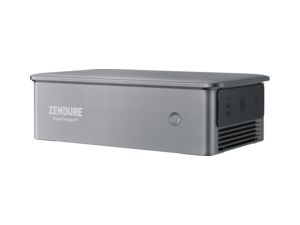
| SolarFlow 800 | Yes | The most compact hub in the range |
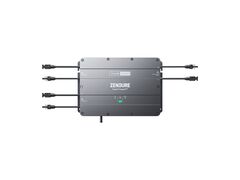
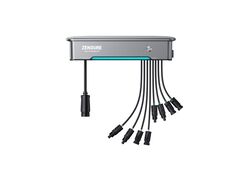
| Hub 2000 | Yes, 2 MPPT trackers, 1800W | No built-in inverter |
| Hyper 2000 | Yes, 2 MPPT trackers, 1800W | Built-in 1200W bidirectional inverter |
| ACE 1500 | Yes, both AC and solar inputs | Station with no built-in battery, an AB module is required |
This breadth of compatibility is a real strength for anyone who already owns an older or entry-level hub: unlike the AB3000X, locked to a single hub already superseded in the manufacturer's active range, the AB1000 keeps finding a place on both recent and older installations alike.
Safety and build: the generation before the full safety architecture
The AB1000 includes a BMS that continuously monitors cell voltage, current and temperature, with protection against overcharge, deep discharge and short circuits. What it lacks, unlike the newer modules in the range (AB1000S, AB2000L, AB3000X), is the aerosol fire suppression system that automatically detects overheating or a technical fault and puts out a starting fire without releasing toxic gas.
The manufacturer also rates the same module at 6000 cycles to 70% retained capacity, a less strict end-of-life threshold than the 80% figure, a more flattering way of presenting cell endurance. For comparison, the range's current S/L/X modules are rated for 6000 cycles to 80%, double the nominal endurance on this same measure.
A confirmed fire occurred in Germany on a Zendure AiO 2400, a different product from this one, attributed by the manufacturer to a contact fault at a solar MPPT input connector. That specific mechanism does not apply to the AB1000, which precisely has no solar connector of its own. No incident specific to the AB1000 has been identified to date. The module remains covered by a 10-year warranty on the cells, the same as the rest of the range despite its entry-level price.
Everyday reliability: minor software niggles, nothing widespread
Cases of the battery disappearing from the app, without being recognised by the hub, do occur and generally require a restart or a manual reconnection. A firmware update can also fail if the module's charge level is too low at the time, a situation that resolves by charging the battery before running the update again.
On temperature, one concrete case illustrates the model's limit well: an installation insulated in polystyrene was not enough to allow charging at -2 °C, exactly matching the stated 0 °C to 45 °C charging range. That is not a fault, it is the stated specification simply applying.
Who the AB1000 is for, and who should look elsewhere
This module is aimed first at anyone who already owns a SolarFlow hub, whichever one it is (including an older or entry-level model like the SolarFlow 800), and wants to add a modest reserve on a tight budget, or complete an existing setup with a light, easy-to-handle module. Its 10-year warranty and compatibility with AB2000 batteries make it a sound choice for that specific use.
It suits less anyone starting a system from scratch with a reasonable budget to spend: at much the same price, the AB1000S brings active self-heating and aerosol fire suppression for the same capacity, and the AB2000L offers a noticeably better cost per Wh for anyone after genuine evening autonomy. For a first purchase, checking exactly which module is actually in the box (AB1000 or AB1000S) remains essential, as both sometimes circulate at the same price from the same retailer.