
What the 40,000mAh (154Wh) really mean
The packaging and the product page both carry two figures side by side: 40,000mAh, and 154Wh. The first is the pack's total charge, counted at a cell voltage close to 3.85V. The second is the energy it actually represents, the figure that lets you compare two batteries running at different voltages. Xtorm publishes both values together in its official manual, which at least avoids the most common mix-up on this kind of product: converting a milliamp-hour figure into watt-hours without ever stating the voltage used.
The chemistry is lithium-polymer (LiPo), not the lithium iron phosphate (LiFePO4) used in some of the larger power stations in this catalogue. LiPo packs more energy per kilogram but generally tolerates fewer full charge cycles before losing capacity. Xtorm does not publish a guaranteed cycle count for the XR204, only a duration-based warranty (see further down this review).
Set against the 809g quoted for the complete unit (reinforced casing and electronics included), that energy works out to a density of roughly 190Wh per kilogram. That's a good figure for an external battery of this capacity: the comparison with the other picks in this round-up appears further down. No independent lab has published a measurement of the energy the XR204 actually delivers once conversion losses are accounted for: that precise figure, available for other batteries in this catalogue, is missing here. What can be stated without reservation is that 154Wh of real capacity is easily enough to recharge a smartphone a good ten times over, or a laptop two to three times depending on how much it draws.
That 154Wh figure has an immediate practical consequence for anyone travelling: it exceeds the 100Wh threshold usually allowed in cabin baggage without paperwork. Between 100 and 160Wh, most airlines require prior approval and cap carriage at two batteries maximum, never in the hold. The XR204 sits right in that intermediate bracket, a point worth checking before a flight rather than after packing the suitcase.
The real power split across the three ports
The XR204's spec sheet shows 100W in bold, and the figure is accurate, under a condition the official manual documents in black and white but the marketing copy does not highlight: that port only delivers 100W when it's the only one in use. The moment a second port comes into play, whichever one it is, its power drops to 65W. The manufacturer's manual publishes a full breakdown for all three ports: a first USB-C PD port (up to 100W alone), a second USB-C PD port (20W), and a USB-A Quick Charge 3.0 port (18W, up to 22.5W with Samsung's SCP protocol).
The most useful detail sits in the last row. With all three ports active, port 1 holds 65W, but ports 2 and 3 together get just 15W, roughly 7 to 8W each depending on the split. That's enough for a smartwatch or wireless earbuds, nowhere near enough to charge two phones at a decent speed at the same time. The most favourable pairing remains port 1 and port 3 together, which totals 87.5W, exactly the figure Xtorm quotes as the maximum combined output on the product's spec sheet: that headline figure is therefore only reachable in this exact two-port configuration, never with all three.
Rugged and IP64: what the rating actually covers
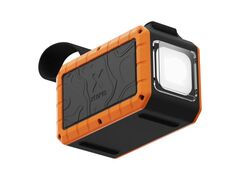
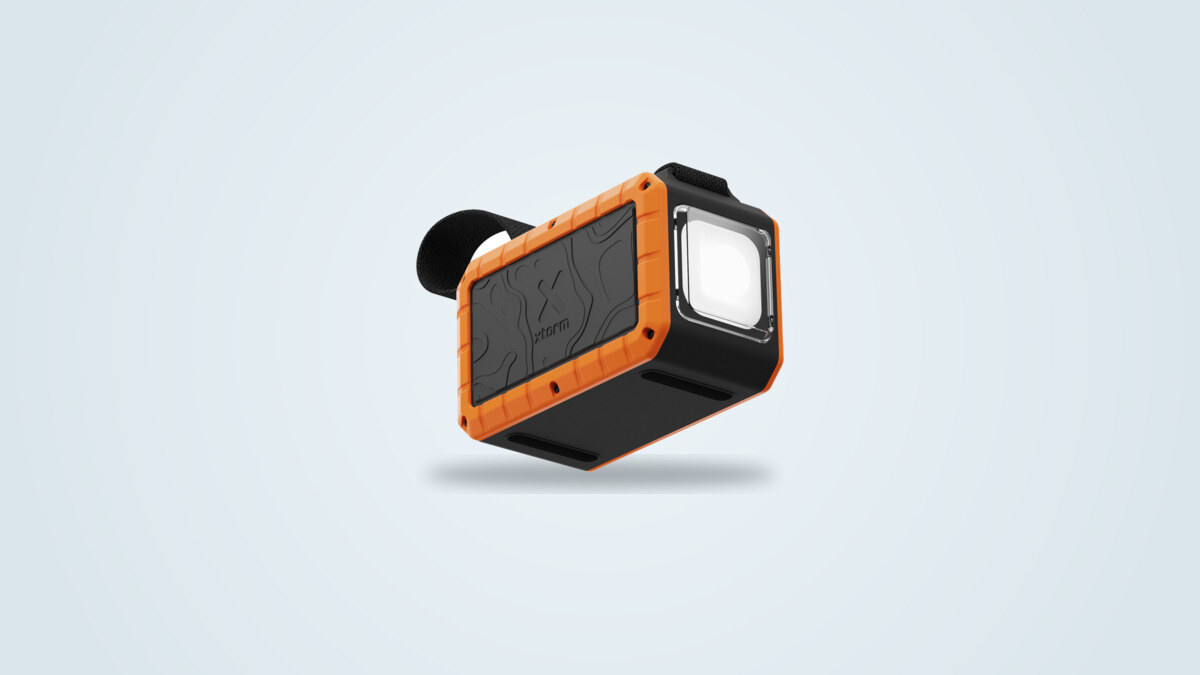
The XR204 belongs to the Xtreme Series, sold under the Rugged name, with a recycled-polycarbonate-and-TPU shell, reinforced corners and an adjustable strap handle. The rating it carries is IP64. That code is worth reading carefully, because it doesn't say what most people assume it says.
The first digit of an IP rating (6) covers dust: it is the highest possible value on that scale, total protection against dust ingress. The second digit (4) covers liquids, and it is far more modest: it covers splashing water from any direction, not jets, not immersion, not prolonged heavy rain. An IP64 shell copes very well with a dusty environment (job site, trail, beach), and shrugs off a shower or a splash, but should not be dunked in water or hit by a direct jet.
| Rating digit | What it protects against | What it does not cover |
|---|---|---|
| 6 (dust) | Total protection against dust | Nothing more to protect on this axis: it's the top of the scale |
| 4 (liquids) | Splashing water from any direction | Water jets, prolonged heavy rain, immersion even briefly |
One distinct point, often confused with water resistance: impact resistance. An IP rating, whatever its digits, never measures resistance to a drop. It only measures ingress protection. To certify impact resistance, a manufacturer needs a separate standard, the best known being the MIL-STD-810 family (drop height, number of faces, temperature). Xtorm publishes no such standard, nor any drop-height figure, for the XR204: the Rugged label here rests on the casing's design (thick shell, prominent polycarbonate corners) and on the commercial line's name, not on a certified, published drop result.
Recharging itself: 3 hours 30 minutes on a single port
The XR204 only accepts input through one port, the same USB-C PD port that also serves as the main output. Xtorm quotes a full recharge in 3 hours 30 minutes (210 minutes) with a 65W charger, the maximum input the unit accepts. That's the manufacturer's own figure; no independent measurement of the actual charging time, or of the shape of the curve (plateau, slowdown near the end), has been found for this specific model.
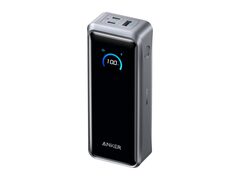
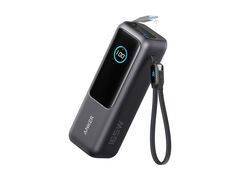
Set against its capacity, this figure places the XR204 among the slower-charging batteries. As a direct comparison, two picks in this round-up refill noticeably faster for a smaller capacity: the Anker A1695 (90Wh) reaches a full charge in 1 hour 57 minutes with a peak at 92W, and the Anker Prime 26250 (around 100Wh, 300W) recharges in under an hour thanks to an input that accepts up to 250W. The XR204 stores more energy than either of those two models, but with an input capped at 65W, it needs proportionally far longer to fill up.
Pass-through charging, which lets a connected device keep charging while the XR204 itself recharges, is supported. Since only one input port exists, the question of priority between several chargers plugged in at once, which comes up on batteries with multiple USB-C inputs, simply doesn't apply here.
Smart display and four-mode torch
The XR204's display shows the remaining charge percentage, the current power on each of the three ports (both input and output), and an estimate of the time left before charging or discharging finishes. That's a level of detail on par with the best batteries in this round-up, and well beyond a simple set of LEDs. In the manufacturer's own visuals, one example screen shows 35W on the first port and 18W on the second used at the same time, a split consistent with the sharing table documented above.
The built-in torch offers four modes, cycled through with successive presses of a dedicated button: a spot beam for lighting up something far ahead, a softer ambient light for a bivouac or a tent, a flashing mode, and an SOS signal. Xtorm discloses no lumen figure for this torch, nor any runtime for each mode independent of the battery's own charge level: that's data the manufacturer does not publish, and no independent source has filled the gap for this model.
809 grams: what that energy reserve weighs
809g on the scale, in a 140 x 70 x 90mm shell: the XR204 is nothing like a pocket battery, and doesn't try to hide it. It's an item you slip into a backpack or keep in a vehicle, not something carried daily in a pocket.
Set against the energy it carries, the sum works out more favourably than it first appears. At 190Wh per kilogram (154Wh declared for 809g), the XR204 sits ahead of two of the three direct rivals in this round-up on that measure, and is only beaten by the Anker Prime 26250, lighter but also less capacious.
This result comes down mainly to what the XR204 doesn't have: no built-in cables, no output above 100W per port, two things that usually add weight to a battery without adding stored energy. The reinforced IP64 shell, conversely, adds weight without adding energy either: the density achieved here reflects a fairly different set of trade-offs from its rivals, not a particular feat on the cells themselves.
Against three direct rivals
Priced at around £105 depending on the retailer, the XR204 goes up against several high-capacity power banks. Here is how it stacks up against three picks already featured in this round-up, on the criteria that actually matter when buying.
| Criterion | Xtorm XR204 | Ugreen 300W 48000mAh | Anker Prime 26250 | Anker A1695 |
|---|---|---|---|---|
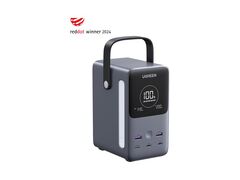
| Declared capacity | 40,000mAh (154Wh) | 48,000mAh (154Wh) | 26,250mAh (≈ 100Wh) | 25,000mAh (90Wh) |
| Maximum power (1 port) | 100 W | 140 W | 140 W | 100 W |
| Maximum combined power | 87.5 W | 300 W | 300 W | 165 W |
| Weight | 809 g | ≈ 1637 g | 600 g | 595 g |
| Energy density | 190 Wh/kg | 94 Wh/kg | 166 Wh/kg | 151 Wh/kg |
| Impact/weather rating | IP64 | None | None | None |
| Built-in light | Yes, 4 modes | Plain LED | No | No |
| Quoted full recharge | 3h30 (65 W) | Not published | Under 1h (250 W) | 1h57 (92 W peak) |
The table sums up the XR204's position fairly well: it isn't the most powerful on any raw-power criterion, but it's the only one of the four to combine an IP rating with a built-in torch, and it beats the Ugreen by a wide margin on energy density despite a similar price. Against the two Ankers, lighter and quicker to recharge, its edge lies in raw capacity and outdoor-ready features, not speed.
Build, brand and warranty
Xtorm is a Dutch brand, published by Telco Accessories BV, based in Houten in the Netherlands; design is Dutch, manufacturing is Chinese, an arrangement common across most of the sector. The manufacturer declares a set of internal protections for the XR204: a temperature-control chip, overcharge protection, automatic power management shared across the ports, short-circuit protection, and cells described as premium grade. These are manufacturer statements, not independently verified results.
The standard warranty runs 24 months. Xtorm offers to extend it to 36 months (2 years plus 1) through product registration within three months of purchase, a free step but one that needs to be remembered to benefit from it. The XR204 sold for the European market complies with the EU's RoHS and electromagnetic-compatibility directives, as well as the 2023 EU Battery Regulation.
The XR204 remains a fairly little-discussed model compared with the best-selling picks in this round-up, which limits how statistically meaningful any customer feedback is at this point. No recurring fault, repeated failure, or recall is documented for this model, but that lack of a negative signal rests on a still-limited volume: a nuance worth keeping in mind rather than a flaw in the product itself.
Real-world uses: camping, power cuts, job sites
The XR204's positioning is clearly outdoor and emergency-focused, not everyday city use. Three concrete situations show where its mix of capacity, ruggedness and torch actually earns its keep.
Camping or a multi-day hike: 154Wh keeps several phones and a camera topped up for days with no access to mains power, and the built-in torch means one less light to pack separately. In a campervan or van, the IP64 rating tolerates the damp and dust of outdoor storage better than an uncertified battery would. During a power cut at home, the capacity is enough to keep a router, phones and backup lighting running for an extended stretch, and the 100W USB-C port alone can fast-charge a laptop to keep working.
On a job site, finally, dust resistance (the top of the scale on that side of IP64) and the strap handle make it easier to carry and use in a messy environment, where an uncertified everyday power bank wouldn't hold up as well over time.
For more everyday use, its 154Wh recharges a modern smartphone roughly seven to eight times depending on its battery size, a figure in line with the usual estimates for this capacity class. That's comfortably enough for a long weekend without recharging the XR204 itself, provided its weight and bulk are acceptable.
Who it's for, and who should look elsewhere
The XR204 suits anyone after a large energy reserve for outdoor use or emergency backup at home, and willing to carry 809g to get it. Its 154Wh, IP64 rating and built-in torch make it a sound pick for camping, van life, job sites or power-cut preparedness, uses where none of the three direct rivals in this round-up offers the same complete package.
It also suits anyone who mainly charges a single large device at a time: in that configuration, the main port genuinely delivers its full 100W, without any of the restrictions documented above.
It suits less well anyone who regularly charges several demanding devices at once: the power drop from the second port onward, and even more so the 15W ceiling shared across three ports, work against that use case. It also suits less well anyone wanting a battery that refills quickly: 3 hours 30 minutes for a full charge, through a single input port capped at 65W, puts the XR204 noticeably behind several rivals of comparable or even lower capacity. Finally, anyone after a genuine impact-resistance certification, beyond the Rugged commercial name, won't find one documented here.