
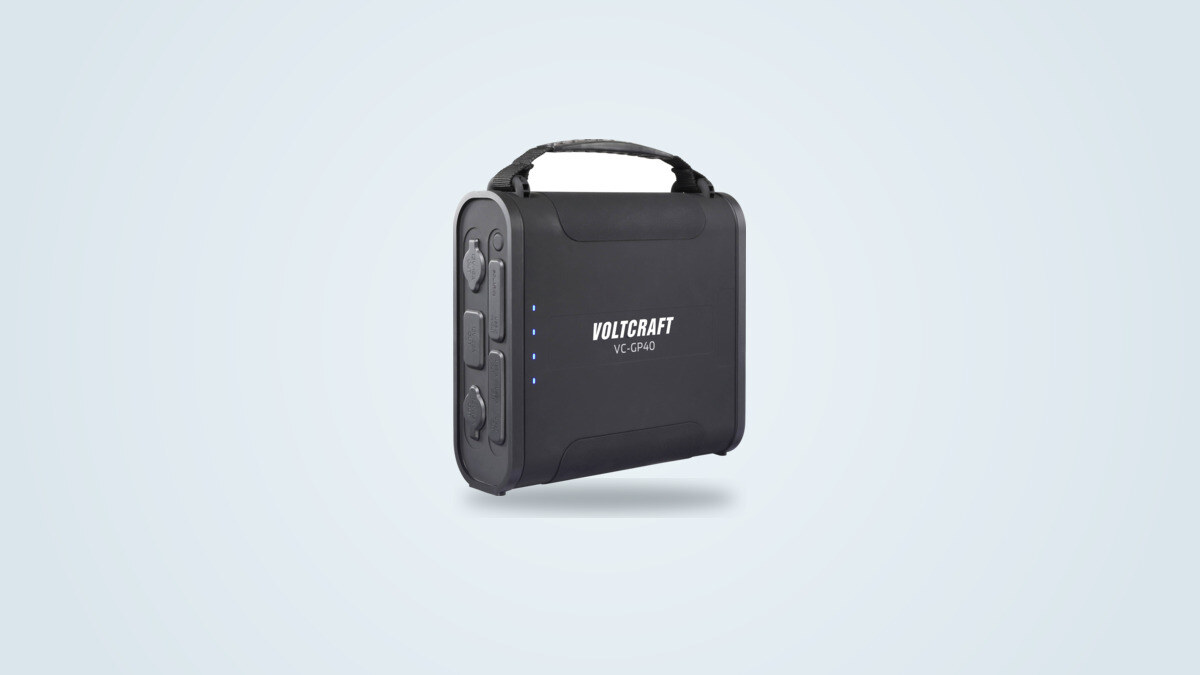
460 Wh, but three different figures for one battery
The VC-GP40's own documentation disagrees with itself. The catalogue listing and the retailer's main sales page both advertise 144,000 mAh. The same retailer's detailed technical datasheet, for the same EAN 4064161491257 and the same product (4.573 kg, 380 x 220 x 81 mm, an identical case across every visual), states 36,000 mAh instead. An exact factor-of-4 gap, on the same unit.
A milliamp-hour does not measure energy, it measures a quantity of charge. Turning it into energy means multiplying it by a voltage, and that voltage is exactly what differs between the two figures. The VC-GP40 uses LiFePO4 cells, whose nominal voltage per cell is 3.2 V. Multiplying 144,000 mAh by 3.2 V gives 460.8 Wh. The complete pack, though, runs at a nominal 12.8 V, the voltage of a 4-cell series arrangement, the same one that feeds its 12 V cigarette-lighter-style outputs. Multiplying 36,000 mAh by 12.8 V gives exactly the same result, 460.8 Wh. Both figures describe the same energy, counted at two different levels of the same pack: the single cell for one, the 4-cell series block that actually powers the unit for the other.
| Figure | Value | What it describes |
|---|---|---|
| Commercial capacity | 144,000 mAh | Total charge, counted at 3.2 V, a single LiFePO4 cell's nominal voltage |
| Stored energy | 460 Wh | What the pack actually contains, whichever mAh figure is used |
| Real pack capacity | 36,000 mAh | The same charge, counted at 12.8 V, the voltage of the 4-cell series pack that powers the unit |
Only the retail listing where the unit is actually in stock at the time of checking defaults to the 36,000 mAh figure. The 96,000 and 144,000 mAh options, wherever they appear, stay marked as unavailable. That is not conclusive proof, but it is one more clue that 36,000 mAh at 12.8 V is how the maker describes its own pack internally, while 144,000 mAh is the conversion chosen for the shop window, a far more striking number to place next to an ordinary phone power bank.
On substance, this 460 Wh figure puts the VC-GP40 in a class of its own within its own catalogue category. The best-equipped 45,000 mAh power bank already reviewed on this site tops out at 166.5 Wh, and a 48,000 mAh model at 153.6 Wh. The VC-GP40 therefore stores 2.7 to 3 times more energy than the largest conventional power bank in the catalogue, inside a case that no longer has much in common with them, as the chart below shows.
A shape that no longer has anything to do with a pocket power bank
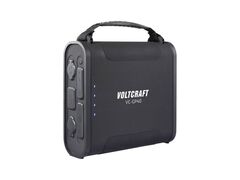
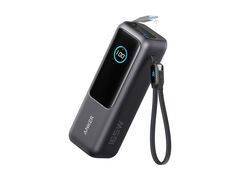
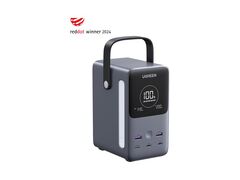
460 Wh does not fit inside a phone-sized case. The VC-GP40 weighs 4.573 kg for 380 x 220 x 81 mm, with a rigid carry handle and a supplied bag rather than a slip pocket. Against other products in the site's power bank category, the gap is stark: 5 times the weight of a 48,000 mAh Ugreen 300 W (1.637 kg), 6 times an Xtorm Fuel Series 5 (722 g), almost 8 times an Anker A1695 (595 g). This is not a manufacturing flaw, it is the direct result of two deliberate choices: a capacity three times higher than the rest of the category, and LiFePO4 chemistry that is less energy-dense than the conventional lithium-ion used by those three rivals.
| Product | VC-GP40 | Ugreen 300 W 48000mAh | Xtorm Fuel Series 5 | Anker A1695 |
|---|---|---|---|---|
| Weight | 4573 g | 1637 g | 722 g | 595 g |
| Energy | 460 Wh | 153.6 Wh | 166.5 Wh | 90 Wh |
| Density | 100.6 Wh/kg | 93.9 Wh/kg | 230.6 Wh/kg | 151.3 Wh/kg |
That last row puts the numbers in perspective. Per kilogram, the VC-GP40 is not badly placed at all: it even beats the Ugreen 300 W, which also has to carry the weight of a 300 W output without the benefit of LiFePO4 chemistry. It stays well behind the Anker A1695 and especially the Xtorm, whose conventional lithium-ion cells store more than twice as much energy per kilogram. That is the well-known trade-off of this chemistry: more thermally stable and longer-lasting over time, it is also mechanically less compact for the same energy. The VC-GP40 does not hide it, it simply carries that trade-off at the scale of a pack three times bigger than the average of its category.
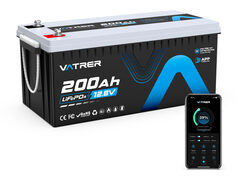
The fairest comparison may not be with a power bank at all, but with a bare 12 V LiFePO4 battery meant for solar kits or van conversions, the same chemistry and the same pack architecture. A battery of that kind, at 200 Ah/2560 Wh, sells for around £0.12 per stored Wh, with no port, no screen and no case protection thrown in: it is a component to integrate, not a finished product. The VC-GP40 costs more per stored Wh (£0.35), but it adds the connectors, the display, the handle and the protection a bare battery does not have. The most honest way to place it is at the junction of two families: too heavy and bulky to compete with a pocket power bank, too sparsely equipped to replace a real station.
The real port layout, beyond the word “Anderson”
The product listing mentions a “Large Anderson 300 W output” alongside “two 12 V sockets”. The retailer's official photos, shot from several angles, show a completely different layout: three round cigarette-lighter-style outputs, clearly labelled on the case itself, none of them shaped like the rectangular two-pin plug of a genuine Anderson Powerpole connector. The three outputs read 12V/15A OUT, 12V/25A OUT and 12V/15A OUT. It is the 25 A output, and only that one, that reaches 300 W (12 V x 25 A). The other two cap out at 180 W each (12 V x 15 A).
The rest of the port selection does match the listing: two USB-A outputs, one USB-C port that works as both a charging input and output (Power Delivery 3.0, up to 100 W), a second output-only USB-C port, and a dedicated “SOLAR-IN” port for a solar panel of up to 100 W, separate from the mains input tucked under its own cover. A central button handles power and the LED light.
The overall picture stays favourable: seven usable outputs (two 12 V at 15 A, one 12 V at 25 A, two USB-A, two USB-C) plus a dedicated solar input, a wide range for the category, wider than most power banks limited to a single 100 W USB-C port. The one real grey area concerns power sharing between the two USB-C ports when both are used at once: neither the listing nor the retailer's documentation states whether each can deliver 100 W at the same time or whether the two share a combined total, a question only a physical test could settle.
300 W in practice: what it can actually power
On paper, 300 W of continuous output is enough for most demanding nomadic devices: a laptop through its own charger adapted to 12 V, a compressor fridge in a converted van (typically 40 to 80 W), a camper van ceiling fan, a 12 V water pump, or several small USB devices at once. That is real power, available on a single DC output, where most power banks in the category cap out at 100 or 140 W over USB-C.
The practical limit is not the power, it is the cable. The 12V/25A output is a round cigarette-lighter-style socket, a format that most devices designed for a genuine Anderson plug or a direct battery connection cannot accept without an adapter. For campervan or van life use, where the 12 V cigarette-lighter socket is already the de facto standard, this is a non-issue. For plugging in an external inverter or a device with a native Anderson connector, the right cable has to be sourced separately, as the product's stated box contents do not appear to include one.
The 100 W USB-C, meanwhile, comfortably covers full-speed laptop charging, including power-hungry models normally supplied with a 90 to 100 W mains charger. Combined with the 460 Wh reserve, and ignoring any conversion losses, that is, in theory, enough to fully recharge a laptop with a 60 Wh battery more than 6 times over before the VC-GP40 runs dry, or to run a small 45 W fridge continuously for around 10 hours.
Charging: the 100 W ceiling
Both the mains and the solar input on the VC-GP40 cap out at 100 W. Neither the product listing nor the retailer's documentation publish a full charge time, which is itself a gap for a product at this price. The maths is straightforward: filling a 460 Wh tank through a tap capped at 100 W takes at least 4 hours 36 minutes, on the unrealistic assumption of a constant input power from start to finish. In practice, as with any lithium battery, the current it can accept falls as the cell voltage climbs towards the end of the charge: a real full charge is likely to take 6 to 7 hours, a duration no public measurement currently allows to confirm more precisely.
This is one of the few areas where the VC-GP40 falls clearly behind much smaller power banks: a 20,000 to 25,000 mAh battery typically recharges in 1 to 2 hours over a high-power USB-C input. Here, the trade-off for a reserve 3 to 5 times larger is a mechanically longer fill time, with no fast-charge option to offset it.
The dedicated solar input, also capped at 100 W, changes the picture for off-grid use: hooked up to a 100 W portable panel in full sun, it can rebuild a meaningful share of the reserve in a single day, without relying on a mains socket. That is an advantage almost no conventional power bank in the category offers, most accepting only mains or USB-C input.
The LED bar and the light: less screen, more light
The product listing advertises an LCD screen. The retailer's official photos, across every visible face of the case, show nothing of the sort: the charge level is shown by a vertical bar of 4 blue LEDs, a 25 %-per-step system like most power banks on the market, not a digital display detailing a precise percentage, an instantaneous power draw or a temperature. This is a second approximation in the official documentation, after the mAh figures, and it is worth correcting before buying for anyone specifically after a detailed readout.
The built-in light, on the other hand, is more generous than the term “LED torch” suggests. In the official photos, it is a large rectangular light panel spanning the full width of one side of the case, closer to a camping lantern's light block than a narrow torch beam. Enough to light up a table or the inside of a tent with no extra accessory, even though no official figure states its brightness in lumens or its own runtime.
Why no mains socket?
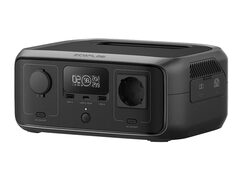
The VC-GP40 has no inverter and therefore delivers no 230 V mains power at all. That is the structural difference that sets it apart from a true power station, and it explains a good part of its price. An EcoFlow River 3, with its 245 Wh, 300 W output and built-in mains socket, is priced at £159.00 on this market, which is actually £3.38 less than the VC-GP40 despite storing barely more than half its reserve. On the Eurozone and US markets the relationship flips the other way, with the River 3 costing more: the inverter that turns the pack's 12 V DC into 230 V AC has a cost, in components and in weight, and how that cost lands against a bigger LiFePO4 pack clearly varies by market.
The consequence for the buyer is clear either way: any device with a simple mains plug, an ordinary phone charger, a kettle, small kitchen appliances, cannot be plugged directly into the VC-GP40. Only USB devices, native 12 V devices (van fridges, lighting, pumps) and those fitted with the right cable for the 25 A output can draw from it. That is a sound trade-off for campervan or van life use already wired for 12 V, and a far more limiting one for anyone hoping to use it as a general-purpose home backup unit.
Against the category's benchmarks
Against the Anker A1695, the current reference in the power bank category, the VC-GP40 wins comfortably on capacity (460 Wh against 90 Wh) and on the variety of its ports (12 V outputs and a solar input that neither Anker version offers), but loses clearly on portability (4.573 kg against 595 g) and on interface polish, the A1695 detailing its cells' health where the VC-GP40 makes do with 4 LEDs. The two products do not answer the same need, which explains a rating gap that owes nothing to any manufacturing shortcoming on either side.
Against the Ugreen 300 W 48,000 mAh, the comparison is more direct: both claim a 300 W output. But the review already published on this site documents a real-world delivery of around 65 % of the Ugreen's rated capacity, a gap its Li-ion chemistry alone does not fully explain. No equivalent measurement exists yet for the VC-GP40, and LiFePO4 cells generally deliver a better share of their rated energy than conventional lithium-ion, but the lack of a measured figure means it cannot be claimed that the VC-GP40 does better on this specific point. It clearly does better on price per stored Wh, though: around £0.35 against £0.89 for the Ugreen.
Against a bare 12 V LiFePO4 battery meant for solar kits, already well rated on this site (4.3 for a 200 Ah unit storing 2560 Wh), the VC-GP40 costs more per stored Wh, £0.35 against £0.12, but it comes with the connectors, the display and the protection that a bare battery leaves entirely to the installer. The product is judged here against a tougher yardstick than that bare battery, which has no USB port, no screen and no output to protect.
Brand, warranty and reliability
Voltcraft is the house brand of Germany's Conrad group, an electronics and test-instrument retailer that has traded since 1923. It traditionally covers measurement gear and workshop electronics rather than nomadic consumer products, newer ground for the brand. The VC-GP40, launched in April 2026, has only a few months of commercial history at the time of writing.
No product recall or recurring fault has been found for this model. That needs to be kept in perspective, though: the product does not currently appear on any major general retail marketplace, and no independent test site or specialist forum has yet published a usable account of it. The absence of reported problems is an honest positive signal, not a guarantee built on a meaningful volume of feedback.
Two things do count in the product's favour: a 3 year manufacturer warranty, well above the 12 to 24 months usual for this kind of product, and LiFePO4 chemistry, recognised for its thermal stability and for lacking the documented thermal-runaway risk that sometimes affects conventional lithium-ion in the event of a cell fault.
Who the VC-GP40 suits, and who it does not
The VC-GP40 targets three specific uses, and covers them well: campervans and converted vans already wired for 12 V, where its shape can be set down once rather than carried daily; home backup during a power cut, keeping USB or 12 V devices running for hours or even days; and extended nomadic remote work, where its reserve can recharge a laptop and peripherals several times over with no mains access.
It does not suit anyone after a power bank to carry daily in a bag: its weight and bulk confine it to a semi-fixed setup. Nor does it suit anyone needing to power a device with a standard mains plug, for lack of an inverter, or anyone who values an ecosystem already backed by independent testing and a broad history of user feedback, which this very recent product does not yet offer.