
On paper: a station that grows with your needs
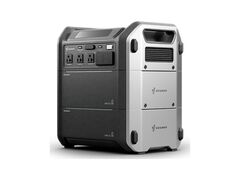
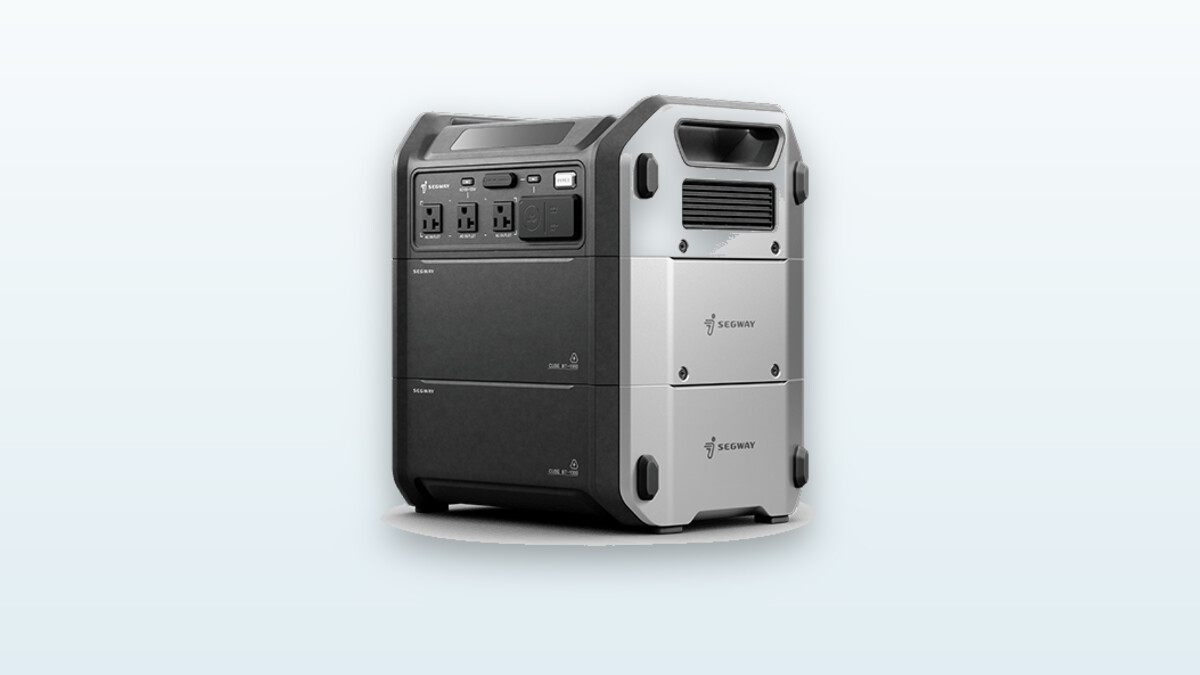
With 2048 Wh of rated capacity, an automotive-grade UL-certified LFP battery and the option to expand up to 5120 Wh with additional 1 kWh blocks, the Segway Cube 2000 targets households and professionals who want to grow their energy reserve without switching stations. It delivers 2200 W continuous across three mains sockets with pure sine wave output, complemented by a cigarette lighter socket, two 100 W USB-C ports and four USB-A ports, for twelve outputs in total. A full mains recharge takes around 1h48, and the solar input accepts up to 800 W with MPPT tracking.
The 4400 W boost mode: limited to resistive appliances
The mode that unlocks a 4400 W peak, known as R-Drive, is not a simple universal power surge: it is explicitly limited by the manufacturer's official documentation to resistive appliances, such as a kettle or a hair dryer, and excludes motor-driven or high-demand appliances such as lawnmowers, air conditioners, coffee machines, tumble dryers, hotplates and microwave ovens, with the recommendation to test compatibility before any extended use. This restriction is identical to the one already documented on the Cube 1000, as both models share the same inverter and the same electronic architecture.
The real cost of expandability
The economics of the modular system hold up: at the price seen, the base unit works out to around 0.88 € per Wh, and a BTX-1000 extension block to around 0.91 € per Wh, barely 3.6% more. Pushing the configuration to its maximum capacity of 5120 Wh (three blocks added to the base unit) comes to just under 4600 €.
The difficulty is not the price, it is access: the BTX-1000 block is currently nearly impossible to find in France, available from a single retailer with stock counted in single units, absent from this product's main sales partner as well as from the manufacturer's official store. The promise of modularity therefore remains, for now, more theoretical than practical for a buyer in France.
Weight: a real issue once the blocks are stacked
The base unit weighs 26.1 kg, already noticeably more than most rival stations of comparable capacity. Each extension block adds around another ten kilos of its own, which makes a full-capacity configuration considerably harder to move than to set up once and leave in place. The manufacturer also offers, in certain markets, a transport trolley dedicated to the Cube range, an accessory that would have no reason to exist if weight were not a real concern once the station is installed.
IPX3: a more limited protection than the outdoor imagery suggests
The complete unit is IPX3-certified, a level that protects against occasional water splashes but not against prolonged rain exposure or immersion. The battery pack alone carries a higher rating (IP56), but it is the rating of the complete unit that actually defines what it can withstand outdoors. This level of protection sits at odds with the camping and outdoor job-site imagery used in the product's marketing: the Cube 2000 is better suited to sheltered or semi-permanent use than to direct, prolonged exposure to the elements.
Charging and the backup function
A full mains recharge, at a maximum power of 1250 W, takes around 1h48, a figure consistent with the official specification. The UPS function switches over to battery power in 20 to 30 ms during a mains outage, a delay typical of what is known as an offline UPS: the mains outage is indeed detected and then compensated for, but this is not zero-millisecond electrical continuity, worth keeping in mind for equipment that could not tolerate any interruption at all, however brief.
Connectivity: the clearest strength
With twelve outputs in total, three mains sockets with pure sine wave output, two 100 W USB-C ports, four USB-A ports, two DC5525 outputs and a cigarette lighter socket, the Cube 2000 covers a wide range of needs without requiring adapters. The Segway-Ninebot Bluetooth app gives access to charge monitoring and remote control within Bluetooth range, with no WiFi for control from further away.
Reliability: blind spots worth knowing about
No independent measurement is available to date to confirm this unit's real-world efficiency or noise level. Another point of caution: no spare parts are listed as available for this model to date, which raises questions about the options in the event of a failure after the 5-year warranty ends. Both of these reservations echo those already documented on the Cube 1000, a model in the same range sharing the same electronic architecture.
The price actually charged
The price seen is 1801 € for the base unit, in stock at the partner retailer. This price level has been stable for at least a year and a half on the French market. The BTX-1000 extension block, when available, sells for around 930 €.
Who it suits, who it does not
It suits anyone setting up a fixed backup reserve at home or on a semi-permanent job site, who values the robustness of automotive-grade LFP chemistry and complete connectivity, and who accepts dealing with substantial weight once the station is in place.
It does not suit anyone looking for genuine everyday mobility (26.1 kg and more with the blocks), anyone counting on the advertised modularity as an immediate purchasing argument rather than a theoretical one, nor anyone who needs waterproof protection for prolonged outdoor use.