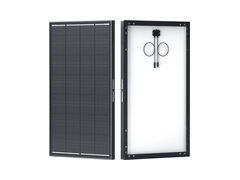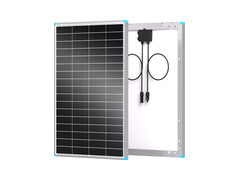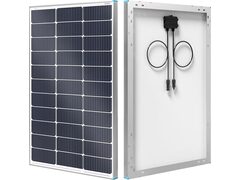

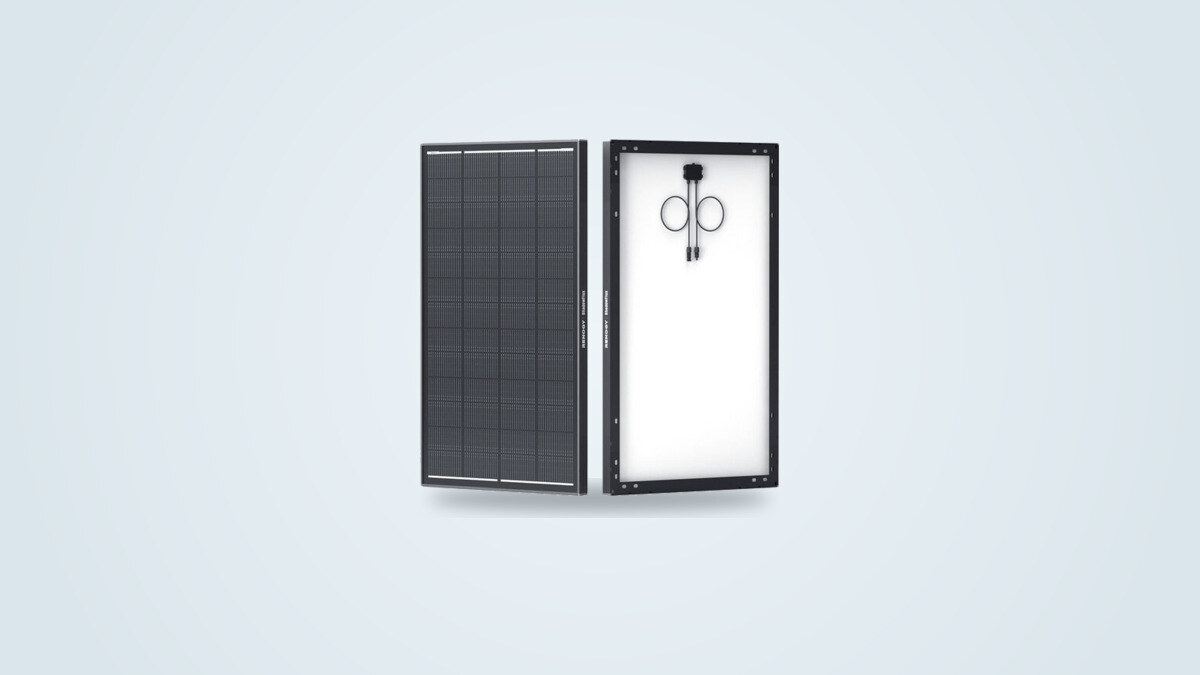
What the ShadowFlux technology actually changes
On a conventional solar panel, cells are wired in series and grouped into three large sections, each protected by a single bypass diode. If just one cell falls into shadow, its entire section gets bypassed: the panel instantly loses a third of its output over a few square centimetres of cover. That is the structural weak point of photovoltaics on a cluttered roof, and it is exactly what the ShadowFlux targets.
The module is split into 28 independent zones, each with its own diode. A localised shadow now knocks out only a fraction of the surface rather than a whole third of the panel: the finer the electrical subdivision, the less a local shadow penalises the whole. The principle rests on straightforward series-wiring physics rather than a marketing angle unique to Renogy, and the same kind of fine segmentation shows up on other manufacturers' panels too.
Renogy claims up to 85% more output in these conditions against a conventional panel. That is a manufacturer figure, valid in the best case for the brand (a thin, well-placed shadow), not an average across every condition: the next section breaks down what that actually means, limits included.
Thin shadow, wide shadow: two very different behaviours
The mechanism plays out differently at two shading scales.
Under a thin, localised shadow (a line, the edge of a roof vent, an aerial mast), the power loss stays broadly proportional to the area covered. A shadow covering roughly a tenth of the panel's surface cuts output by about that much, a world away from the disproportionate collapse of a conventional three-diode panel, where the same thin shadow can cut output by more than 90% by taking out an entire section.
Once a wider shadow covers several cells at once, though, say a tree branch crossing the panel, output still drops sharply. Across a pair of panels from this range wired together, output falls to around 35W under wide shade, against more than 300W in full sun.
The physical reason lies in the series wiring: on a conventional panel, one shaded cell forces its low current onto its entire section, which can hold twenty-odd healthy cells forced to idle along with it. With 28 sections instead of 3, each section only holds a handful of cells: a shaded cell then drags down a far smaller group, which is why the loss tracks the actual shaded area far more closely.
N-type cells at 25%: what holds up beyond the headline figure
The N-type cell is not a Renogy exclusive: it is the generation succeeding PERC across the whole photovoltaic industry. Two advantages come up consistently, regardless of brand. The first concerns heat: a PERC cell, boron-doped, suffers from light-induced degradation that worsens with heat, while an N-type cell, phosphorus-doped, does not show that mechanism.
The ShadowFlux's power temperature coefficient sits at -0.29%/°C, a figure that directly reflects that advantage: for every degree above 25 °C, the panel loses only 0.29% of its output, against -0.35% to -0.40%/°C for a typical PERC panel. On a vehicle roof where surface temperature regularly tops 60 °C in summer, the cumulative gap adds up to several points of output.
| Panel | Coefficient | Estimated loss at 60 °C |
|---|---|---|
| Renogy ShadowFlux 200W | -0.29%/°C | ≈ 10.2% below rated output |
| Typical PERC panel | -0.35% to -0.40%/°C | ≈ 12.3% to 14% below rated output |
This remains an arithmetic projection from published manufacturer coefficients, applied to a 35 °C gap above the 25 °C reference: not a measurement on two panels placed side by side at the same time, only the gap the respective spec sheets allow to calculate.
The second advantage concerns degradation over time. Renogy covers module output for 25 years with an 80%-retained commitment at that point, a pace more favourable than typically associated with a standard PERC cell, even if the track record on this consumer cell generation remains shorter than PERC's, which has been deployed for longer. The 16 busbars (against 5 to 9 on a conventional panel) also cut resistive losses and limit the impact of a micro-crack, for the same reasons already established on the Renogy 16BB from the same cell range.
Format and weight: a density on par with the 16BB, not a standalone selling point
At 1262 x 764 x 30mm for 10.81kg, the ShadowFlux takes up around 0.96 m² for 200W installed, a density of roughly 208W per square metre of roof. That is a good figure in absolute terms, but it owes nothing to ShadowFlux technology as such: the Renogy 16BB 175W, which shares the same N-type cell technology but not the anti-shading split, posts a near-identical density, around 206W per square metre.
| Panel | Power | Surface | W/m² | g/W |
|---|---|---|---|---|
| Renogy ShadowFlux 200W | 200W | 0.96 m² | ≈ 208 | ≈ 54 |
| Renogy 16BB 175W | 175W | 0.85 m² | ≈ 206 | ≈ 55 |
| Renogy 100W rigid | 100W | 0.50 m² | ≈ 200 | ≈ 59 |
| EcoFlow 100W flexible | 100W | 0.65 m² | ≈ 155 | ≈ 23 |
The flexible EcoFlow panel stands out on an entirely different axis: at just 23g per watt against 54 to 59g for the three rigid panels, it is by far the lightest, a direct result of its glass-free, frameless build. It pays for that with a lower surface density (155 W/m² against 200 to 208 W/m² for the rigid panels, which make better use of every square centimetre of roof) and typically a shorter working life at equal cell technology.
Against the other two rigid panels from the same maker, the ShadowFlux brings no format or weight advantage: its added value sits entirely in the anti-shading split described above, not in a better density.
MC4 connectors and voltage stability under partial shade
The ShadowFlux uses IP67-rated MC4 connectors, the near-universal standard across the solar industry. Its open-circuit voltage of 36.5V and its voltage at maximum power point of 31.3V for 6.86A sit within the input range of almost every 12V and 24V MPPT controller on the market, which generally accept noticeably higher voltages to leave headroom for cold weather.
The zone split brings a second benefit, less visible on a spec sheet: by keeping more cells active under partial shade, the module's output voltage stays steadier than on a conventional panel, where a fully bypassed section swings the available voltage sharply. An MPPT controller locks onto its maximum power point more easily on a stable voltage than on one jumping between values with every passing cloud or moving shadow.
One practical point for anyone with an existing setup: wiring this panel in series with existing PERC modules of a different optimum voltage can slightly cap the whole string at the weaker module's level, exactly as with the 16BB from the same maker. The safest option remains wiring it to its own MPPT input where the controller offers more than one.
Installation: weight and weatherproofing worth planning for
At 10.81kg for 1262 x 764mm, the ShadowFlux is manageable alone without major difficulty but is large enough to benefit from a second pair of hands when positioning it on a sloped roof or in a light breeze. The panel does not ship with mounting brackets: that is a separate purchase, common enough for this kind of product but worth budgeting and timing for.
On weatherproofing, the manufacturer's spec sheet quotes IP67 for the panel and connectors as a whole. An IP68 figure, a step up, also circulates for this same model on some pages without official Renogy documentation confirming it: better to go with the IP67 the manufacturer states and clarify the point before a heavily exposed install, a marine one especially.
The quoted operating range, -40 °C to 85 °C, comfortably covers conditions found on a vehicle roof across a European winter and summer alike. Low-iron tempered glass, a corrosion-resistant aluminium frame and the junction box round off a build that follows the sector's proven standards.
Build quality, warranty and what the spec sheet actually confirms
Construction follows the standards already detailed above. Renogy covers materials and workmanship for 5 years and guarantees 80% of rated output at 25 years, a pace in line with recent market benchmarks rather than above them: several rivals quote 10 to 12 years on materials alone, double this panel's cover.
The language used around the electrical split sometimes goes further than what the spec sheet lists: product communications mention dynamic current routing and switching in 0.01 seconds, wording that suggests active control electronics. The spec sheet itself, though, sticks to a bypass-diode architecture, a standard junction box and no additional active component listed. A bypass diode physically reacts within a fraction of a microsecond once forward-biased, which makes the claim technically true while dressing it in wording closer to electronics marketing than to the description of an actual extra onboard component.
No safety recall has been found for this model. An older recall concerns a foldable flexible panel from a completely different generation (overheating risk, 2016), unrelated to this rigid, tempered-glass build.
Renogy also now sells part of its ShadowFlux range under the complementary REGO branding, with no specification difference identified for this particular model between the two names.
Pricing and where it sits against the rest of the Renogy range
The price observed in the UK sits around £234, against roughly £144 for the 16BB 175W from the same maker using the same cell technology. The gap, close to £90, comes neither from efficiency (near-identical) nor from density per square metre (equivalent), but entirely from the 28-zone anti-shading split.
| Criterion | Renogy ShadowFlux 200W | Renogy 16BB 175W | Renogy 100W rigid |
|---|---|---|---|
| Price observed | ≈ £234 | ≈ £144 | ≈ £66 |
| Bypass diodes | 28 | 3 | 3 |
| Module efficiency | 20.7% | 20.6% | 20% |
| Materials warranty | 5 years | 5 years | 10 years |
Per watt, the ShadowFlux remains an expensive panel: around £1.17 per watt against £0.82 for the 16BB. That premium only makes sense if the roof in question genuinely faces recurring partial shade (an aerial, a roof vent, a roof rack). On a clear roof, the 16BB offers near-identical base efficiency for noticeably less, and the 100W rigid from the same maker goes further still on the materials warranty (10 years against 5) for anyone who needs neither the power nor the anti-shading split.
Who this panel suits, and who it does not
The Renogy ShadowFlux 200W suits first and foremost anyone fitting a panel onto a campervan, van, boat or shed roof that is already partly taken up by an aerial, a roof vent, a rack or a flue, in other words a roof where a thin, localised shadow recurs at some point most days. The 28-zone split brings a genuine gain there, consistent with the physical mechanism behind this segmentation, not just a manufacturer claim.
It suits less well anyone with a completely clear roof and no predictable source of shade: the 16BB from the same maker offers near-identical base efficiency for noticeably less. It also does not suit anyone dealing with a wide, permanent shadow (a nearby tree covering a large part of the roof all day), a case where output drops sharply whatever panel sits underneath. Finally, anyone after a portable, foldable format for nomadic use should look at a flexible or foldable panel rather than this rigid, 10.81kg module.