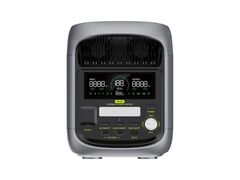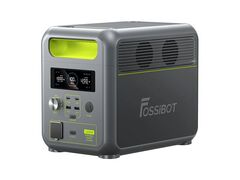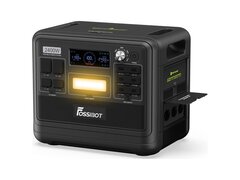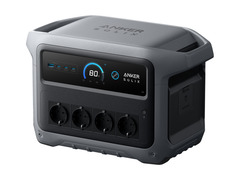

On paper: the same capacity as the F1200, 600W more
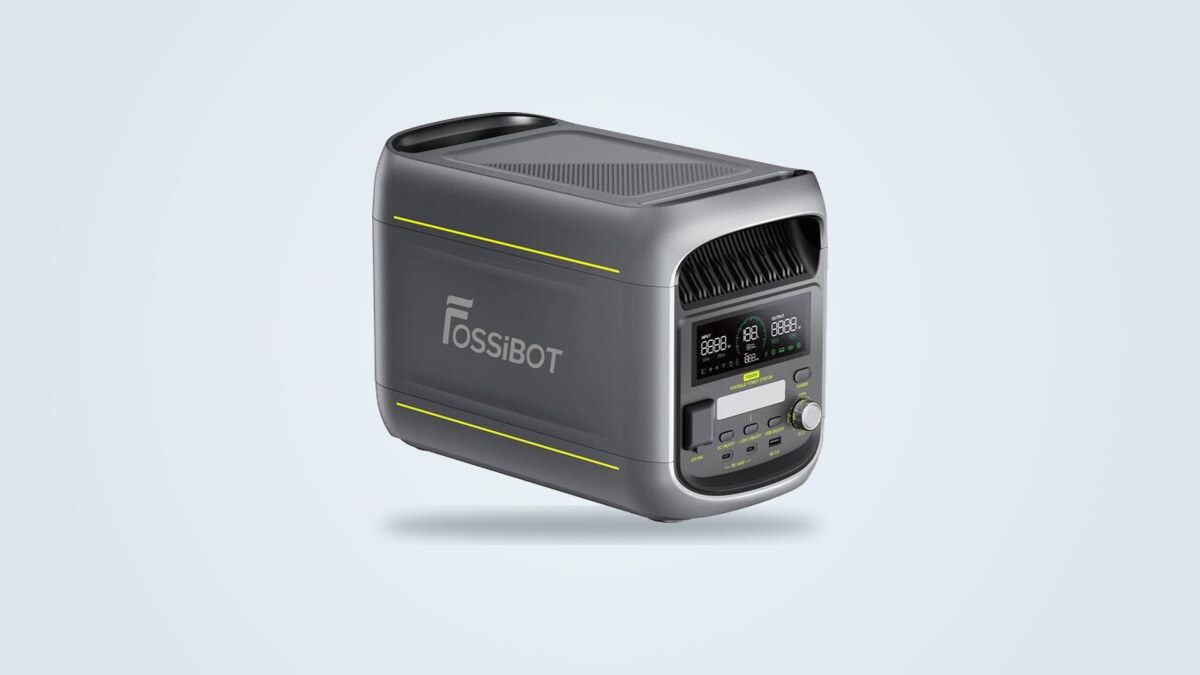
The Fossibot F1800 is a 1024Wh portable power station with a LiFePO4 battery, sitting between the F1200 and the F2400 in the manufacturer's range. It matches the F1200's capacity exactly, but delivers 1800W continuous instead of 1200W, 600W more for a modest price difference. It also adds what the F1200 lacks entirely: a WiFi and Bluetooth control app, a third AC outlet, and a warranty rated at 5 years.
Launched in April 2026, the F1800 occupies a precise spot in the Fossibot catalogue: more versatile than the F1200 for demanding home or off-grid use, without the F2400's 22kg (48.5lb) or price tag. The observed price sits around £471, with some variation depending on the period and promo codes.
2700W or 3600W surge: two official figures for the same unit
The Fossibot F1800's surge power rating is not agreed upon, even within the manufacturer's own documentation. Most sales channels, including the US version of the official site and most marketplaces, list 2700W for 400ms. The official French product page and its German counterpart, however, list 3600W: exactly double the 1800W continuous rating, the same ratio shown for the other stations in the range (1200W/2400W for the F1200, 2400W/4800W for the F2400). Neither page mentions the other figure, and nothing suggests these are two materially different hardware versions.
In practice, this matters little as long as the unit is only asked for under 1800W continuous: that figure does not vary across any source checked. The gap only matters when starting a device with a high inrush current (a compressor, a motor, a power tool), during the fraction of a second the station is supposed to absorb the surge. With no way to settle which figure is correct, it is safer to plan around the more cautious of the two, 2700W.
One last point is worth flagging for anyone comparing figures found online: in Japan, the same F1800 is sold with continuous output capped at 1500W (3000W surge claimed), a common adaptation for that market's 100V mains. The figures in this review apply only to the European and American version rated at 1800W, the only one sold in the markets covered here.
Mains recharging: the clearest strength over the F1200
On mains power, the Fossibot F1800 goes from 0 to 80% in 45 minutes and reaches roughly 100% in 68 minutes, thanks to an adjustable input of up to 1200W. That is faster than the F1200, which takes 49 and 70 minutes respectively for the same milestones, with a lower maximum input power (1000W). The gap is not huge, but it points the same way as the rest of the spec sheet: the F1800 does better than its same-capacity sibling on nearly every objective criterion.
On solar, the input caps at 500W (12 to 60V, a single MPPT tracker), for a full charge in about 2 hours in full sun according to the official documentation. Via a 12V car socket, expect around 9 hours, a normal figure given the low power available from that type of outlet, best treated as a top-up rather than a primary charging method.
Two 140W USB-C ports, unless you use them together
The Fossibot F1800 has two USB-C ports rated at 140W each, plenty for charging a laptop very quickly. The official documentation, however, spells out a condition that does not appear in the marketing copy: that 140W figure only applies if a single port is in use at a time. As soon as both are drawing power at once, each one drops to 5V and 3A, about 15W, a tenth of the advertised figure.
For everyday use, charging one device at a time over USB-C is not a problem. The limit shows up when trying to fast-charge two laptops, or two power-hungry devices, at the same time: the only options are then to use an AC outlet instead, or accept a very slow charge across both USB-C ports at once. The rest of the port selection includes one 18W USB-A port (versus two on the F1200) and a 12V/10A (120W) car-style output.
The WiFi/Bluetooth app the F1200 and F2400 do not have
This is the most visible difference from the rest of the Fossibot range at comparable capacity: the F1800 is controlled from a WiFi and Bluetooth mobile app, while the F1200 and F2400 are both limited to a screen and physical buttons, with no connectivity at all. The app lets you monitor charging remotely, set the mains charging power (400W, 800W or 1200W), and turn on an ECO mode.
This ECO mode prioritises the battery or available solar power and only switches to mains once the charge drops to 10%, according to the official documentation. The manufacturer pairs it with a claimed saving of up to £110 a year on the electricity bill, by reducing a standby draw stated at around 15W when the unit stays plugged into the mains without being used. That estimate depends heavily on local electricity prices and how much time the station genuinely spends idle: it should be read as the manufacturer's own ballpark figure, not an independent measurement.
A genuine capacity extension, wired by hand
Unlike the F1200 and the F2400, the Fossibot F1800 accepts a capacity extension through an external lead-acid or lithium battery, at 12, 24 or 48V, up to 15A. That is a rare feature at this price point, one that in theory allows going beyond the standard 1024Wh without buying an entire second station.
The condition attached to this feature is worth knowing before buying: the connecting cable is not included, and wiring it is left to the buyer. No official information specifies a recommended cable reference or a detailed wiring diagram beyond the manual's general guidance. For anyone wanting something usable straight out of the box, this is therefore not the station's most accessible feature; for anyone comfortable with a bit of electrical wiring, it is genuine headroom that neither the F1200 nor the F2400 offers.
1800W continuous: what happens beyond that
The distinction between surge power (a few hundred milliseconds, at the start-up of a motor or compressor) and continuous power (what the unit can sustain in ongoing operation) is key to understanding the F1800's real limits. A purely resistive load, such as a hot plate or an electric heater, draws its full rated power continuously from the moment it is switched on: it therefore never benefits from the surge rating, which is reserved for brief current spikes.
A resistive load of 2500W, above the 1800W continuous rating, trips the unit's overload protection; it becomes usable again after being switched off and back on. That behaviour matches what a properly working protection circuit should do: it suggests the 1800W continuous limit is real and actively enforced, rather than a marketing figure that could be exceeded without consequence.
In practice, the F1800 easily powers a computer, a compressor fridge, a router, a power tool, or a moderately powerful kettle. It reaches its limit with high-power resistive appliances (an induction hob at full power, an electric heater above 1800W, an oven) used alone at full load, or combined with other devices already drawing power.
What no independent measurement confirms
Several figures the manufacturer highlights currently rest entirely on its own documentation, with no independent measurement found during this research.
The UPS switchover time, claimed at under 10ms, has not been the subject of any independent, instrumented measurement found here. The noise level, claimed at around 30dB below 200W of discharge and under 35dB at 600W (measured from over one metre away, according to the manufacturer), has likewise not been checked by any measurement outside the brand; the user manual, for its part, sets a normal operating ceiling of under 60dB, a notably higher figure that appears to cover the entire charging range, fan at full speed included, rather than just the low-power use case highlighted in marketing.
No independent measurement has established how many watt-hours are actually usable out of the claimed 1024Wh, either. Unlike the F1200 or the F3600 Pro from the same brand, this real-world usable capacity figure is therefore not published in this review: the rated capacity and the LiFePO4 chemistry of the cells are not in question, but the inverter's actual efficiency across the charging range remains, at this point, an area with no reliable data.
Warranty: 5 years that hold up, on a model still new to the market
The manufacturer's stated warranty is 5 years (60 months). That duration is consistent between two separate official pages from the manufacturer: the user manual, which explicitly sets 60 months of warranty for quality defects under normal use, and the manufacturer's warranty policy for portable power stations on the European market, which now places the F1800 in the same 5-year tier as the F800, the F1200, the F2400, the F3600 Pro and the F7200. On the American version of that same policy, however, the F1800 is not named in any category as of this writing, which does not allow the same duration to be confirmed for a purchase made through the US service.
No recall or safety notice mentioning this model was found. The LiFePO4 battery is rated for more than 4000 cycles to 80% capacity, a figure that stays consistent from page to page, unlike the uncertainty around the surge power rating. The official operating ranges run from -10 °C to 40 °C (14 °F to 104 °F) on discharge, and 0 °C to 40 °C (32 °F to 104 °F) on charge. One thing the warranty does not offset: the F1800 has only been on sale since April 2026, leaving no meaningful reliability track record either way.
Against the F1200 and the F2400: the right size in the right place
The F1800 occupies a very precise spot in the manufacturer's range, between a simpler, cheaper F1200 and an F2400 that is twice as heavy and noticeably pricier.
| Criterion | Fossibot F1800 | Fossibot F1200 | Fossibot F2400 |
|---|---|---|---|
| Capacity | 1024Wh | 1024Wh | 2048Wh |
| Continuous power | 1800W | 1200W | 2400W |
| Mains charge 0 to 80% | 45 min | 49 min | not stated |
| App / Bluetooth | Yes (WiFi and Bluetooth) | None | None |
| AC outlets | 3 | 2 | 3 |
| Capacity extension | Yes, external battery | No | No |
| Weight | 11.25kg (24.8lb) | 11.5kg (25.4lb) | 22kg (48.5lb) |
On connectivity and control, the F1800 is the only one of the three with an app: neither the F1200 nor the F2400 has one, an absence independently established on each of the two other models. That is a strong argument for anyone who wants to monitor consumption remotely or schedule charging, a feature neither of the other two sizes in the range offers. On the other side, the F2400 keeps a clear edge on raw capacity and on a high-current 12V output the F1800 lacks, while the F1200 remains the cheapest of the three for anyone who does not prioritise power or the app.
Who it suits, and who it does not
It suits anyone who wants more power and connectivity than the F1200 without moving up to the F2400's size and price: home backup for hungrier appliances (an induction hob, a microwave, power tools), remote work on the go with a laptop that needs a quick top-up, or camping and van life with a need to check status remotely through the app.
It suits less anyone who needs to charge two power-hungry devices over USB-C at the same time, or who needs to know the exact surge rating with certainty before plugging in a device with a high inrush current: the two official figures available (2700W and 3600W) do not settle the question. It is also a poor fit for anyone after more than 1024Wh of storage without going through a self-wired extension, an extra step the F2400 avoids by offering double the capacity directly in a single unit.