
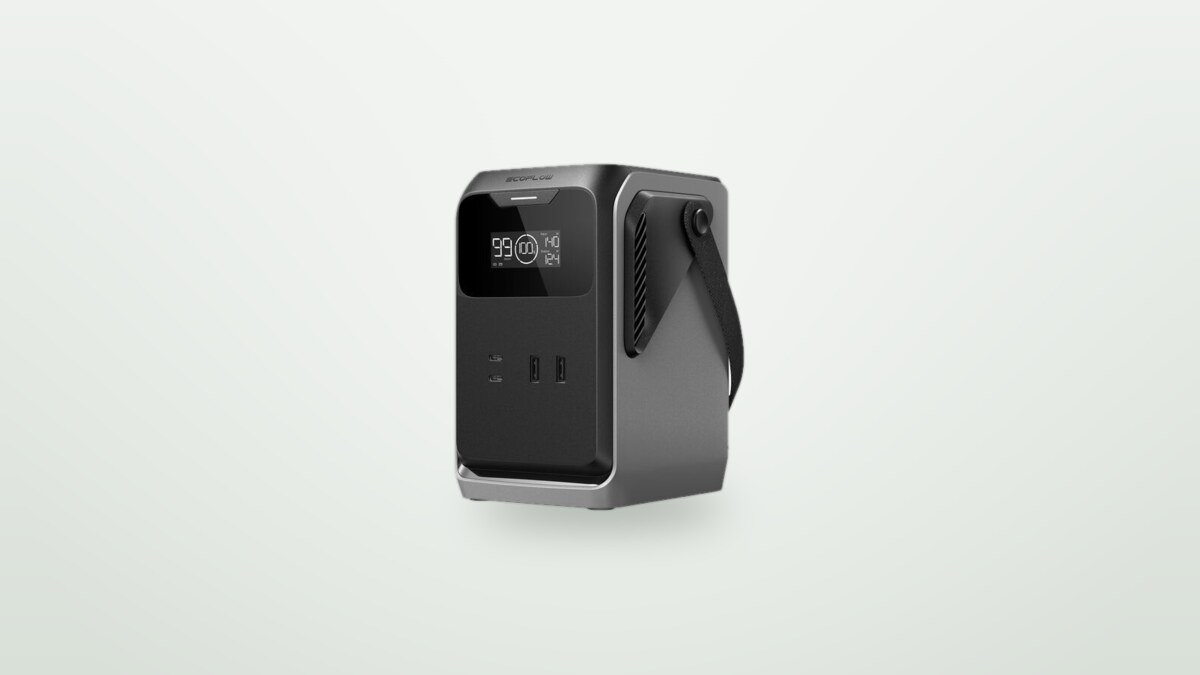
No 12 V car port, no dedicated solar input, despite what the name suggests
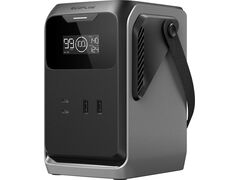
The manufacturer's official documentation is clear on this exact point: the Trail 200 DC's spec table explicitly lists no car port and no dedicated solar input. Its only outputs are one 140 W USB-C port, a second 100 W USB-C port (both bidirectional, able to either charge a device or recharge the station itself), and two 12 W USB-A ports.
Contrary to what a quick glance at the lineup might suggest, neither the 12 V car port nor the dedicated solar input is shared between the two models: both belong to the Trail 300 DC (288 Wh), which has a genuine 12 V car port (120 W max) for both input and output. Charging the Trail 200 DC from a car therefore means using a USB-C adapter plugged into the vehicle's own cigarette lighter socket, not a direct 12 V cable. In the same way, a solar panel can only charge it if the panel itself has a USB-C output, just like any other USB-C device: it has no optimised solar input and no dedicated port for it.
Inverter-free efficiency, plausible in principle, never confirmed by measurement
The core argument behind the Trail lineup is architectural: by removing the inverter that converts the battery's DC current into 230 V AC, the station skips a conversion step and the losses that come with it, powering devices directly over USB instead. The physical principle is not in question: one less conversion mechanically means fewer losses.
The manufacturer states a discharge efficiency of around 95 %, presented as roughly 12 percentage points better than a classic inverter-based architecture. That precise figure, however, no longer appears on the manufacturer's current product page, and no calculation method is published anywhere to back it up: it should be treated as an indicative order of magnitude, not a verified measurement. No independent measurement of the Wh actually delivered by this specific station has been found either.
220 W combined, 140 W on the main port, never measured under sustained load
The maximum advertised discharge power is 220 W combined, with a 140 W ceiling on the main USB-C port (Power Delivery). That figure fits a portable use case: enough to run a demanding laptop or fast-charge a tablet, while leaving headroom for a second device on the secondary 100 W USB-C port or the two 12 W USB-A ports. The manufacturer claims compatibility with around 90 % of common portable electronics that run on USB today, a plausible estimate given how widespread USB-C charging has become on recent laptops, but it remains a marketing claim rather than a verified inventory.
No independent measurement has been found confirming that this 140 W is genuinely sustained rather than a peak figure, or that the station holds its power output without thermal throttling during extended use at full load. That remains a point to verify in the field rather than an established fact.
A small built-in display does show the remaining charge percentage, an estimated number of hours of runtime, and the wattage received on input and delivered on output: enough to track the split between ports without an app or a wireless connection.
Fast charging claimed, but the marketing figures have shifted over time
At launch, the manufacturer highlighted an 80 % charge in 57 minutes using both 100 W USB-C ports at the same time. The current product page communicates differently, advertising a full charge in about one hour through the single 140 W port alone. Both figures remain physically consistent with each other (charging through two ports at once is logically faster than through one), but this shift in how the number is communicated shows these are marketing values rather than a fixed, verified measurement.
No independent, timed verification of these charging times has been found for this specific model.
Silent by design, with no fan and no inverter
No inverter also means no trace of the characteristic AC-conversion hum, and the manufacturer's official documentation confirms a fanless design. In principle, that makes it a station that is silent by construction rather than through active optimisation.
This review deliberately carries no dedicated noise scoring axis: no decibel measurement has been found for this model, and the site's scoring grid never awards points on the basis of a manufacturer claim alone. That axis's weight is redistributed across the other criteria instead of inventing a figure.
IP30: dust protection only, no water resistance
The IP30 rating covers dust only (first digit) and offers no protection against water at all (second digit at 0). Despite marketing built around outdoor adventure, the station itself does not resist rain or splashes: the manufacturer even sells a separate waterproof carry case, an implicit admission that the bare unit is not meant for moisture.
A second point is worth clarifying: the UN38.3 certification highlighted in the product's marketing is an air-transport standard for lithium batteries (covering vibration, shock, and altitude resistance during air freight), not a consumer drop test. The drop resistance claimed elsewhere is not backed by any published test protocol or any independent measurement that could be found.
No recall identified, but still a very short track record
No product recall and no widespread manufacturing defect has been found specifically for the Trail 200 DC. The brand has been the subject of an official recall on a completely different model (a large inverter-based station unrelated to the Trail lineup), not to be confused with the product covered in this review.
The battery's LiFePO4 chemistry is recognised for its longevity, and the commercial warranty runs for 3 years. Since the product has only been on sale for about ten months at the time of writing, no multi-year field feedback is available yet: the question of long-term durability remains open.
The manufacturer's official documentation also states a very low charge loss at rest, around 5 % per month of storage without use. That figure is consistent with LiFePO4 chemistry, known for a slower self-discharge than a typical lithium battery, but it too has not been cross-checked by any independent measurement so far.
A niche of its own within its lineup, with no true rival elsewhere
Within EcoFlow's own lineup, the Trail 200 DC has no real direct rival at its own size from other brands: comparable 100 % DC stations from other manufacturers tend to sit closer to the size of its bigger sibling, the Trail 300 DC (288 Wh), rather than the 200 DC (192 Wh). Comparing the 200 DC directly against stations 40 to 50 % larger would skew the judgment.
| Criterion | Trail 200 DC | Trail 300 DC | River 3 |
|---|---|---|---|
| Capacity | 192 Wh | 288 Wh | 245 Wh |
| 230 V AC outlet | No | No | Yes (300 W) |
| 12 V / dedicated solar port | No | Yes (120 W max) | No |
| Weight | 1.83 kg | 2.58 kg | 3.4 kg |
This table only cross-references official specifications, no performance measurements: the River 3 remains the only one of the three with a genuine AC outlet, at the cost of noticeably higher weight and without the two Trail models' 100 % DC architecture. The choice between the two families comes down to a simple trade-off: the River 3 covers a wider range of devices (AC included) in a bulkier package, while the Trail models bet everything on lightness and USB efficiency at the cost of reduced versatility.
What 192 Wh get you in practice, by calculation rather than measurement
Without an independent measurement of the capacity actually delivered, a simple calculation from the known specifications gives a rough order of magnitude: 192 Wh through the USB-C output is enough to fully recharge a current smartphone (11 to 20 Wh of battery depending on the model) around ten times, or a laptop (50 to 60 Wh) three to four times, before the station itself needs recharging. This calculation assumes a favourable conversion efficiency and does not replace a field measurement, which does not exist for this model as of now.
For photography, video, or light bivouac use, this amount of energy covers about one day of modest, everyday use (camera body, phone, small light) rather than a full long weekend with no intermediate recharge at all.
Who it suits, and who it does not
It suits anyone looking for an ultra-light energy reserve for exclusively USB devices (phone, camera, drone, small laptop) while hiking or camping, who is fine relying only on USB ports, with no AC outlet and no 12 V port at all.
It does not suit anyone who needs a 12 V car port or a dedicated solar input (the Trail 300 DC is the one to look at instead), anyone who needs to power a 230 V AC device even occasionally, or anyone who prioritizes genuine water resistance for use in the rain.