
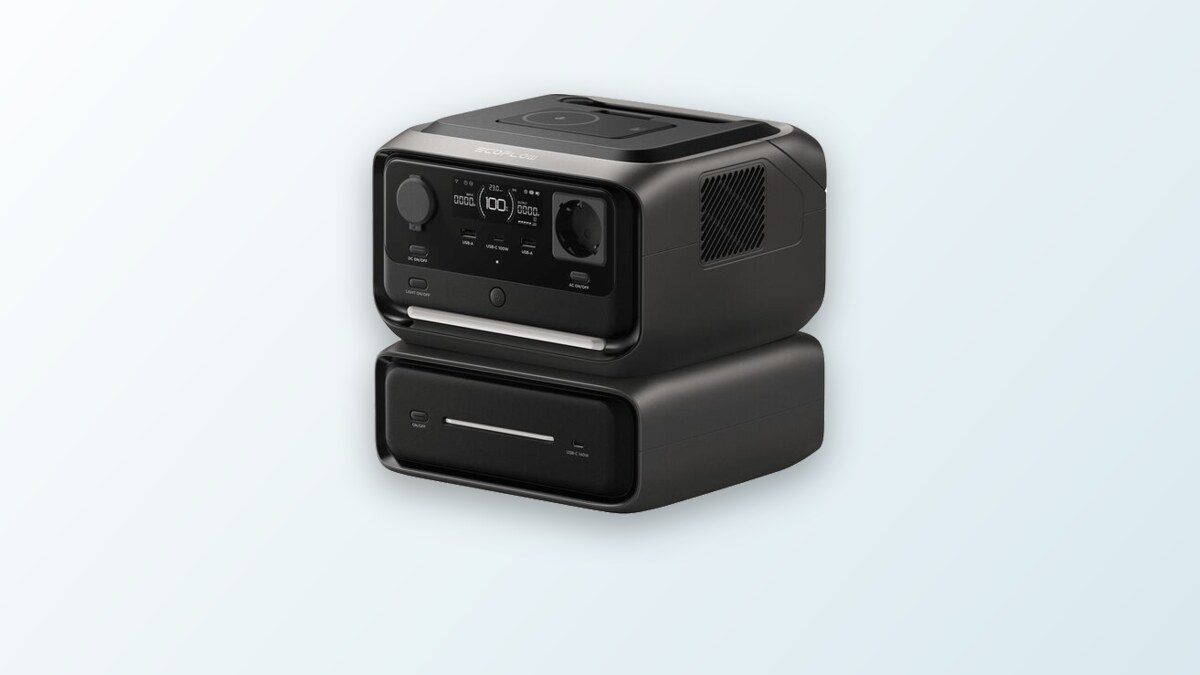
The concept: a base station and a battery you can detach
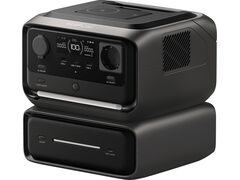
The River 3 Max Plus (Wireless) starts from a simple idea: pair the River 3 Plus station (286 Wh) with an EB600 add-on battery (572 Wh, called the EB580 in some markets outside Europe) to reach a total capacity of 858 Wh. Nothing new there on its own, several manufacturers offer stackable expansion batteries. What sets this model apart comes down to two additions: a 15 W Qi2 wireless charging pad built into the top of the station, and a small magnetic 5000 mAh external battery, named Rapid, which attaches to the station through a system of contacts and clips, with no cable or screws.
The Rapid battery is not simply another expansion battery among others: once detached, it also works as a wireless charging puck for the smartphone, and travels alone in a pocket. It is this dual role, backup capacity AND portable charging accessory, that forms the real core of the product.
The built-in 15 W Qi2 charger: the real standout feature
Setting the phone on top of the station to charge it with no cable to hunt for is, in daily use, the most frequently praised feature of the product. This is not a gimmick, wireless charging and the detachable battery answer a real need: not having to give up a cable port for a simple phone top-up.
One nuance is worth knowing, though. Across the Rapid battery lineup (the same electronic component powers both the 5000 mAh unit supplied here and a 10,000 mAh version sold separately), the Qi2 charging speed does not always hold at 15 W for the full duration: on at least one unit, it drops to 5 W after about ten minutes, a behaviour reproduced across several units and several phones. Another recent phone, for its part, displays a slow-charging warning instead of the expected maximum speed, a comparable symptom. The two Rapid battery models involved, 10,000 mAh and 5000 mAh, are not identical, but the similarity of the symptom suggests a setting worth watching across the whole lineup rather than an isolated flaw in a single unit.
The detachable Rapid battery: gimmick or genuinely useful?
Once detached from the station, the Rapid slips into a pocket and keeps working as a standard magnetic power bank, including wireless charging on the back of the phone. The magnetic attachment to the phone is very solid, with a crisp snap and a premium finish, with no mechanical flaw on this specific point.
The point where data is missing concerns a different mechanism: the attachment between the station and the battery itself, handled by electrical contacts (pogo pins) and clips rather than magnets alone. No independent field feedback on how it holds up over time, on any mechanical play that might appear after several months, or on how well the contacts resist dust has been found to date. This is not a negative signal in itself, more a genuine blind spot in the available data for a still-recent product, worth keeping in mind rather than ignoring.
The real charge time: 60 minutes for the base, about 2h20 for the full pack
The most highlighted figure, a full mains charge in 60 minutes, is accurate, but it describes the base station on its own (286 Wh), charged at its maximum input of 360 W. Once the EB600 battery is added to reach 858 Wh, the maximum input stays capped at 360 W: the charge time for the full pack therefore mechanically follows the total energy to be stored, and works out to around 2h20, or 858 Wh divided by 360 W.
This is not a hidden flaw, more a nuance in how it is communicated: the "60 minutes" promise remains literally true, but it describes the smallest configuration of the product, not the one sold with the add-on battery included.
600 W (1200 W in X-Boost mode): output that lags behind the direct competition
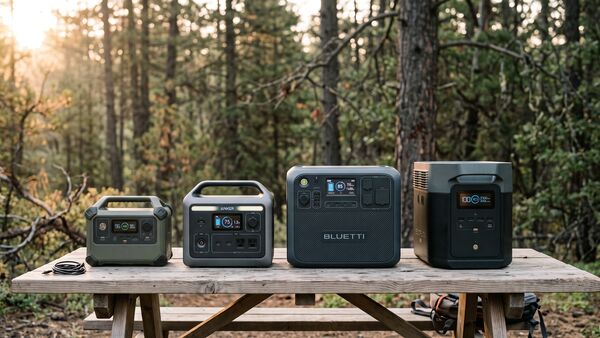
In the roughly 800 Wh station segment, the 600 W continuous output (1200 W in X-Boost mode) is the product's main comparative weakness. At equal or lower capacity, several direct competitors clearly exceed this figure, at an equal or lower price.
| Criterion | River 3 Max Plus (Wireless) | Anker SOLIX C800 Plus | Bluetti AC70 | Jackery Explorer 1000 v2 |
|---|---|---|---|---|
| Capacity | 858 Wh | 768 Wh | 768 Wh | 1070 Wh |
| Continuous output | 600 W (X-Boost 1200 W) | 1200 W (1600 W peak) | 1000 W (2000 W Turbo) | 1500 W |
| Built-in wireless charging | Yes, Qi2 15 W | No | No | No |
| Detachable external battery | Yes, Rapid 5000 mAh | No | No | No |
| Weight | not reliably disclosed | ≈ 10.5 kg | ≈ 9.7 kg | ≈ 10.8 kg |
The takeaway is clear: for anyone who prioritises raw output on the same budget, the Anker SOLIX C800 Plus or the Bluetti AC70 are the more favourable choices on this specific axis. The River 3 Max Plus (Wireless) compensates with slightly higher capacity and a modular concept none of the three offer, but it cannot claim output as a selling point.
Efficiency and noise: what is known, what is not yet known
No measurement of the energy efficiency of the full 858 Wh pack is available to date. The only data available covers the electronics of the base station in the same line (286 Wh, plus an even simpler 245 Wh model), with measured output efficiency between 81% and 87% depending on the power drawn. These figures give a plausible order of magnitude for the device family, without certifying the specific efficiency of the full pack once the EB600 battery is stacked on.
On noise, the real level sits between 30 and 33 dB(A) at one metre under full load, close to the quoted 30 dB: broadly quiet operation, including for continuous use nearby. No measurement specific to the full pack with the EB600 battery active has been found, on the other hand, and this configuration carries more electronics that could dissipate more heat than the station on its own.
Backup power, reliability, warranty
The automatic switchover to battery power on a mains outage is rated under 10 milliseconds by the official documentation, a value sufficient to protect a computer or a home internet router from an outage with no perceptible restart. The LFP chemistry is rated for 3000 cycles before dropping to 80% of its original capacity, a standard level for this battery chemistry.
No recurring structural flaw (charging failure, breakage, main battery failure) has been identified on this specific model, a reassuring point even though it must be weighed against the product's youth, launched in mid-2025. The warranty runs for 5 years on the station and 2 years on the detachable external battery, a logical gap given the more intensive use expected of this accessory carried around daily.
Camping, remote work on the road, photo/video: where it is genuinely in its element
At the campsite, the concept really comes into its own: the station stays at base to light the tent and run a cooler, while the Rapid battery heads off in a pocket to charge the phone along the way. For remote work on the road, the 858 Wh covers a good chunk of the day for a laptop, a monitor, and a router, and the backup switchover guards against brief outages during a video call.
For photo and video work in the field, the station tops up camera and accessory batteries, and the Qi2 pad charges the phone between shots without tying up a cable port. In a campervan for short trips (a weekend), the capacity is enough for lighting and charging devices, but extended use with a permanent fridge will quickly exceed its 858 Wh, and its 600 W continuous output will limit larger appliances.
A list price that is not the best price actually seen
The price displayed on an ongoing basis for this model generally sits within a wide range: the regular price outside promotions sits more between 600 and 630 €, with occasional lows dropping to 500 to 550 € during time-limited sales. A higher list price closer to 680 to 700 € also exists at some retailers, without representing the best price available on the market.
For a purchase with no urgency, comparing several retailers before ordering can amount to a difference of several tens of euros, a variation typical of this kind of recent product rather than an anomaly specific to this model.
Who it suits, and who it does not
It suits anyone who genuinely wants the flexibility of the modular concept, setting the phone down cable-free every day and being able to detach a lightweight energy reserve for an outing, without making raw power a priority.
It does not suit anyone looking above all for high continuous output for large appliances on the same budget, nor anyone who needs the fastest possible full charge across the entire pack rather than just the base station.