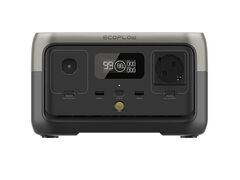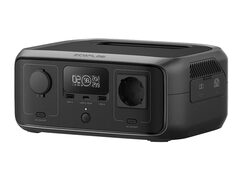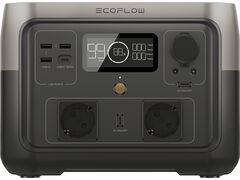

256 Wh quoted, 217 delivered: the outlet you pick counts
A power station never gives back what it stores. Between the cells and the socket sits a conversion, and conversion is paid for in heat. The useful question is therefore not how much the River 2 holds, but how much comes out of it, and on that point it springs a surprise: the answer changes with the outlet you use.
On the 230 V socket, under a 150 W load, 217.2 Wh come out of the 256 quoted, or 84.8 %. On the 12 V output, 221.9 Wh, or 86.7 %. And over USB-C, at 60 W, 233 Wh, or 91 %. Six points of efficiency between the two ends, sixteen watt-hours in real life, purely because the outlet changed.
The mechanism is simple. To put out 230 V alternating current you need an inverter, and an inverter draws a fixed amount of power just to run, whether it is feeding 10 W or 300. To put out 5 or 20 V direct current, a converter is enough, and it is far more frugal. The lighter the load, the more the inverter's own consumption weighs in the total, and the wider the gap between the two paths grows.
The practical consequence fits into one sentence: to recharge a laptop or a phone, go through USB-C rather than plugging the original mains brick into the 230 V socket. You gain sixteen watt-hours, and you avoid the double conversion that ate them along the way.
Round-trip efficiency, the figure nobody puts on the box
The 84.8 % of the mains socket only tell half the story. They measure what leaves the battery, not what had to be put into it. Filling the battery has a cost too, and that second toll is almost always passed over in silence.
On recharge, the River 2 draws 341 W from the wall, and charging efficiency settles a little under 80 %. Once the two stages are chained together, from the wall through to the station's 230 V socket, 67.8 % remain. Put another way, of 100 Wh paid for at the metre, 68 come back out usable as alternating current.
This is neither a fault nor a quirk of this model: every station with an inverter pays for two conversions, and the order of magnitude holds for the whole category. But the figure is worth knowing before imagining you might store cheap electricity overnight to use during the day. At that efficiency, tariff arbitrage does not add up.
300 W continuous, and what that really allows
The 230 V socket delivers 300 W continuous. That is the figure which decides what the station can do, and it deserves to be translated into appliances rather than watts. At 300 W you can run a laptop and its screen, a modem, a router, a lamp, a small fan, a television, a compact projector, a tool charger. What will not run, and never will, is the kettle, the hairdryer, the toaster, the induction hob, the microwave, the space heater. Anything that heats is out of reach.
X-Boost mode raises the ceiling to 600 W, but it does not manufacture power. It lowers the voltage delivered so as to keep the appliance inside the inverter's envelope, which works on purely resistive loads, the ones that simply heat, and fails on those that demand a stable voltage. Motors and compressors cope badly. The manufacturer puts it in those terms itself, recommending the mode for heating appliances and warning that the others remain incompatible.
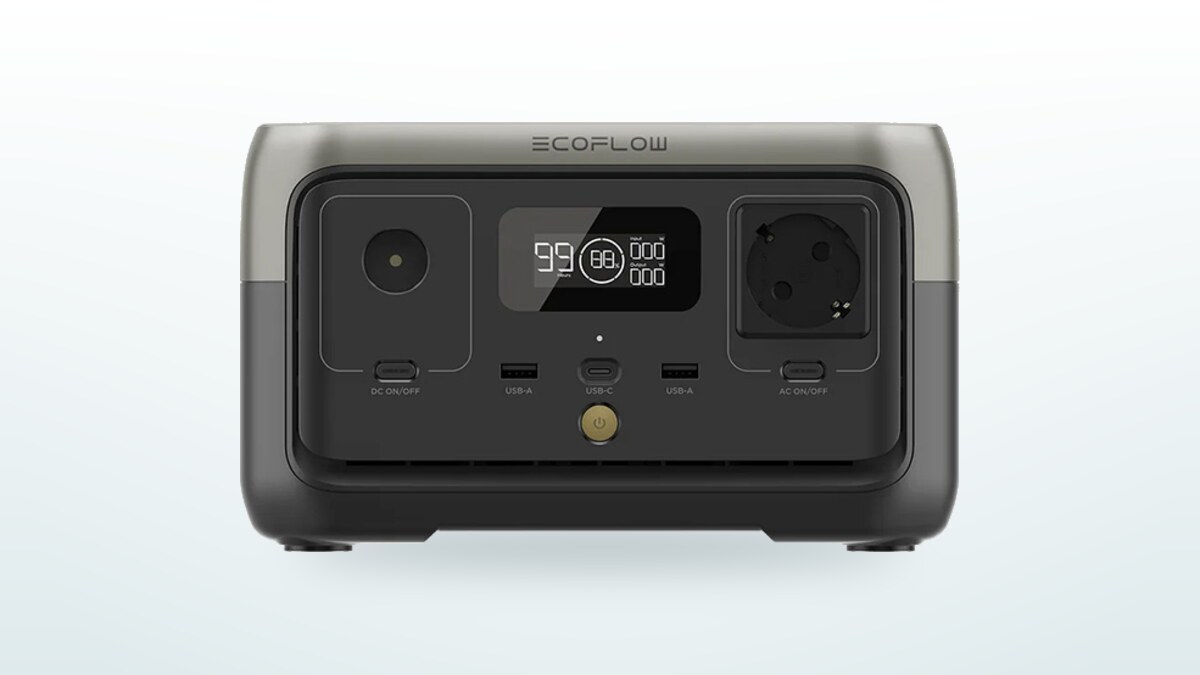
A layout limit compounds the power limit, and it often goes unnoticed: the European version carries a single 230 V socket. The version sold in the United States has two, but on the model distributed in Europe only one appliance can be run on mains output at a time.
An honest caveat is in order: how X-Boost actually behaves on this precise model, which appliances get through and which refuse, the voltage effectively delivered in degraded mode, none of that can be stated with any precision. What precedes describes the principle of the feature, not the behaviour of this particular machine.
One hour for a full charge: promise kept
This is where the River 2 impresses most, and for a precise reason: the promise can be checked, and it holds. The manufacturer quotes 0 to 100 % in sixty minutes; a complete fill takes just about an hour, with 341 W drawn from the wall. In a category where the quoted times often assume conditions nobody ever meets, that is rare enough to be worth saying.
The other charging paths are more uneven. Over USB-C it takes a little more than four and a half hours, for an efficiency of 77.6 %: the port that delivers best is also the one that fills worst. On the solar input the ceiling is 110 W, and the three hours quoted with a panel of that rating rest, as the manufacturer writes in a footnote, on laboratory conditions. Under a real sky, with a real panel lying flat, expect longer.
| Source | Time | Power | Efficiency |
|---|---|---|---|
| Mains socket | About 1 h | 341 W at the wall | A little under 80 % |
| Solar input, 30 V | not recorded | A little over 110 W | 85.9 % |
| 12 V input | not recorded | Capped at 8 A | 76.7 % |
| USB-C | About 4 h 30 | 95 W charger | 77.6 % |
Worth noting, the solar input is the most efficient of the four at 85.9 %. On a station taken outdoors, that is good news: the free energy is also the one that loses the least along the way.
As a backup supply, it beats its own spec
Plugged in between the wall socket and an appliance, the River 2 works as a backup supply: it passes the mains straight through and switches to its battery the moment the mains disappears. Everything hinges on how long that switch takes, because a computer or a modem will reboot if the gap lasts too long.
The manufacturer quotes less than 30 milliseconds. The switch happens in about sixteen milliseconds, and in both directions, from the mains to the battery as much as the other way round, with a stable amplitude at the moment of transfer. That is nearly twice as good as the promise, which is unusual enough to be worth pointing out: here, the manufacturer undersells its product.
The counterpart remains, discreet but permanent: left on standby with the mains output active, the station draws 3.71 W. Over a full year that comes to some thirty kilowatt-hours, more than the battery holds in one hundred and thirty complete cycles. A backup supply earns its place through the service it renders on the day of the outage, not through its energy balance. And since there is only one 230 V socket, you have to choose what you protect: the router or the computer, not both.
The fan, the main point of friction
It is the criticism that comes back most often, and it is well founded. The fan kicks in as soon as you go past a hundred watts or so, on discharge as much as on charge. On a 300 W machine, that means it runs through a large share of the uses that justify buying it: feed anything more demanding than a phone and it makes itself heard. And since a complete fill happens at 341 W, it also runs for the whole hour of recharging.
Added to that are audible relay clicks whenever the state changes. It is not a manufacturing defect, it is the normal sound of a contactor switching over, but in a quiet room you hear it.
Who does that bother? Anyone planning to run it in a bedroom at night, or behind a silent workstation. For anyone using it outdoors, in a workshop or as occasional backup, the question does not arise.
The quality of the electricity it puts out
A station can deliver plenty of energy and deliver it badly. On that front, the River 2 does well on the 230 V side and less well on the USB side.
The alternating waveform is a true sine wave, with a third harmonic 47.5 dB below the fundamental, which is clean. Some ripple remains perceptible and a spike appears around 24 kHz, in all likelihood the switching carrier, but nothing that troubles a domestic appliance. Sensitive electronics, including the switch-mode supplies of computers, take it without reservation.
USB-C is more uneven. It tops out at 60 W, which is enough for an ultraportable but not for a demanding machine, and it does not handle PPS, the mode that lets recent phones fine-tune their charging voltage. Above all, its ripple climbs with the voltage requested.
| Voltage | Peak-to-peak ripple |
|---|---|
| 5 V | 33 mV |
| 9 V | 42 mV |
| 12 V | 160 mV |
| 15 V | 250 mV |
| 20 V | 404 mV |
The 33 mV at 5 V are beyond reproach. The 404 mV at 20 V are much less so: that is the voltage a laptop uses, precisely the device a station gets bought for. No damage is to be feared, power supplies know how to filter, but the gap between the two ends of the range is stark.
3000 cycles and 5 years: what those figures assume
The chemistry is lithium iron phosphate, LFP, which ages far better than ordinary lithium and copes rather better with heat. The manufacturer quotes more than 3000 cycles before dropping to 80 % of the original capacity, and a five-year warranty in Europe. The two figures agree between the product page and the manual.
A commercial footnote does spell out how those 3000 cycles translate into years, and it deserves to be read: at six cycles a week, 3000 cycles come to 9.6 years. The ten years people think they are reading therefore assume six complete uses a week, not one a day. At one cycle a day you drop to a little over eight years; at two, to four years. The figure remains good for the category, it simply is not what a quick read suggests.
One last point, and it counts for use on the move: charging is impossible below 0 °C, a battery management system safeguard. Discharging, on the other hand, stays allowed down to −10 °C. In practice, a station left in a car boot in winter will feed your devices, but will refuse to fill up until it has come back to an acceptable temperature.
River 2 or River 3: what the new generation changes
The question comes up inevitably, since the two sit side by side on the shelf. And the answer is counter-intuitive: the River 3 is smaller and dearer. It comes down to 245 Wh against 256, and carries a premium. What it gives in exchange is written elsewhere.
| Criterion | River 2 | River 3 |
|---|---|---|
| Quoted capacity | 256 Wh | 245 Wh |
| Mains output | 300 W | 300 W |
| USB-C output | 60 W | 100 W |
| 12 V output | 100 W | 126 W |
| All outputs combined | not published | 550 W |
| Height | 145 mm | 113 mm |
| Weight | 3.5 kg | 3.5 kg |
| Cycles and warranty | 3000, 5 years | 3000, 5 years |
The clearest gain is USB-C, which goes from 60 to 100 W. Given what we saw above, namely that USB-C is the most efficient path through the machine, gaining forty watts on that port is no detail: it appreciably widens the list of computers you can feed by the best of the routes.
The second gain is the format. Thirty millimetres less in height, at constant weight, changes the way the object stows under a seat or in a boot. The rest is unchanged: same mains output, same chemistry, same cycles, same warranty.
For anyone hesitating, the reasoning is therefore simple. If the main use is a laptop and USB devices, the River 3 is worth its premium. If it is the 230 V socket that counts, the River 2 offers eleven watt-hours more for less, and nothing that changed concerns it.
Who it suits, and who it does not
It suits first of all as a household backup supply. Sixteen milliseconds of switchover, a modem and a computer behind it, and a power cut becomes a non-event. That is the use where its limits do not show and where its qualities count for most.
It suits next for light work on the move: a laptop, a phone, a light, a day outdoors or in a place with no socket. Going through USB-C draws the best out of it, and the one-hour recharge lets you fill up over a lunch break.
It does not suit use in a campervan as the main source. At 256 Wh it covers the phone and the computer, not a fridge over time nor the smallest cooking plate. Those who have tried say so bluntly, and the arithmetic backs them up: a small fridge uses more in a day than it holds.
Nor does it suit anyone hoping to save money by storing electricity at off-peak hours. With 67.8 % round-trip efficiency, the tariff gap is eaten by the losses before it even exists. Nor, finally, anyone who needs silence: the fan starts early and makes itself heard.