
What the USB-C output is really worth
The EcoFlow 60W (USB-C) solar panel has a USB-C output port, the headline feature on its product page: plug in a phone, tablet or laptop directly, with no power station in between. In practice, that USB-C port is limited to 15 W (5 V/3 A), a figure confirmed consistently by several retailer spec sheets.
That 15 W ceiling is enough to charge a phone or a tablet at a decent pace: as a rough guide, a roughly 4,000 mAh (15 Wh) smartphone battery would recharge in a little over an hour at a steady 15 W, ignoring conversion losses. For a laptop, though, 15 W amounts to a very slow top-up: most modern laptops need 45 to 100 W for a normal charge, and 15 W at best slows down battery drain during use rather than genuinely recharging it.
The full 60 W printed on the box therefore never flows through the USB-C port, but through the second connector described below, built above all for charging a power station. That's a nuance the product page and the marketing copy do not spell out, even though it changes what the panel can actually do depending on the device being charged.
Weight and format, the panel's real selling point
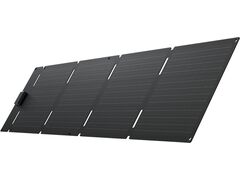
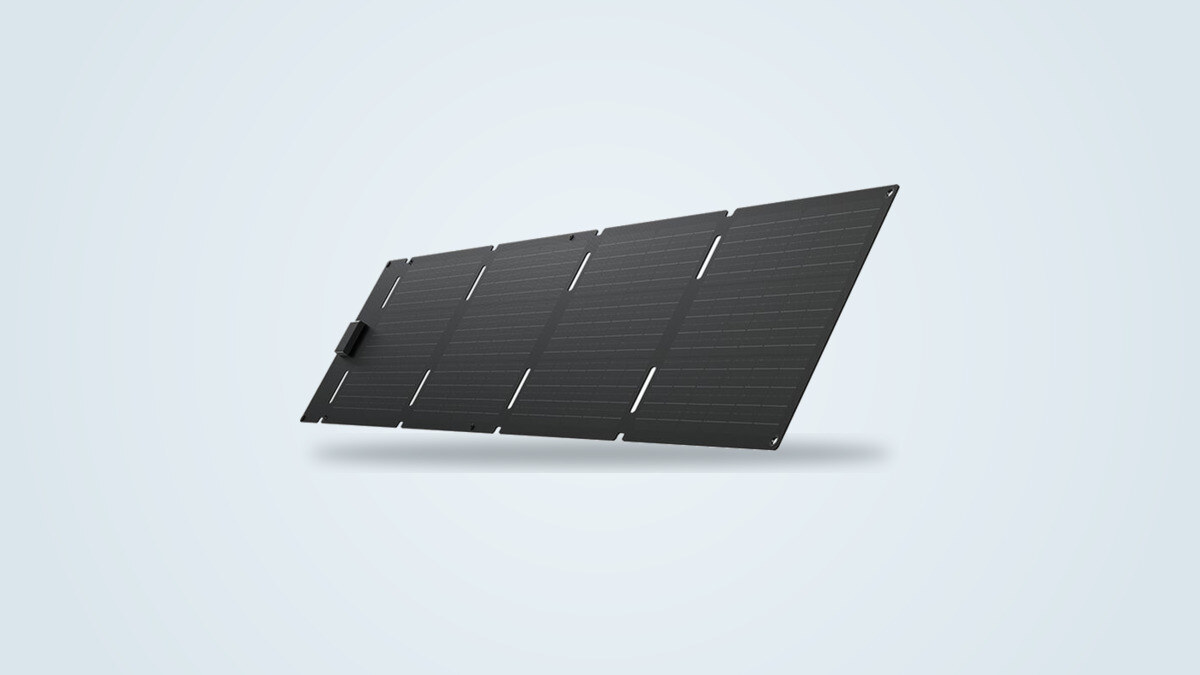
Unfolded, the panel measures 53.4 x 12.2 in (135.6 x 30.9 cm) at 1.0 in (2.5 cm) thick. Folded into four panels, it packs down to 12.5 x 12.2 x 1.8 in (31.7 x 30.9 x 4.5 cm), barely thicker than a hardcover book, for a rated weight of 4.4 lb (2 kg).
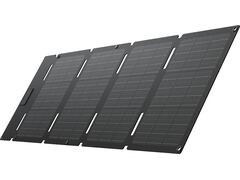
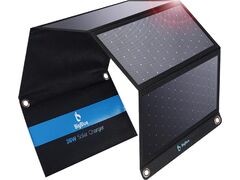
This makes it one of the easiest panels to slip into a hiking bag or a piece of luggage in this power class. It is, however, heavier and bulkier than its smaller sibling, the EcoFlow 45W (3.1 lb / 1.4 kg, same TOPCon cell design), which trades 15 W of rated power for a 1.3 lb (600 g) saving. At the other end, an entry-level solar charger like the BigBlue 28W (roughly 1.4 lb / 0.65 kg) stays lighter still, but delivers barely over half the 60W's rated power.
The panel ships with a carrying case that includes a tilting stand, which also protects it once folded. No independent data was found on how this folding mechanism holds up after extended, repeated use for this exact version of the product.
Real efficiency: what the 25% TOPCon and 60 W claims are worth
EcoFlow rates this panel's conversion efficiency at up to 25%, thanks to N-type monocrystalline TOPCon (Tunnel Oxide Passivated Contact) cells. That figure, measured under standard industry conditions (STC: 1,000 W/m² irradiance, 25 °C cell temperature, AM1.5 reference spectrum), remains a manufacturer figure, as is the case for nearly every nomad solar panel on the market.
In the field, the output measured on the DC connector described below reaches between 53 and over 60 W in direct full sun for this exact version of the product, a high proportion of the rated figure. No independent measurement with a published protocol (load type, distance, precisely described sunlight conditions) was found for this exact version of the product, which rules out stating a more precise percentage for the gap between the claim and reality.
As with any nomad solar panel, output drops sharply as soon as the sky clouds over or the sun's angle of incidence moves away from perpendicular, a phenomenon common to this entire product category and not precisely quantified for this version. N-type cells generally behave more stably under heat in full sun than the P-type cells more common on entry-level panels, which in theory limits the efficiency loss on the hottest days.
A second connector, for plugging into an EcoFlow station
Beyond the USB-C port, the panel has a second connector, a DC5521 type, which is the one that actually delivers the panel's advertised 60 W maximum (22 V/2.94 A at maximum power point, for an open-circuit voltage of around 25.6 V). A DC5521-to-XT60i adapter cable is included in the box, letting the panel plug directly into the solar input of an EcoFlow River or Delta series station, with no accessory to buy separately.
This dual output sets the panel apart from other direct-USB nomad panels in its category, such as the BigBlue 28W (USB-A only) or its own smaller sibling the 45W: it allows charging either a device directly or a compatible station, without having to pick a different panel depending on the task at hand. The downside of that versatility is the confusion the "USB-C" name can create, suggesting the panel's full power flows through that port, when it is actually the DC connector that plays that role.
Plugging this panel into a station from another brand requires finding an adapter matching that station's solar input format, since the DC5521 connector and its XT60i cable are built above all for the EcoFlow ecosystem.
IP68 and build: weather resistance
The panel is IP68 certified, the highest protection level on the standard scale against water and dust, matching the best-rated nomad panels in this comparison (EcoFlow 45W, and the same brand's 110W to 400W bifacial panels). Its cells are protected by an ETFE coating and fibreglass circuit boards, a construction now common on mid-range and high-end nomad panels.
This temperature range remains a manufacturer figure, not independently verified for this exact version of the product. No hinge or connector failure has been identified for this panel to date, but the track record available is naturally more limited than for the same range's 110W to 400W bifacial panels, which have been on the market longer and are more widely covered.
A name that covers two quite different versions
Before comparing this review with other information found online, one point is worth knowing: the name "EcoFlow 60W Solar Panel" refers to at least two products with different specifications. A version with no USB-C port at all, using MC4 connectors only and built exclusively for charging a power station, remains on sale in parallel: it is rated at a lower cell efficiency (21 to 22%) and a higher weight (roughly 7.1 lb / 3.2 kg according to several retailers). EcoFlow's own support team confirms explicitly that this version has no USB-C output whatsoever.
| Feature | Version with no USB-C (MC4) | USB-C version (this panel) |
|---|---|---|
| USB-C port | None | Yes, capped at 15 W |
| Main connector | MC4 | DC5521 (XT60i cable included) |
| Rated cell efficiency | 21 to 22% | Up to 25% (TOPCon) |
| Rated weight | Roughly 7.1 lb (3.2 kg) | 4.4 lb (2 kg) |
The panel's smaller sibling, the EcoFlow 45W, follows the same pattern at a lower rated power: TOPCon cells rated up to 25%, the same overall design, built-in USB-C. No accessory allows linking two panels from this compact range together to add up their output, unlike some larger panels on the market.
Build and warranty: the shortest in the EcoFlow range
EcoFlow was founded in 2017 in Shenzhen, China, and has since become one of the reference players in the portable power station market, with a broad ecosystem of panels, batteries and accessories that work together. No recall has been identified for this panel to date.
Worth noting: this panel's manufacturer warranty is limited to 12 months, against 5 years for the same brand's 110W, 160W, 220W and 400W bifacial panels already reviewed on this site. That gap in coverage is not trivial for an accessory permanently exposed to sun and weather, and is worth knowing before buying, even though no recurring build defect has been identified for this version to date.
Against other direct-USB nomad solar panels
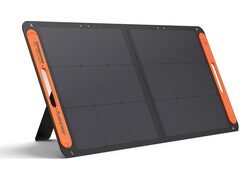
Compared with other direct-USB nomad panels already reviewed on this site, the EcoFlow 60W sits in the middle of the pack on power, between the very compact BigBlue 28W and a much more powerful panel like the Jackery SolarSaga 100W, which leans more toward charging a station.
| Criterion | EcoFlow 60W (USB-C) | EcoFlow 45W (USB-C) | BigBlue 28W | Jackery SolarSaga 100W |
|---|---|---|---|---|
| Rated power | 60 W | 45 W | 28 W | 100 W |
| Direct device output | USB-C, 15 W max | USB-C | USB-A | USB-C and USB-A |
| Rated cell efficiency | Up to 25% | Up to 25% | ≈ 22% | ≈ 23% |
| Water/dust rating | IP68 | IP68 | IPX4 | IP65 |
| Rated weight | 4.4 lb (2 kg) | 3.1 lb (1.4 kg) | ≈ 1.4 lb (0.65 kg) | Not specified here |
| Observed price | ≈ £79 | ≈ £68 | ≈ £51 | ≈ £256 |
The BigBlue 28W remains the lightest and cheapest of the four, but delivers barely over half the power and is limited to USB-A with an IPX4 rating, well below the IP68 on the EcoFlow panels. The Jackery SolarSaga 100W offers nearly double the rated power, with both a USB-C and a USB-A port, but its main output stays in XT60 for charging a station and its price runs well above the 60W's. The smaller EcoFlow 45W takes the same approach at a lower power and price.
Price and positioning in the range
At the time of writing, the EcoFlow 60W (USB-C) solar panel is priced at around £79 on the manufacturer's site. It sits above its smaller sibling the 45W (around £68) and well below a far more powerful panel like the Jackery SolarSaga 100W (around £256).
Before buying, checking for "USB-C" or "Type-C" in the exact product name remains the best way to avoid comparing, or paying for, a version that isn't the one described in this review: the version with no USB-C is sold at similar prices despite a lower rated cell efficiency and no direct device charging at all.
Who this panel suits, and who should look elsewhere
The EcoFlow 60W (USB-C) is aimed first at anyone who wants to charge USB devices directly (phone, tablet, small power bank, electric air pump) while hiking, on a light camp, or travelling, without carrying a power station. Its compact format and 4.4 lb (2 kg) weight make it a solid nomad companion for this exact use, with the added option of plugging into a compact EcoFlow station via the included cable.
Anyone looking to quickly recharge a large power station should instead look at a dedicated bifacial panel from the same brand (110W, 160W, 220W or 400W), more powerful and fitted with a native XT60 cable built for that job. Anyone wanting to fast-charge a laptop directly in the sun should also look elsewhere, since 15 W remains far too little for that use. And anyone who confuses this model with the version with no USB-C, sometimes found at a similar price but incapable of any direct device charging, risks an unpleasant surprise on arrival.