
What the announced 400W is really worth
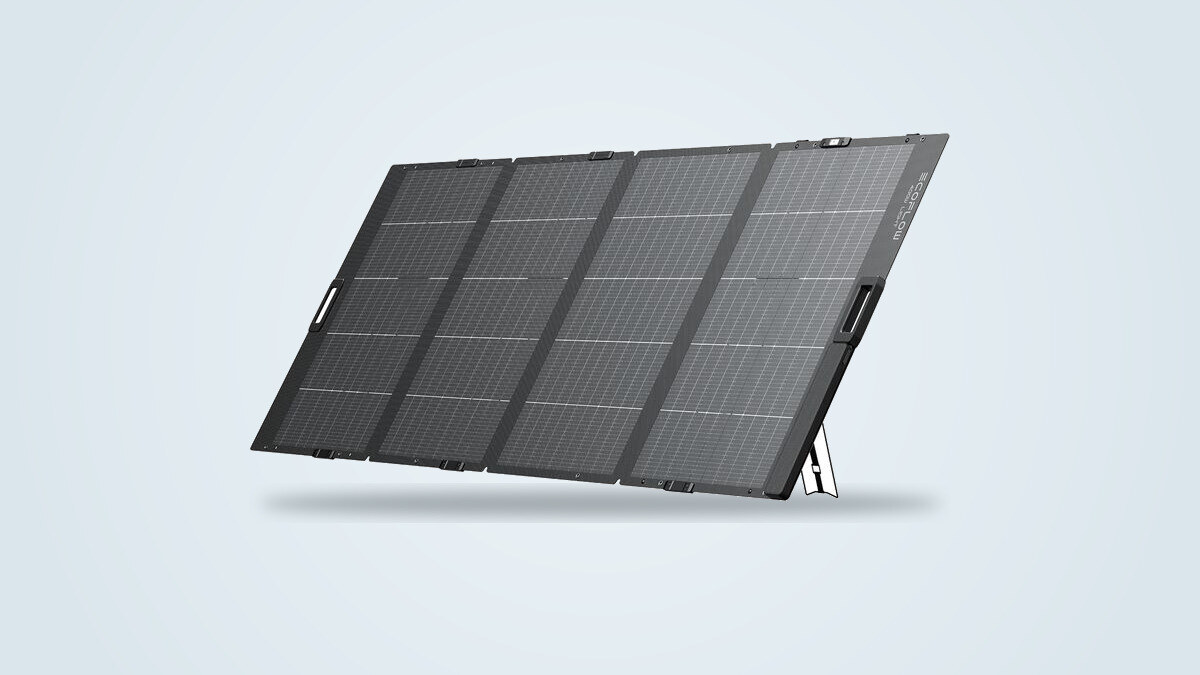
The EcoFlow 400W solar panel is rated at a nominal 400 W, a value standardised under the industry's usual test conditions (STC: 1000 W/m² of irradiance, 25 °C cell temperature, AM1.5 reference spectrum). This convention allows two panels to be compared, but it is never met as such outdoors, a phenomenon common to this whole category of product and already covered for the 160W and 220W in the same range.
The manufacturer also quotes a second, more flattering figure: up to 445 W under BNPI conditions, a test protocol specific to bifacial panels that accounts for the rear face's contribution under favourable conditions. This figure remains a manufacturer value, obtained under a different protocol from standard STC conditions, not a result obtained in real-world use.
No independent figures on power actually delivered outdoors were found for this recent bifacial version of the panel. Research is made harder still by an earlier, heavier, non-bifacial panel sharing an almost identical commercial name (see below): the vast majority of figures found online under the name "EcoFlow 400W" actually concern that other product, and cannot be carried over here without confusion.
Another 400W panel circulates under an almost identical name
Before searching for other reviews of this product, one point is worth knowing: the name "EcoFlow 400W solar panel" today refers to at least two products with notably different hardware. An earlier version, still widely sold under reference 664871, weighs about 16 kg for the panel alone (up to 19 kg with its separate stand case), uses classic non-bifacial monocrystalline cells with an announced efficiency of about 22 to 23%, connects via MC4 (an XT60 adapter being supplied for EcoFlow stations), and is limited to IP67. The current version, the one described in this review and referenced by this site's product page, uses a bifacial design announced at up to 25%, weighs 10.2 kg, connects via native XT60 and reaches IP68, with a warranty that is also longer.
| Feature | Earlier version (ref. 664871) | Current version (this panel) |
|---|---|---|
| Design | Monofacial | Bifacial (up to 25%) |
| Weight | ≈ 16 kg (19 kg with case) | 10.2 kg |
| Connector | MC4 + XT60 adapter | Native XT60 |
| Rating | IP67 | IP68 |
The bifacial design in practice, at a larger scale
Like the other recent bifacial panels in EcoFlow's portable range (160W, 220W), this 400W model adds a second layer of cells on its rear face, able to capture light reflected off the ground. The manufacturer announces a gain of up to 25% over an equivalent monofacial panel through this principle. This figure is a ceiling, not an average: it depends entirely on the albedo of the surface the panel rests on, that is, how much light that surface reflects.
On a highly reflective surface (fresh snow, light sand, a concrete slab), the real gain gets close to the marketing promise. On grass or dark soil, the most common ground in camping, that same gain drops well below it, a variability already noted on the 160W and 220W in the same range and with no reason to disappear on this larger format. With a deployed length of 2.5 metres, the exposed rear cell surface is mechanically larger than on the range's more compact formats, which favours a larger absolute bifacial gain (in watts) without changing the dependence on ground type.
Weight, the real trade-off of the 400W format
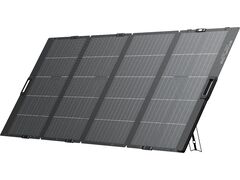
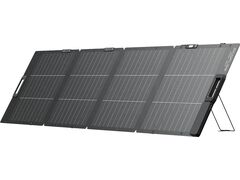
Once unfolded over its 2.5 metres, the EcoFlow 400W panel weighs 10.2 kg announced, for a width of 96.7 cm and a thickness of 2.6 cm. Folded into four sections, it packs down to 65.9 x 96.7 cm at 3.6 cm thick, closer to a large suitcase than a backpack: its width alone exceeds most cabin-bag limits.
Against its only direct same-power competitor already reviewed on this site, the Anker Solix PS400 (15.9 kg), the EcoFlow 400W weighs 35.8% less, a clear gap that is no accident: this panel carries over the lighter build already seen on the 160W and 220W in the same range, while the Anker keeps a more classic structure. Against its own smaller siblings, the gap runs the other way and stays significant: this panel weighs about twice as much as the 220W (5.1 kg) and more than two and a half times the 160W (3.8 kg), a direct mechanical consequence of the cell surface needed to deliver 400 W.
In practice, a panel this size gets carried from the vehicle to the setup spot, not in a backpack for a hike. Once deployed, handling it with two people becomes preferable as soon as the wind picks up, since the surface caught by the wind is proportionally larger than on the range's more compact formats.
Three-angle stand: handy, but sized for a smaller format
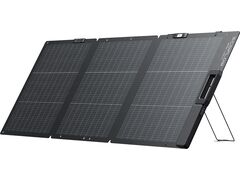
The panel carries over the built-in stand adjustable across three angles (30°, 45°, 60°) and the sun-exposure guide already found on the 220W in the same range, which help aim for the best sunlight without guesswork. That is a real step up from a simple pair of fixed kickstands, common on classic portable panels.
On a panel this wide, a stand originally designed for a more compact format can show its limits in wind resistance or stability on uneven ground, a point already raised for the Anker Solix PS400, its direct same-power competitor (see below). No such issue has been found for this EcoFlow panel to date, which remains an honest reservation rather than a proven flaw: the track record available for this recent version is by nature more limited than for a product sold for several years.
Native XT60, but no parallel connection yet
The XT60 cable comes built into the panel over about 3.5 metres, sparing the need to carry a separate cable to plug into an EcoFlow River or Delta series station. It is the ecosystem's native connector, directly compatible without an adapter with almost all of the brand's generators.
Two real limitations come with this choice. First, plugging this panel into a station from another brand requires an adapter matching that station's solar input, with no extension cable included in the box, unlike the Anker Solix PS400, which ships with two extension cables and a native XT60 adapter. Second, and this is a limitation specific to this model: no parallel-connection accessory is available yet to link two 400W panels together and reach a combined 800 W, an option the manufacturer itself announces for later in the year on this lightweight range. Finally, as on almost every panel of this power class, there is no USB output: charging a phone directly is not possible without going through an intermediate station.
IP68 and a 5-year warranty: the best of the current generation
The panel is IP68 rated, the highest protection level on the standard scale, matching the 160W and 220W in the same range and above the IP67 of the Anker Solix PS400. In theory, this level allows for temporary immersion, well beyond a simple downpour.
EcoFlow was founded in 2017 in Shenzhen, China, and has since established itself as one of the leading players in the portable power station market, with a broad ecosystem of panels, batteries and accessories that work together. The manufacturer warranty runs for 5 years, two and a half times the duration offered on the Anker Solix PS400 (2 years) and above the 3 years typical at Jackery. No recall has been identified for this panel to date; passive solar panels of this kind, with no stored energy cell or onboard charging electronics, are in any case rarely affected by the safety recalls that more often hit lithium battery products.
How long to fill a large station
As a rough guide and at the nominal 400 W rate only (rarely reached as such outdoors, see above), an EcoFlow Delta 2 (1024 Wh) would fill in about 2h34, and a Delta Pro (3600 Wh), the large station this panel is most naturally paired with, in about 9h00. This simplified calculation ignores conversion losses and the slowdown in charging near the end of a fill, and the real duration typically runs longer than this calculation, since outdoor power availability falls back from the nominal peak for this category of panel, in a proportion that could not be established independently for this bifacial version (see above).
Two panels wired in parallel would roughly halve this time, provided the station's solar input accepts a combined power of at least 800 W: a setup no official accessory yet allows to be wired properly on this lightweight range.
Versus the Anker Solix PS400, its direct competitor
At equal power (400 W), the most direct comparison remains the Anker Solix PS400, already reviewed on this site. The EcoFlow wins on weight, weatherproofing and warranty; the PS400 keeps the edge on a more universal connector and included cables.
| Criterion | EcoFlow 400W | Anker Solix PS400 |
|---|---|---|
| Cells | Bifacial (up to 25%) | Monocrystalline (23%) |
| Weight | 10.2 kg | 15.9 kg |
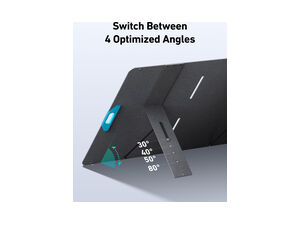
| Stand / angles | 3 angles + guide | 4 angles (30-80°) |
| Connector | Native XT60, no extension included | Native MC4, 2 extensions + XT60 adapter included |
| Rating | IP68 | IP67 |
| Warranty | 5 years | 2 years |
| Catalogue price | £549.00 | £849.00 |
The PS400 reaches 92% of its nominal power in full sun according to the review published on this site, a proportion with no independent equivalent for the EcoFlow's bifacial version to date (see above). Conversely, the EcoFlow clearly wins on everything tied to long-term ownership and to price: about a third less weight, one rating step up in weatherproofing, a warranty two and a half times longer, and a noticeably lower catalogue price on this market. For anyone who already owns an Anker Solix station, the PS400's direct compatibility remains an argument specific to its ecosystem; for anyone without a station yet, or who already has EcoFlow gear, this panel is the more coherent choice of the two over time.
Who this panel is for, and price observed
The EcoFlow 400W panel is aimed first at anyone who already owns a large EcoFlow power station (River or Delta series, Delta Pro chief among them) and wants to recharge it as fast as possible in the sun, for a base-camp style use: a camper van parked for several days, extended camping, or a standby backup at home. Its weight, well controlled for its power class, makes it, to date, the easiest 400 W panel to set up alone in our catalogue.
Conversely, anyone after a genuinely everyday-portable format should look at the 220W (5.1 kg) or 160W (3.8 kg) in the same range, just as bifacial and weatherproof, for less power. Anyone with a station from another brand will need to budget for an adapter, or may prefer the Anker Solix PS400 and its native MC4 connector. And anyone wanting to reach 800 W by linking two panels will need to wait: no parallel-connection cable is offered yet for this lightweight range.
Listed at £549.00 on the official UK catalogue, well below the PS400's £849.00, this panel's price has also been seen closer to 461 to 546 euros during promotions on continental European markets: a gap wide enough to justify comparing prices before buying rather than relying on the catalogue price alone.