
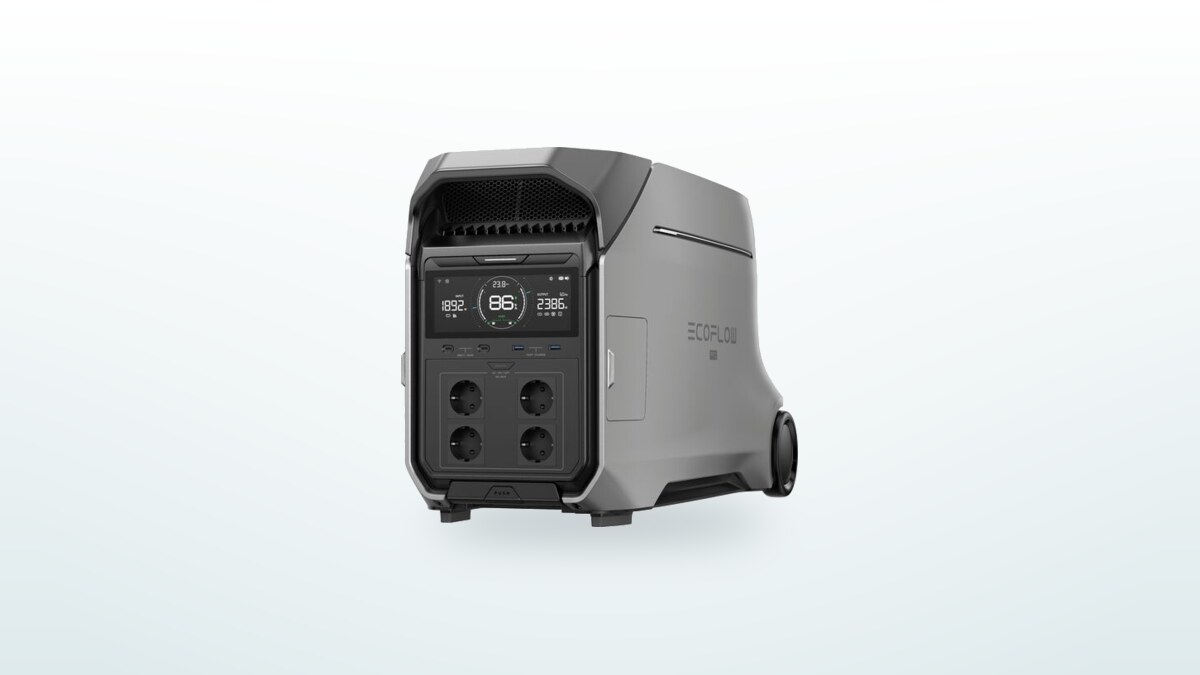
Real-world efficiency among the best in this segment
Out of the 4096 Wh of advertised capacity, discharge efficiency is high but varies with the power drawn: around 95 to 98 % at a load of 500 to 2000 W. In practice, the station returns 3911 Wh under a 500 W load and 3999 Wh under 2000 W, out of the 4096 Wh advertised.
On mains charging, efficiency drops to around 82 to 85 %, with roughly 15 to 18 % extra energy needed to refill the full capacity. That is a common order of magnitude for this type of device, and taken together, these figures place the Delta Pro 3 near the top of stations this size for overall energy efficiency.
30 dB at 2000 W: an honest figure, with limits
Unlike other stations from the same brand where the advertised noise figure turns out to be misleading, the Delta Pro 3's 30 dB rating at 2000 W holds up with precision. Below that threshold, the unit really does stay very quiet.
The advertised figure clearly states its measurement condition (2000 W), a level of transparency rarer than it sounds for this type of spec sheet. Beyond that threshold, though, the noise level climbs sharply: around 43 dB at 3700 W, and up to 52 dB when the unit charges and discharges at the same time, the worst-case scenario. This progression stays consistent with the advertised figure, which never claims to cover full power, but it is worth knowing for anyone planning sustained indoor use.
X-Boost 6000 W: effective on small motors, not on large compressors
X-Boost mode allows output to exceed the 4000 W continuous rating, up to 6000 W, by tolerating a drop in output voltage. On moderate power motor loads (angle grinder, jackhammer, large appliances), this mode works without issue. The list of compatible devices the manufacturer itself highlights actually stays focused on resistive loads or small motors: deep fryer, coffee maker, drill, microwave, heater, hair dryer.
On a more demanding load with a high starting current draw, such as a multi-ton central air conditioning unit, the mode instead runs into its own overload protection and cuts out. So this is not a guaranteed ceiling for every type of device, but a conditional capability that depends heavily on the nature of the load plugged in. The official documentation itself specifies that the output should not stay connected to the grid while this mode is active, at the risk of triggering a low-voltage protection: a technical nuance worth keeping in mind for anyone planning a backup scenario that combines X-Boost with the home grid.
IP20, not IP65: a mix-up not to repeat
One technical point is a frequent source of confusion: the Delta Pro 3's main unit is only IP20 rated, a basic level of protection against solid objects, with no protection against water. Only the separately sold expansion battery is IP65 rated, a much higher level that includes protection against water jets.
This distinction is easy to miss on a quick read of a spec sheet, and the IP65 rating is sometimes wrongly applied to the whole product. In practice, this means the main unit is meant for indoor use or sheltered outdoor use, despite being positioned as a backup power station capable of handling demanding jobs: in the rain or in a damp environment without extra protection, this is not the right device.
Charging and outputting 240 V at the same time: a limit worth knowing
The Delta Pro 3 cannot charge from mains power and deliver 240 V output at the same time, a limitation built into the unit itself. In practice, a scenario where someone wants to recharge the station from a generator while powering 240 V loads does not work as expected: the output cuts out or refuses to start beyond a modest power level.
This technical limit sits in tension with the product's marketing, which highlights both home backup use and simultaneous solar recharging. In practice, a transfer switch likely isolates the home circuit from the grid during an outage, which would limit the real impact of this constraint for a correctly installed home backup setup, but this specific point remains unconfirmed for this exact product.
10 ms backup switchover: enough for a computer or a NAS
In UPS mode, the Delta Pro 3 switches to its own power in 10 ms during a mains outage. That delay is short enough that a desktop computer, a NAS or a home router will not restart, since the internal power supply of this type of device generally tolerates very short micro-interruptions without a visible break.
This fast switchover should not be confused with the isolated case of a damaged PC power supply covered further below: that problem is attributed to poorly managed earthing between the home circuit and the station, an electrical installation issue distinct from the switchover speed itself.
Early bugs, generally fixed, still worth watching
Across the first two years on the market, the same pattern shows up repeatedly across different markets: software bugs that appeared shortly after launch, generally fixed afterward through firmware updates. A sleep and wake defect affecting solar charging was identified and then fixed, as was a false electrical short-circuit alert. A scheduling defect causing unwanted charge and discharge cycles was officially acknowledged by the manufacturer's support team on a specific date, a fairly reassuring sign for how this type of problem gets handled.
A second, more occasional type of defect affects battery balancing or charge management, with isolated cases of unexpected draining or lockups requiring a manual reset. A more serious failure, with smoke and an electrical arc, occurred on one of the very first units produced; the refund came through quickly, and the case appears to be an isolated one.
One more specific technical case is worth knowing: a desktop computer's power supply was damaged during a backup-mode transfer in one instance, a problem attributed to poorly managed earthing between the home circuit and the station during the switchover. This case remains isolated and does not point to a generalised design flaw, but it illustrates the value of having the complete installation (station, transfer switch, earthing) checked by a professional before connecting sensitive equipment downstream.
Set against these early bugs, the manufacturer's 5-year warranty provides a real counterweight: it comfortably covers the period when this type of software defect is most likely to appear, and it stays consistent with the device's high-end positioning. That said, it does not remove the need to keep the app and firmware up to date, since most of the fixes mentioned above arrived that way.
12 kWh in one unit, up to far more as a full system
In a simple configuration, the Delta Pro 3 accepts two add-on batteries to go from 4096 to 12,288 Wh. The 48 kWh figure sometimes advertised actually corresponds to a full system linking up to three Delta Pro 3 units, each with its own add-on batteries, paired with a home distribution panel and the brand's own backup generator: a setup far heavier and more expensive than a simple expansion, not to be confused with single-unit capacity.
For the vast majority of households, adding one or two extra batteries to a single unit is more than enough to cover typical home backup use. The multi-unit system targets a different profile, that of genuine whole-house backup power over several days, with an investment and installation on an entirely different scale than a simple capacity expansion.
Solar recharging up to 2600 W: two independent MPPT inputs
The Delta Pro 3 accepts up to 2600 W of solar power, split across two independent MPPT inputs, each accepting a voltage of 11 to 150 V and current up to 20 A. The benefit of two separate inputs rather than one is concrete: two panel strings facing different directions, an east-facing slope and a west-facing one for example, can each run at their own maximum power point without shade or orientation on one string penalising output from the other.
For reference, based purely on the advertised rated power and a usable capacity of around 3999 Wh, a full solar recharge works out to a little over an hour and a half in theoretical terms at a constant maximum power. This theoretical figure rarely plays out in real-world conditions, since sunlight varies throughout the day: it gives a sense of the setup's potential, not a charge time to expect on a typical day.
Charging speed depends heavily on available power
The 60-minute figure for a charge from 0 to 80 % assumes an input power close to the 2900 W maximum, achievable on a standard European electrical setup. At that power level, a full charge takes just under two hours under these conditions. On a setup that can only supply lower input power, charging time stretches out proportionally, which is not a flaw in the product: the same logic explains the noticeably longer charge times seen on power-limited electrical setups.
51.5 kg: the most widely agreed weak point in the whole review
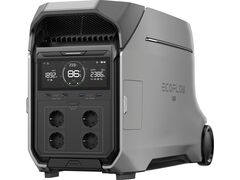
Despite its wheels and telescopic handle, the 51.5 kg weight comes up as the most consistent criticism: moving it over uneven ground or up a flight of stairs often takes two people. The telescopic handle itself feels flimsy once extended.
For a fixed installation, whether for home backup or in a dedicated space, this weight matters little once the unit is in place. For any use requiring regular moves over rough terrain, though, it is a real constraint to plan for.
Home backup: the essential role of a qualified electrician
For backup use at the electrical panel rather than through a simple outlet, a transfer switch must be installed by a qualified electrician: the manufacturer itself states this explicitly, citing a risk of electrocution and fire if installed by an unqualified individual. Without this switch, there is a risk of power feeding back into the grid.
Market-specific data on the cost or exact process for this type of installation is not available for this particular unit: this is a point to clarify directly with a local electrician before basing a full home backup project on this product.
Up against the Anker SOLIX F3800 and the Bluetti AC300 + B300
In the high-end station segment around 4 kWh, two direct alternatives stand out: the Anker SOLIX F3800 and the Bluetti AC300 paired with its B300 battery.
| Criterion | EcoFlow Delta Pro 3 | Anker SOLIX F3800 | Bluetti AC300 + B300 |
|---|---|---|---|
| Capacity | 4096 Wh | 3840 Wh | 3072 Wh |
| AC output | 4000 W (X-Boost 6000 W) | 6000 W | 3000 W |
| Expandable (single unit) | 12,288 Wh | 26,900 Wh | 12,300 Wh |
| Price seen | ≈ 3299 € | ≈ 3499 € | ≈ 2699 € |
The Anker SOLIX F3800 wins out clearly on continuous power and maximum expandability, while the Bluetti stays more affordable but less powerful. The Delta Pro 3 stands out for its larger base capacity and real-world efficiency among the best in the segment.
Who it suits, and who it does not
It suits anyone looking for a powerful home backup power station, installed permanently with a transfer switch fitted by an electrician, or anyone who needs a large energy reserve for a job site or an event without having to move it daily.
It does not suit anyone looking for portable use with frequent moves over rough terrain, anyone counting on X-Boost mode to run a large motor load such as central air conditioning, or anyone planning outdoor use exposed to water without extra protection.