
What the 1024 Wh capacity is really worth
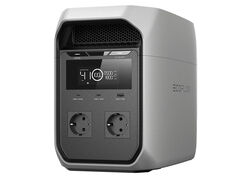
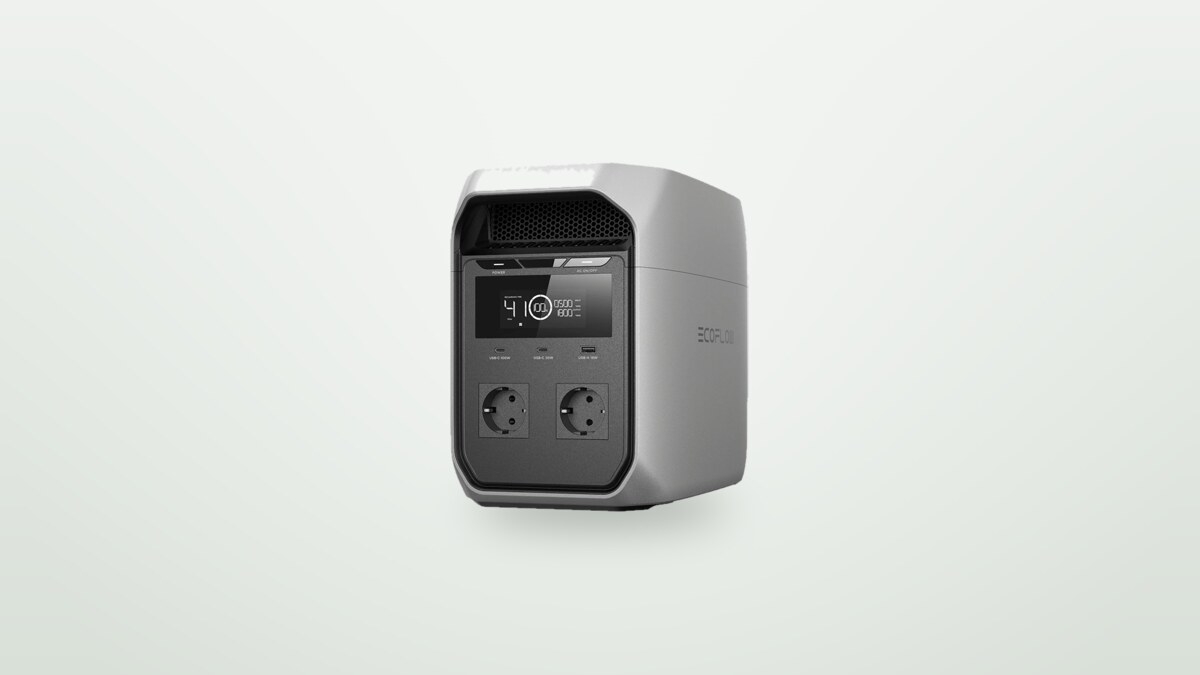
The Delta 3 Classic uses a 1024 Wh LiFePO4 battery (51.2 V, 20Ah), rated for 4000 cycles before dropping to 80 % capacity. The actually usable capacity, comes out at 950 Wh, an efficiency of 92.77 %, a very good figure for this station format.
At full continuous load (about 1800 W), a complete discharge takes about 30 minutes, a figure consistent with the theoretical calculation once losses are accounted for. Under this sustained load, the battery temperature rises from about 35 °C at rest to 52 to 53 °C, a notable increase that stays within an operating range managed by the built-in cooling system.
A deliberately closed system: what that changes
An important point to check before buying: despite a name close to the base "Delta 3" and the "Delta 3 Plus," the Classic cannot be expanded with an additional battery. That is confirmed without ambiguity by EcoFlow's own official specification table (battery extension: no), by the Delta 3 extension battery's own product page, which explicitly excludes the Classic from its compatibility, and by the official positioning of the European launch press release, which presents this choice as a deliberate simplification rather than an oversight.
This confusion between the Classic and the rest of the lineup is real: the two names are close enough to suggest the same product, when they are in fact two different references with different expansion capabilities.
The real output power depends on where the unit is sold
This is the most interesting angle in this review, and it appears nowhere in a comparative way in mainstream marketing: the advertised continuous output power is not the same everywhere. In Europe as in the United States, it reaches 1800 W continuous (2400 W in X-Boost mode in Europe, 2600 W in the US). In Japan, the same reference caps at 1500 W continuous, 2000 W in X-Boost mode, and 3000 W peak, 17 % less than in Europe on continuous power.
The mechanism is physical and well understood in the electrical industry: at a lower grid voltage (100 V in Japan versus 230 V in Europe), for the same allowable current limit on the inverter side, the available power drops mechanically, an effect reinforced by Japanese household circuit standards generally rated for lower currents. This is not a localized deception, each EcoFlow regional site honestly advertises the right figure for its own market, but a blind spot in the global comparison that does not appear to be pointed out anywhere. The model sold in France corresponds to the "Europe" column of this chart.
Mains recharging: the promise kept
On this point, the claims match reality. EcoFlow advertises 45 minutes to reach 80 % and about 60 minutes for 100 % on mains power. A full charge takes about 55 minutes in practice, a result consistent with the manufacturer's claim.
The solar input, meanwhile, stays more modest than on the Delta 3 Plus in the same lineup: 500 W maximum on a single MPPT, against 1000 W and two MPPT inputs on the Plus. For occasional top-up charging, this limit is not a problem, but it is worth knowing for anyone planning to use solar charging as their main source.
USB-C: 100 W and 30 W, not two times 100 W
The Delta 3 Classic has two USB-C ports, but they do not deliver the same power: the first reaches 100 W, the second caps at 30 W. This is a nuance worth knowing before buying: a reader planning to recharge two laptops at full speed at the same time on both USB-C ports will not be able to, only one of the two devices will receive its full power.
| Output | Power |
|---|---|
| Mains sockets (x2, Europe) | 1800 W continuous, 2400 W in X-Boost |
| USB-C #1 | 100 W |
| USB-C #2 | 30 W |
| USB-A | 18 W |
| 12 V output | Not present |
This table also confirms another point worth knowing: unlike a good part of the competition in this segment, the Delta 3 Classic offers no 12 V or cigarette-lighter output, a real limitation for camping or van use aimed at powering 12 V accessories directly.
Classic, Delta 3, or Delta 3 Plus: clearing up the confusion
EcoFlow's Delta 3 lineup is dense, and the Classic shares its starting capacity of 1024 Wh with two other closely named references, which fuels genuine confusion. The table below summarizes the real differences.
| Model | Delta 3 Classic | Delta 3 | Delta 3 Plus |
|---|---|---|---|
| Starting capacity | 1024 Wh | 1024 Wh | 1024 Wh |
| Expandable | No | Yes, ~5 kWh | Yes, 5 kWh and up |
| Launch price | 599 € | ≈ $499 | ≈ $599 to $799 |
The lesson to take away: it is not starting capacity that sets these three references apart, that is identical, but expandability and the number of ports. Any mention of an expansion option for the "Delta 3 Classic" is most likely a mix-up with one of its two cousins.
What physics says about the marketing visual
A widely circulated promotional visual shows the station powering a refrigerator and an electric grill at the same time, with no apparent strain. The math is simple: an electric grill typically draws between 1200 and 2500 W. At that power level, the Delta 3 Classic would drain completely in 20 to 40 minutes, with the grill alone, not even counting the refrigerator. The scene remains technically possible for a very short time, but it suggests a comfortable runtime that the battery's physics cannot sustain over time.
This is not exactly a false claim, the power the grill needs stays under the advertised 1800 W ceiling, but it is a good example of a visual that optimises the impression of ease at the expense of a realistic read on the available runtime.
Cycle life: a figure with no consensus
EcoFlow advertises 4000 cycles before capacity drops to 80 %, a figure consistent with the LiFePO4 chemistry used. A range of 3000 to 3500 cycles is also put forward for this same reference. The official European launch press release, for its part, does not cite any precise cycle figure.
This gap is not resolved to date: no definitive explanation has been found, and one plausible but unconfirmed hypothesis is confusion over which end-of-life threshold is used (80 % remaining capacity versus a different threshold elsewhere). With no independent accelerated-aging measurement available, the most honest approach is to flag this divergence rather than arbitrarily side with one figure or the other.
Real price and availability
The listed price can be confusing: the European launch promotion at 549 € (instead of 599 €) was only valid from March 16 to April 15, 2026. Several months later, EcoFlow's official site still visually displays this crossed-out price even though the product is out of stock there, a display leftover rather than an actually available offer. A specialised French retailer currently has it in stock at 599 € including VAT, full price, no discount.
| Market | List price | Price found |
|---|---|---|
| France | 599 € | 599 € (limited stock) |
| Germany | 599 € | 469 to 503 € (-22 to -30 %) |
| Japan | ≈ 591 € converted | ≈ 311 to 376 € converted (-35 to -45 %) |
This marked price drop across several markets, five to eleven months after launch depending on the region, is rather good news for the patient buyer: it reflects real competitive pressure in this price segment. French distribution, however, remains limited for now, outside of EcoFlow's own site and a few specialised retailers.
Who the Delta 3 Classic is for
This product suits anyone looking for a simple, quiet, and affordable home backup power station, with no intention of growing its capacity later: occasional power cuts, extra power for small appliances, backup power for sensitive devices thanks to its 10 ms automatic transfer switch. Its high efficiency and fast recharging also make it a good choice for anyone who simply wants a reliable reserve with no setup complexity.
It suits less well anyone planning to grow their storage capacity in the future (the Delta 3 Plus is then the more consistent choice), anyone who needs a 12 V output for camping or van accessories, or anyone charging mainly by solar with a need for input power above 500 W.