
30 dB advertised, 44 to 47 dB measured: the best established gap in this review
The manufacturer's advertised 30 dB figure corresponds to a reading taken at around 50 cm, without specifying at what load level. Under full load, the real noise level instead climbs toward a noticeably higher range as the applied power increases.
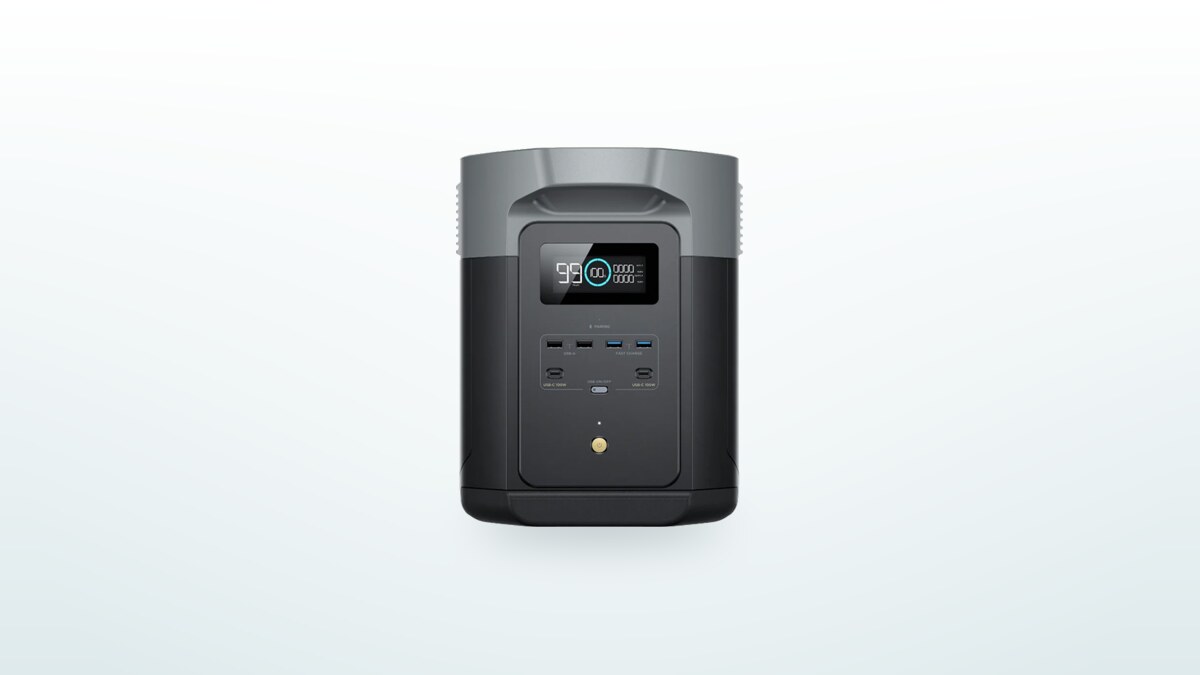
Below roughly 500 W of output, the unit stays generally quiet and close to the advertised value. As the applied load climbs toward maximum power, the noise level reaches 44 to 47 dB, a significant gap on a logarithmic scale where every 10 dB step corresponds to a doubling in perceived loudness. Using the unit at close range during a fast charge or heavy draw therefore turns out noticeably more audible than the spec sheet suggests.
Real efficiency: it varies with the power drawn
Out of the 2048 Wh of advertised capacity, the energy actually delivered sits between 1750 and 1800 Wh over a full charge then discharge cycle, an efficiency of around 85 to 88 %. The inverter's instantaneous efficiency, measured at different load levels, follows a wider range: around 74 % at low load, up to over 90 % at full load.
These two sets of figures do not contradict each other: they describe two different things. Full cycle efficiency includes storage and conversion losses across the entire energy path, while the inverter's instantaneous efficiency varies with the applied load, a common mechanism on this type of device: the electronics draw a near-fixed operating power, which weighs proportionally heavier on a small load than on a large one.
X-Boost 3100 W: what it actually delivers
The X-Boost mode allows the unit to exceed its 2400 W continuous rating up to 3100 W, by tolerating a slightly degraded output voltage. On simple resistive loads, the outcome is concrete: a 1500 W space heater runs at full power, a 2200 W hair dryer runs but with noticeably less heat, and a 2800 W induction cooktop has its power clipped to the point of staying usable only for slowly heating water, not for real cooking.
This mode stays limited to a single appliance at a time, switches off automatically during recharging, and is not recommended for finely regulated electronics such as an air conditioner or a computer, which need a steadier waveform than the degraded mode can supply. Relying on this mode repeatedly beyond its limits would wear the battery faster than staying within the 2400 W continuous rating.
For reliable sizing, it is therefore best to treat the 2400 W continuous rating as the reference, and X-Boost as an occasional fix for a simple resistive appliance, never as a power reserve to draw on continuously.
6144 Wh maximum: expandability that even reaches back to the older generation
The base capacity of 2048 Wh can take up to two additional batteries to reach 6144 Wh in total. Notably, the extension battery built for the Delta 2 Max is also compatible with the unit from the older Delta Max generation (2021), a backward compatibility set by the manufacturer itself. It does not, however, work with the smaller, plain Delta 2, a more modest model from the same name family but with different electronics: the physical connection is detected fine, but charging and discharging do not take place between these two specific units.
One point deserves clarifying so as not to misunderstand how the station can be used: on its mains socket, the unit works in one direction only, it recharges from the grid but cannot feed stored energy back into it. Feeding power back into the home requires a separate add-on unit from the brand. This is not a flaw in itself, more a clarification of the product's positioning: a portable, expandable station, not a bidirectional home storage system.
30 ms backup switchover: useful, but not true round-the-clock backup
The manufacturer's official documentation sets the automatic switchover to battery power at under 30 milliseconds in the event of a mains outage, with one important caveat: this basic backup function does not reach 0 milliseconds. For a computer, a home router or lighting, the transition stays unnoticeable. For equipment that cannot tolerate the slightest micro-interruption, this is not the right solution.
Over time, the base capacity also cannot provide very long-lasting permanent backup: under a typical continuous load, the runtime is closer to a few hours than a full day. For a domestic backup lasting several hours during a one-off outage, the capacity is largely enough; for a need for round-the-clock backup over 24 hours, count on the capacity extension or scale back expectations.
Minor connector issues that can occur, without breaking overall operation
Minor connector faults exist on this model: a USB port that intermittently stops working, usually fixed by a factory reset, or a 12 V cigarette-lighter port that is faulty from the start. None of these cases calls the unit's overall operation into question, but their existence is worth knowing about.
Customer support also stands out as a point of concern, with response times sometimes long and exchanges that can be unsatisfactory. No hard data makes it possible to gauge how often this really happens, but the point is worth flagging rather than staying silent about it.
A real data gap: no degradation measurement after several years
The Delta 2 Max has been on sale since 2023, which should be long enough to measure real capacity degradation over successive cycles. Yet that is not the case: no hard measurement of residual capacity after several years of use has been found, only the manufacturer's own claim (3000 cycles before dropping to 80 % of original capacity).
This lack of hard data does not mean the battery degrades badly: it simply means nobody has published a precise measurement that would objectively confirm it, despite the time the product has been available. That is a real limitation for anyone looking for a firm guarantee on exact longevity beyond the manufacturer's promise.
Mains recharge: 53 minutes, with some nuance on the full 100 %
The 53 minute figure for a 0 to 80 % mains charge is one of the best established points in this review. For a full charge to 100 %, the duration most often sits around 80 to 90 minutes, with a few isolated readings running either faster or slower, without a clear explanation standing out (firmware version or unspecified conditions, depending on the case).
By combining mains and solar recharging at the same time, the charge to 80 % can drop to around 43 minutes depending on the available solar power. The solar input alone tops out at 1000 W spread across two independent MPPT trackers, for a full charge in a few hours on a sunny day.
23 kg: among the lightest in its category, without being light
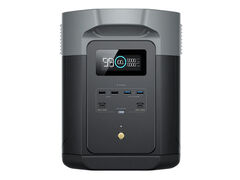
At 23 kg for 2048 Wh, the Delta 2 Max comes in below several direct competitors of the same capacity, which tend to sit around 27 to 28 kg instead. That is still no small weight to carry around regularly, but it is notable at this capacity. No wheels are provided, so moving it relies entirely on the built-in handle: worth keeping in mind for anyone planning to move it around often on their own.
Why LFP chemistry really changes the picture compared with the older generation
The Delta 2 Max succeeds the original Delta Max, released in 2021, which used a nickel manganese cobalt (NMC) chemistry rated for around 500 cycles before dropping below 80 % capacity. The Delta 2 Max switches to lithium iron phosphate (LFP), rated for 3000 cycles, six times more. This shift is not specific to EcoFlow: it reflects a broader move across the entire portable power station industry toward this more stable, longer-lasting chemistry, at the cost of a slightly lower energy density offset by an overall more compact format from one generation to the next.
This chemistry change explains much of the difference in marketing language between the two generations: the longevity promise highlighted on the Delta 2 Max is not just a marketing claim, it corresponds to a real, measurable technical change on paper, even though no independent measurement of wear after several years has yet confirmed it in the field for this specific model (see above).
A price that has dropped sharply since launch
Launched in 2023 at a list price close to €2100, the Delta 2 Max now sits around €949, with occasional promotions that have already dropped below €830 during time-limited flash sales. This drop of more than half in three years is consistent with the usual price trajectory for this type of electronic product, between amortizing research and development costs and newer generations arriving on the market.
For anyone not in a hurry, watching for promotional periods can make a real difference to the final budget, with the gap between the standing price and the best one-off price regularly exceeding €100.
Up against the Bluetti AC200L and the Jackery Explorer 2000 Plus
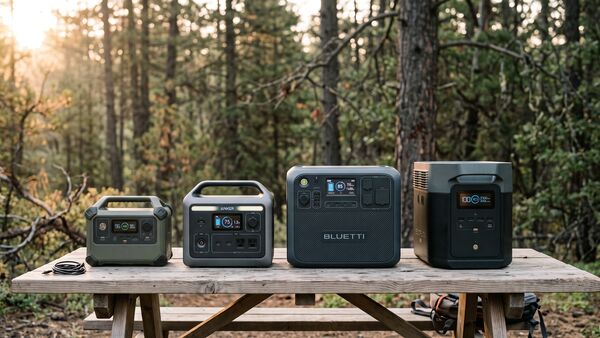
In the 2 kWh station segment, two direct alternatives stand out: the Bluetti AC200L and the Jackery Explorer 2000 Plus.
| Criterion | EcoFlow Delta 2 Max | Bluetti AC200L | Jackery Explorer 2000 Plus |
|---|---|---|---|
| Capacity | 2048 Wh (expandable to 6144 Wh) | 2048 Wh (expandable to 8192 Wh) | 2042 Wh (expandable to 24 kWh) |
| Continuous power | 2400 W | 2400 W | 3000 W |
| Mains recharge 0 to 80 % | 53 min | ≈ 45 min | ≈ 1h30 |
| Weight | 23 kg | ≈ 28 kg | ≈ 28 kg |
The Delta 2 Max remains the lightest of the three and one of the fastest to recharge. The Jackery Explorer 2000 Plus wins clearly on maximum expandability and raw power, while the Bluetti AC200L edges ahead by a few minutes on mains recharging. For versatile use without a need for major expansion, the Delta 2 Max remains a well-balanced choice.
Home backup, RV, job site: where it truly fits in
For occasional home backup, the 2400 W continuous rating covers a large share of a household's appliances, refrigerator and freezer included, and the automatic switchover protects sensitive equipment from a brief outage. Expanding up to 6144 Wh stretches the runtime to cover an outage lasting several days rather than a few hours, provided you invest in the additional batteries.
In an RV or converted van, the base capacity comfortably covers several days of everyday use (refrigerator, lighting, charging devices), and the solar input up to 1000 W can restore a good share of the charge on a sunny day. The 23 kg weight, however, remains better suited to a vehicle with a dedicated spot than to nomadic use on foot.
On a job site without grid access, the continuous power output can run common power tools, and quiet operation at moderate use avoids the nuisance of a combustion generator, with the reservation already raised above about noise under fast charging or heavy load.
Who it suits, who it does not suit
It suits anyone looking for a versatile 2 kWh station that recharges quickly and is relatively light for its category, for use at home, in a van or outdoors, without needing perfectly quiet operation under full load.
It does not suit anyone who needs a very quiet environment during fast charging or heavy draw, nor anyone who needs true round-the-clock backup over 24 hours without an extension, nor anyone looking for direct feed back into the home grid without an additional accessory.