
The MP200's real output against the 200 W claim
As with any solar panel, the 200 W printed on the MP200's spec sheet is a standardised figure (1000 W/m² of irradiance, 25 °C cell temperature, standard spectrum), a convention that is useful for comparing two panels but is never met exactly outdoors. The sun's angle of incidence, cloud cover and the panel heating up in direct sun all pull it down mechanically, a trait shared by this entire product category.
On panels sold under this same commercial reference, the power available in full summer sun, under a clear sky and with the tilt angle set correctly, climbs to around 190 W, close to 95% of the nominal figure, a high proportion for this format. With weaker sunlight (late morning, autumn light) it tends to sit closer to 120 W. As soon as heavy cloud cover moves in, available power drops to 30 to 40% of nominal, roughly 60 to 80 W.
As a rough order of magnitude, these figures mean roughly 5 to 6 hours of full sun to fully recharge a 1000 Wh station in the best case, and more than 14 hours once the sky clouds over, before conversion losses. The MP200's monocrystalline cells are rated up to 23.4% efficiency, a figure in the upper half for a foldable panel of this power, though it does not reach the 25%+ N-type cells fitted to some newer bifacial rivals.
Weight and folded size
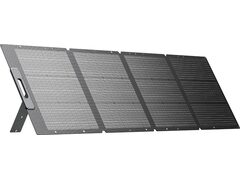
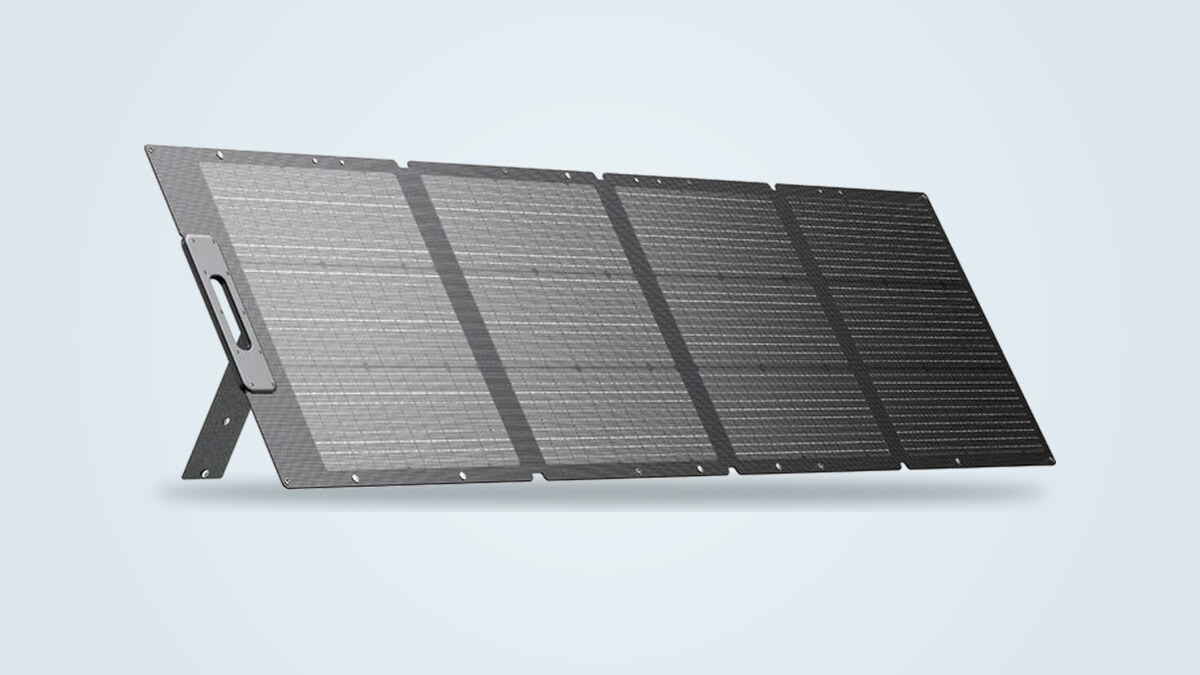
Unfolded, the MP200 measures 60.8 x 210.5 cm, a considerable length that comes from its four hinged sections, each roughly 52 cm wide. Folded, it forms a briefcase-shaped block of 60.8 x 58.5 x 4.5 cm and carries by a handle built into the first section.
On the scales, the MP200 is rated at 8.14 kg, making it one of the heaviest 200 W foldable panels in our catalogue. For comparison, a recent bifacial panel of the same power comes in at 4.8 kg, a standard N-type model reaches 6.2 kg, and another bifacial rival is rated at 5.1 kg: only one other monocrystalline four-panel unit gets close to its weight, at 8.02 kg. The gap matters most when carrying it on foot or hiking; loaded into a van or a boot, it counts for far less.
The four-section folding system, hinged with sewn fabric joints, packs down fairly flat, even if its footprint is slightly larger than two-panel units of the same power. The handle built into the first section makes short carries easy, but its single oval grip is no substitute for a proper shoulder strap over a longer walk.
One commercial reference, several different panels
Worth knowing before buying, more so than any single line on the spec sheet: Bluetti sells several generations of 200 W panel under the single MP200 reference with genuinely different characteristics, and the manufacturer itself warns that the unit actually shipped can vary. The version described in this review (23.4% efficiency, 8.14 kg, IP67) is the one currently listed by the manufacturer, but it is not the only one to have carried this name.
| Specification | Version described here | Range under the same reference |
|---|---|---|
| Cell efficiency | 23.4% | 23.4 to 24% |
| Quoted weight | 8.14 kg | 7.3 to 8.7 kg |
| Open-circuit voltage (Voc) | 24.6 V | 24.6 to 26.1 V |
| Ingress protection | IP67 | IP65 to IP67 |
This spread is not trivial: a 1.4 kg difference is noticeable when carrying the panel, and the gap between IP65 (splash resistance only) and IP67 (brief immersion resistance) genuinely changes what you can risk in wet weather. Before using a newly received unit, it is worth checking the specifications printed in its own manual rather than relying solely on this page, which describes the version currently listed by the manufacturer without guaranteeing it matches the unit delivered.
Keeping one product code across generations to avoid multiplying retail listings is not unique to Bluetti, but the scale of the gaps here (up to 1.4 kg, two full IP steps) deserves particular attention before buying. One more practical consequence flagged by the manufacturer itself: never wire two different versions sold under this reference together in series, as it risks unbalancing the input voltage seen by the station.
Claimed weatherproofing and frame durability
The ETFE coating over the MP200's cells is a common choice on higher-end foldable panels: more scratch and UV resistant than plain PET lamination, it helps the panel withstand repeated folding and unfolding over its working life.
The IP67 rating claimed for the version described here is more ambitious than the IP65 (splash resistance only) claimed by several direct rivals of the same power. Unlike one direct rival with the same IP67 certification, whose own manufacturer page separately advises against any exposure to rain or snow, the MP200 carries no such caveat in its own documentation.
On the other hand, the frame has no tie-down loops at all: only assembly rivets are visible around its edge. That rules out staking the panel down with cord or a peg in windy conditions, a gap not shared by every panel at this power level. The manufacturer also does not quote a cycle-life figure for the fabric hinges joining the four sections.
One last limit already touched on: the quoted operating range, -25 °C to 65 °C, covers almost any outdoor use, but it applies to the version described here. Nothing guarantees it is strictly identical on another version sold under the same name.
The MC4 connector and its limits
The MP200 offers a single output: a standard MC4 connector at the end of a cable built into the panel. That is the norm for portable solar, which opens up broad compatibility: beyond Bluetti stations fitted with a suitable input (AC180, AC200L, Elite 100 V2, Elite 200 V2, EB3A and others), most third-party solar generators with an MC4 input can plug in directly.
Two real limits come with that choice. First, there is no USB-A or USB-C output on the panel itself: charging a phone or a powerbank directly is impossible without routing through a station or an intermediate controller with its own ports. Second, unlike some direct rivals that bundle a multi-tip cable or an extra adapter alongside the native MC4, the MP200 ships with a single, non-detachable MC4 cable: connecting to any system without a native MC4 input means buying a separate adapter.
The built-in cable is a fixed length that cannot be extended without an adapter, worth checking if the station needs to sit several metres from the panel out in the sun.
Adjustable kickstands and setting up on site
Each section of the MP200 has its own rear kickstand, adjustable across several positions and locking without tools. That adjustable tilt lets the panel face the sun more directly depending on the time of day, a genuine production gain over a panel simply laid flat.
Full deployment takes only a few seconds once the panel is out of its sleeve: unfold the four sections and set the kickstands to the position needed. On loose ground (sand, damp soil), the lack of tie-down loops already noted makes it harder to keep the panel stable in strong wind: the kickstands alone do not always stop it tipping over, a limitation shared by several panels of this format without a dedicated anchoring system.
Build quality, warranty and brand track record
Bluetti is an established player in the portable solar generator market, with a wide catalogue of panels and stations spanning pocket-sized units to multi-kilowatt installations. The MP200 carries a 2-year manufacturer warranty, in the middle of the segment: neither the shortest nor the longest against direct rivals ranging from 2 to 5 years depending on the brand.
No recall or safety issue has been identified for this panel. The ETFE coating and the four rigid, fabric-hinged sections are a proven approach, shared by most higher-end foldable panels of this power.
The most serious concern on this axis is indirect: the manufacturer's handling of a single commercial reference across several generations of hardware with distinct specifications, detailed above, reflects room for improvement in product communication, even though it does not affect the build quality of any individual unit.
Against the direct 200 W competition
Around £400, the MP200 competes with several foldable panels of the same nominal power. The table below summarises the most significant gaps against three direct references.
| Criterion | Bluetti MP200 | Anker Solix PS200 | Fossibot SP200 | Jackery SolarSaga 200W |
|---|---|---|---|---|
| Weight | 8.14 kg | 4.8 kg | 8.02 kg | 6.2 kg |
| Cell efficiency | 23.4% | over 25% (bifacial N-type) | 23.4% | 25% |
| Ingress protection | IP67 | IP68 | IP67 | IP68 |
| Connectivity | MC4 only | MC4 + XT60i included | MC4 + 4 tips included | MC4 only |
| Warranty | 2 years | 5 years | 2 years | 3 years |
| Observed price | about £399 | about £298 | about £219 | about £399 |
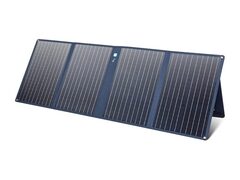
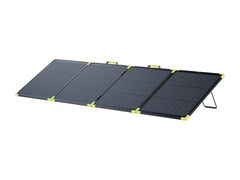
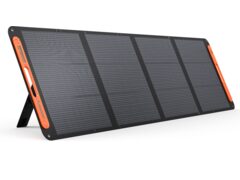
The MP200 sits between the two extremes of this comparison: it has neither the low weight of the bifacial PS200 nor the accessible price of the SP200, but it matches or comes close to both rivals on claimed weatherproofing and cell efficiency. Against the Jackery SolarSaga 200W, pricier and a touch lighter, the MP200 keeps a price edge at broadly comparable specifications. The real trade-off has less to do with brand than with the buyer's own priorities: minimum weight, a tight budget, or the versatility of the cables included in the box.
Who this panel suits, and who it does not
The MP200 suits a van, motorhome or garden setup where the panel stays on the ground near the station being charged, without being carried daily over long distances: its weight is barely noticeable once loaded into a vehicle, and its universal MC4 output opens it up to most stations on the market, Bluetti or otherwise. The price also stays reasonable against better-equipped but pricier rivals.
It suits hiking or bikepacking less well, where every hundred grams counts: a recent bifacial panel drops under 5 kg for equivalent power. It is also not the right fit for anyone wanting to charge a phone or a powerbank directly in the sun, since there is no USB port: that means routing through a station or an intermediate controller instead.
Before buying, the single most important point remains the variability found under this same commercial reference: check the manual supplied with the unit received on arrival rather than relying solely on the specifications described here, which cover the version currently listed by the manufacturer.