
Bluetti Elite 100 V2: our full review

Between 890 and 946 Wh actually returned out of the 1024 Wh claimed: one of the best efficiency figures in its compact category. But the 30 dB claimed only holds under 600 W, with the real figure climbing to 49 dB at full power, and a genuine fault affected the startup of some refrigerators at launch, since fixed by a firmware update.

Our rating
3.9/5
Capacity and efficiency: 4.3 out of 5 (weighting 25%)Capacity4.3Output power: 4.0 out of 5 (weighting 25%)Power4.0Recharging: 4.1 out of 5 (weighting 15%)Recharging4.1Ports and control: 3.6 out of 5 (weighting 15%)Ports3.6Build and endurance: 3.6 out of 5 (weighting 12%)Build3.6Noise: 3.5 out of 5 (weighting 8%)Noise3.5
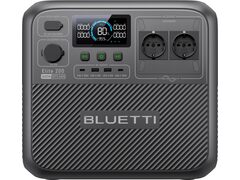
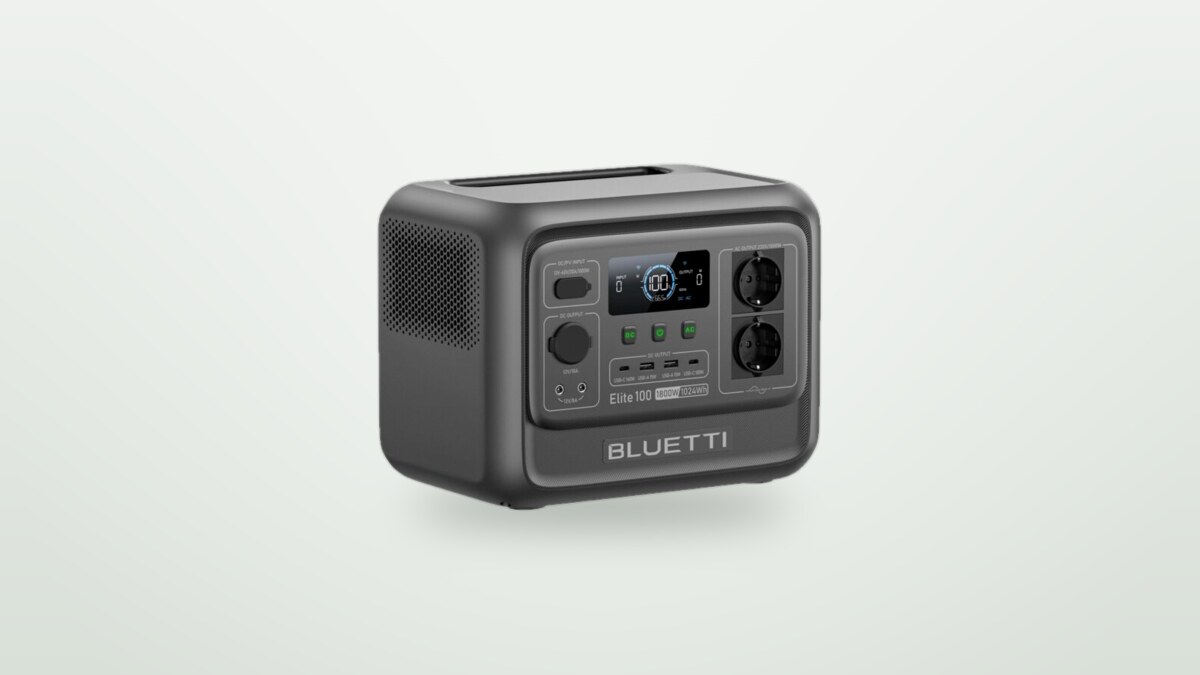
Bluetti Elite 100 V2 portable power station seen from a three-quarter angle, screen lit, two mains sockets and USB ports visible

The essentials

The Bluetti Elite 100 V2 lives up to its performance promises: between 890 and 946 Wh actually returned out of the 1024 Wh claimed, one of the best efficiency figures in its compact category, and a full charge in 66 to 70 minutes once TurboBoost mode is switched on from the app. Two commercial omissions are worth knowing: the claimed 30 dB only holds under 600 W, with the real figure climbing to 48-49 dB(A) at full power, and the 45 minutes claimed for 80 % charge actually run closer to 50. More seriously, a genuine early-life fault affected the startup of some small refrigerators and freezers, since fixed by an update, and cases of permanent shutdown exist, with no known frequency. With only two mains sockets and a catalogue price noticeably above the price actually observed on the market, it remains a solid compact station, provided you check its firmware and compare prices before buying.

Strengths

  • Between 890 and 946 Wh actually returned out of the 1024 Wh claimed, one of the best efficiency figures in its compact category
  • Full charge in 66 to 70 minutes, matching or beating the claim once TurboBoost mode is switched on
  • Solar input up to 1000 W, the most generous in its compact-format category
  • UPS function confirmed with no perceptible interruption on a desktop computer
  • Compact format, easy to carry with one hand, 11.5 kg
  • No recorded safety recall, either on this model or the brand

Limitations

  • Only two mains sockets, against three at part of the direct competition
  • The claimed 30 dB only holds under 600 W: up to 48-49 dB(A) at full power
  • A genuine startup fault on some small refrigerators and freezers at launch, since fixed by an update but requiring up-to-date firmware
  • Cases of permanent shutdown exist, with no frequency statistics available
  • Catalogue price noticeably above the price actually observed on the market
  • Official five-year warranty documentation incomplete for this specific model
Cost of available energy
658 £per kWh returned

Computed from today's price and the measured capacity, not the claimed capacity. Cheaper than 10 of the 14 comparable products in the catalogue, on claimed capacity.

Bluetti Elite 100 V2: see the full details and price →

1024 Wh claimed, between 890 and 946 Wh actually available

The 1024 Wh printed on the case are a LiFePO4 cell capacity, measured upstream of the inverter. Through the mains socket, the energy actually recovered depends on the power drawn, and on this model the gap stays contained.

Returned energy at 230 V settles in a range of 890 to 946 Wh depending on the load, or 87 to 92 % of rated capacity. That is a very good result for this compact format: return efficiency climbs as high as 92 % under a moderate 500 W load, before easing back to around 88 % at full power.

1024 Wh
rated capacity claimed
910 Wh
typical return (230 V)
89 %
share of rated capacity actually available

Full wall-to-socket efficiency settles around 82 % on the mains round trip, and close to 91 % at peak return. A full charge takes around 1140 Wh drawn at the meter, consistent with the 1024 Wh stored. On the DC outputs, efficiency climbs further: around 86 % over USB-C, but only 66 % on the USB-A ports, noticeably behind.

70 minutes claimed: real, but only once the right mode is switched on

Timed in TurboBoost mode, a full charge takes 66 to 70 minutes, matching or beating the claim. The 80 % mark is reached in around 50 minutes, a little more than the 45 claimed.

66 min
full charge in TurboBoost mode
50 min
up to 80% of charge
1200 W
maximum mains charging power
The condition rarely highlighted: the TurboBoost mode needed to reach these times does not switch on by itself. It has to be turned on from the app, and without it the station charges at around 600 W, close to double the claimed time. Without that mode active, a full charge takes close to 1 h 50, a considerable gap for a simple setting left untouched.

Another point worth knowing: regular use of the fast mode places extra strain on the battery over time. For an everyday charge with no urgency, the standard mode remains a reasonable choice, even at the cost of speed.

On the solar side, the input accepts up to 1000 W, the most generous in its compact category. But it goes through a single XT60 connector, which in practice limits how many panels can be combined without an extra adapter.

30 dB claimed, up to 49 dB in practice at full charge

The 30 dB figure quoted by the manufacturer is real, but it only holds under a load below 600 W. As soon as the station charges in TurboBoost or delivers close to its maximum power, the level climbs to 48 to 49 dB(A) at one metre, a ceiling that stays the same between fast charging and discharge at 1800 W.

30 dB
claimed, under 600 W only
49 dB
reached at 1 m in fast charging or at full power

The positive point is that this ceiling does not get worse even at full charge: the fans are thermally controlled and do not climb further. One case describes near-continuous fan operation even under very light load (around 15 W) on a single unit, at odds with the behaviour usually described: worth watching rather than generalising, since it concerns a single instance.

On the surface, the station does not run worryingly hot: around 38 to 45 °C after 30 minutes at full power, for a 25 °C ambient temperature.

Only two mains sockets, and a standby draw worth watching

With only two mains sockets, the Elite 100 V2 sometimes forces the use of a power strip to plug in several appliances at once, where part of the direct competition offers three. The rest of the connectivity stays generous: two USB-C ports (one at 140 W), two USB-A ports and two DC outputs.

With the mains output switched on and nothing plugged in, the station draws between 10 and 16 W depending on the mode, peaking at around 13 W in the advanced scheduling mode. That is not negligible over several days on standby, even though an eco mode exists to cut this draw.

Worth knowing before buying: fine control (charge ceiling, silent mode, scheduling) runs entirely through the app. Its stability is uneven, ranging from glitchy to very polished depending on the build, likely tied to the version installed.

A genuine launch fault on compressor loads, since fixed

At launch, a real and reproducible technical issue affected the startup of some small compressor-based refrigerators and freezers: the appliance struggled to start, the refrigerator's interior light pulsed, and the power shown by the station differed sharply from the power actually drawn, as read on a wattmeter.

The issue specifically affected small conventional compressor loads, not large appliances or inverter-type compressors, which worked normally from the start. A firmware update has since fixed this behaviour for the loads concerned, after first being rolled out to a portion of units for testing before wider release.

The point to remember: a unit sold as refrigerator backup initially carried a genuine weakness on that exact use case. For a station left without a firmware update, nothing guarantees this behaviour has been fixed: check the installed version before relying on it for a critical use.

Permanent shutdowns, and firmware that cuts both ways

A second, distinct fault affects a portion of the units in circulation: a complete and permanent shutdown of the unit, with no restart possible through the button or the app. In one case, it took over a month of waiting for parts before an approved repair centre could reach a diagnosis.

Other firmware updates have introduced the opposite behaviour, just as troublesome: unable to switch off with a long button press, or conversely refusing to restart after an update, with the only fix being to reconnect a power source to the solar input to wake the unit.

No public failure-rate statistics exist, and overall ratings on the markets where reviews exist (around 4.5 to 4.7 out of 5) do not point to a mass failure. Such cases nonetheless remain real, without it being possible to measure their exact frequency.

Five-year warranty claimed, an official documentation gap to clear up

The five-year warranty, put forward in commercial spec sheets and confirmed on sales pages, has a curious gap: the manufacturer's own official page listing warranty length by model does not mention this specific product, only older models in the range. This duration is therefore not spelled out in the expected place.

A confirmed positive point: no product registration is required for the standard warranty, with a dated proof of purchase being enough. On the other hand, the extended warranty offered on other products from the brand is explicitly not open to this model.

No safety recall: neither this station nor the brand has been subject to any recorded official recall to date, a situation that stands out against several direct competitors in the sector that have had recalls for overheating risk over the past two years.

Three lineup traps to avoid before buying

The name "Elite 100 V2" covers several different products that are worth telling apart before comparing prices or reviews.

A "Bio-based" version exists, with strictly identical electrical specifications, only the casing changing material (bio-based plastic). The two versions can therefore be compared without reservation on technical grounds.

The "Premium 100 V2", on the other hand, often displayed side by side in shops, is a different model with a higher claimed power output. The two should not be confused when comparing prices or specifications.

Finally, in the Japanese market, this same product is sold under an entirely different name, which explains the apparent scarcity of Japanese reviews under the name used in Europe.

Against competitors of comparable capacity around 1000 to 1070 Wh, the Elite 100 V2 stands out for its generous solar input and an efficiency among the best in its category, but it loses ground on the number of mains sockets and on catalogue price, noticeably above the price actually observed on the market.

Who it suits, and who it does not

It suits anyone looking for a compact format that is easy to carry with one hand, for camping, remote work on the move or occasional backup at home, with good efficiency and fast charging once the right mode is switched on. Its UPS function, confirmed with no perceptible interruption on a desktop computer, makes it a reliable base for protecting sensitive equipment.

It suits less anyone who needs to plug in more than two mains appliances at once, wants to power large appliances continuously, or plans to use it as refrigerator backup without first checking that the firmware is up to date.
In one sentence: a compact station with genuinely good efficiency and fast charging, held back by only two mains sockets, a fan louder than claimed at full power, and a genuine early-life fault on compressor loads that needs to be confirmed as fixed by an update.

The product and its alternatives

Bluetti Elite 100 V2

Bluetti Elite 100 V2

599.00£ (11)

1024Wh and 1800W in just 11.5kg: the ultra-compact power station that recharges to 80% in 45 minutes and switches to UPS backup in 10ms.

View product
Bluetti AC180

Bluetti AC180

See price (9)

1152Wh and 1800W in a portable format: the versatile power station that runs almost anything and recharges to 80% in 45 minutes. Camping, van and home backup.

View product
Bluetti Elite 200 V2

Bluetti Elite 200 V2

See price (8)

2073Wh and 2600W in a 40% more compact format: the new-generation power station with lightning recharge in 1h, UPS function and a battery rated for 17 years.

View product
Bluetti Elite 300

Bluetti Elite 300

1599.00£ (4)

3014 Wh, 2400 W (4800 W surge) in just 26.3 kg: certified by Frost & Sullivan as the world's most compact 3 kWh power station.

View product

Frequently asked questions

Between 890 and 946 Wh through the 230 V socket depending on the power drawn, or 87 to 92 % of rated capacity. That is a good result for a station of this compact format.

Yes, but on one condition: TurboBoost mode has to be switched on from the app. Without it, charging runs at reduced power and takes close to double the time.

It is real but limited to a load under 600 W. At full charge or in fast-charging mode, the level instead climbs to 48 to 49 dB(A) at one metre.

A real fault affected the startup of some small compressor-based refrigerators and freezers at launch. A firmware update has since fixed this behaviour: check that your station is up to date before relying on it for this use.

Two mains sockets (230 V), a more limited number than part of the direct competition, which offers up to six. The rest of the connectivity (USB-C, USB-A, DC outputs) remains complete.

The rating in detail

Our rating
3.9/5
Capacity and efficiency 4.3
Output power 4.0
Recharging 4.1
Ports and control 3.6
Build and endurance 3.6
Noise 3.5
Bluetti Elite 100 V2: see the full details and price →