
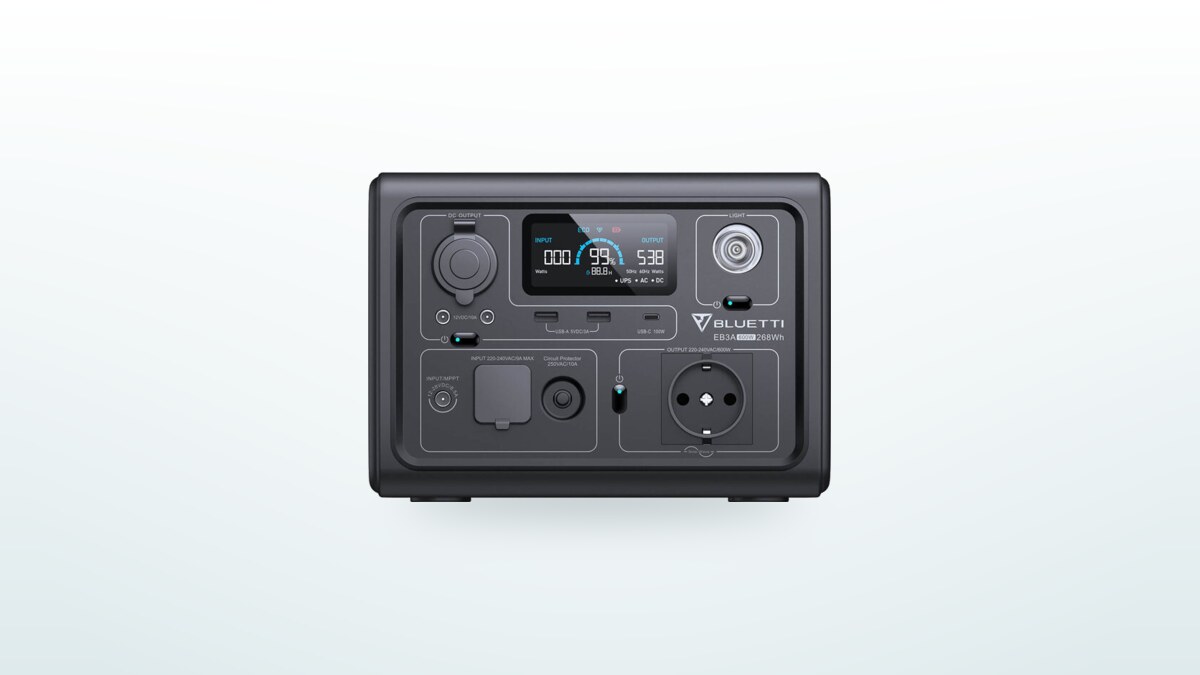
A product that is now discontinued
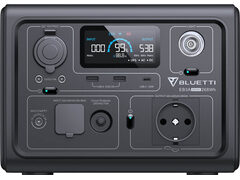
Launched in 2022, the Bluetti EB3 A has now been withdrawn from production by the manufacturer, which replaces it with the Elite 30 V2 (288 Wh, 5-year warranty). The EB3 A remains available while stocks last, at a price now notably lower than its launch price.
This status does not undermine the value of a review of this product: with several years of hindsight now available, the Bluetti EB3 A actually offers a far better-known reliability profile than a recent launch. It does change the buying advice, however: more appealing on sale or secondhand than at full price against newer, better-warrantied models.
1200 W in surge mode: the power actually available
The spec sheet highlights a continuous output of 600 W, with a surge mode rated up to 1200 W for occasionally getting a hungrier appliance through. Under a resistive load close to that upper limit, the output voltage sags sharply, dropping from around 230 V to around 140 V, for actual delivered power that falls back to around 360 W, far short of the claimed 1200 W.
This mode works through widened voltage tolerance, reserved for purely resistive loads such as a space heater or an iron: it is not suitable for sensitive electronics, nor for motor- or compressor-driven appliances, a point the official documentation specifies but that the "1200 W" figure alone, prominent in the marketing, does not suggest. On a hair dryer or a high-end electric kettle, the power obtained remains well short of what the connected appliance itself claims.
For reliable sizing, it is therefore better to treat the 600 W continuous rating as the real usage ceiling, and to treat surge mode as an occasional fix on a heater, rather than as a broadly usable power reserve.
30 or 40 minutes to 80 %? What the data show
The figure most often highlighted, a charge from 0 to 80 % in 30 minutes, corresponds to a combined input power of 430 W, reached only by combining AC charging with a second simultaneous source (solar or 12 V). On AC power alone, actual input power caps out closer to 330 W, which mechanically extends the time needed.
The manufacturer's own documentation is not entirely consistent on this point either, with some more recent marketing materials citing 40 minutes to reach 80 % instead. The best-established duration, and the most useful for planning a full recharge, sits closer to 1 hour 15 minutes to 1 hour 30 minutes on AC power alone, a range that stays consistent from one measurement to another despite the gap on the "30 minutes" figure alone.
In absolute terms, this charging time remains fast compared with the direct competition from its launch era, which generally needed several hours for an equivalent capacity. Charging speed therefore remains a genuine strength of the product, provided one does not expect to systematically match the most flattering figure shown at the top of the spec sheet.
Real-world efficiency: good at full load, weaker on light draw
Out of the 268 Wh of rated capacity, the energy actually retrievable most often falls between 220 and 231 Wh, for an efficiency of around 82 to 86 %. A noticeably higher efficiency, around 94 %, appears in isolation and without corroboration: this discrepancy remains unexplained and deserves to be treated with caution rather than taken as the reference value.
This efficiency is not a fixed value: it drops noticeably when the power drawn is low. Under a modest continuous load, on the order of 85 W, typically a laptop plugged in for several hours, measured efficiency falls to around 55 %, against 78 % under a heavier 400 W load. The mechanism is a classic one for this type of device: the inverter draws an almost fixed operating power, which weighs proportionally more heavily when the connected load is small.
In practical terms, this means the EB3 A suits medium or sustained power uses better than permanent standby duty for small, isolated loads: in the latter case, a significant share of the stored energy is simply lost in conversion.
Standby parasitic consumption follows the same logic: switched off, the battery holds its charge over long periods, but left with its AC or DC outputs enabled and nothing plugged in, it discharges at around 4 to 5 % per hour. A detail worth knowing for anyone planning to leave the station in standby for extended periods rather than switching it off completely between uses.
A charge indicator that sometimes loses track
A recurring fault affects the product, over a period spanning several years: the displayed remaining-battery percentage can jump abruptly by several dozen points, or freeze temporarily near the end of charging or discharging, before correcting itself or after a full recalibration cycle.
Its recurrence across several years makes it the most notable hardware-related point of caution for this product. Nothing indicates a widespread hardware failure rather than a software behavior of the battery management system: however, no numerical measurement makes it possible to determine precisely between the two explanations.
Occasionally unexpected protection shutdowns, particular caution for CPAP use
Beyond the 600 W continuous power threshold, an overload protection shutdown can trigger: nothing unusual about that on its own. More troubling, a shutdown is sometimes triggered under much more modest loads, on the order of a few dozen watts, particularly during extended use as an instant backup (UPS/EPS function).
This point deserves particular attention for anyone considering the EB3 A as backup power for a CPAP device, a use case the product's own marketing actually highlights: an unexpected shutdown in the middle of the night defeats the very purpose of the backup function. The manufacturer itself notes, on a dedicated page, the existence of an automatic protection shutdown in the event of deep discharge or overheating, presented as normal safety behavior rather than a defect.
No software fix specifically resolving this behavior has been identified, and no official product recall exists either. For critical, extended backup use, a prior check with the specific device involved, rather than blind trust in the spec sheet, remains the most prudent approach.
A difficult start in 2022, not to be confused with the current situation
At launch, quality control proved uneven, with a higher rate of units arriving defective and customer service response times well beyond the stated commitment. These cases are concentrated almost entirely in the very first weeks of commercialization, a classic production-line break-in period rather than an indicator of the product's reliability as it later circulated over the following years.
It would therefore be misleading to present this rocky start as representative of the product's current state, several years and many production cycles later. It remains useful to know, however, for anyone considering buying an older secondhand unit: checking that it works properly on receipt remains a reasonable precaution, as with any secondhand electronic device.
A fan that is clearly audible under load
Noise level under load most often falls between 44 and 54 dB, a fairly wide range that mostly reflects differences in load and listening distance rather than a genuine divergence between units. In any case, the fan becomes clearly audible or noticeable as soon as the load drawn exceeds about a hundred watts.
Under light use, below about a hundred watts, the unit generally stays quiet or even inaudible. It is mainly under sustained load or during fast charging that the fan becomes noticeable, a behavior typical of this type of station but one that stands out here as a more pronounced weakness than on other comparable models.
2-year warranty and after-sales support: the weakest point of the file
The manufacturer's warranty remains fixed at 2 years, short compared with much of the direct competition, and with the brand's own successor, the Elite 30 V2, which moved to 5 years. A warranty extension program exists at the manufacturer but explicitly excludes this model, reserved for higher-end ranges.
After-sales support can be slow and unsatisfying, with turnaround times of several weeks and inconsistent handling from one case to the next. This situation is not specific to this product, which suggests a broader customer-support capacity issue rather than an isolated flaw in this particular model.
Connectivity and wireless charging: a genuine strength
With up to eight simultaneous outputs, one AC socket, a 100 W USB-C port, two USB-A ports, two DC 5521 outputs, a 12 V car socket, and a built-in 15 W Qi wireless charging pad on top, the EB3 A remains generous for its size and price. The European version has a single 230 V socket, capped at 600 W: as soon as two mains appliances need power at the same time, a power strip becomes essential. Wireless charging works through a thin case without needing to remove it, with a slightly lower efficiency than wired charging, on the order of 85 %, which is normal for this type of technology.
This feature has remained uncommon on compact stations in this price segment, and largely explains the product's initial appeal for everyday nomadic use: setting a compatible smartphone directly on the unit, with no extra cable to carry, remains a genuine everyday convenience.
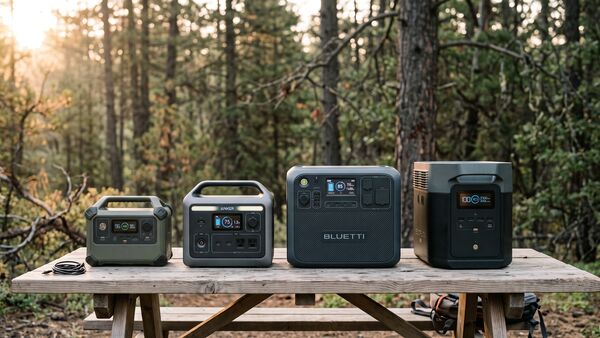
Camping, road trips, photography: the format behind the EB3 A's success
Weight and compact size remain the product's best arguments for occasional nomadic use. While camping, its 268 Wh and 600 W output are enough to run an electric cooler, lighting, and charging for several devices over a weekend, with enough margin for an occasional small kitchen appliance thanks to surge mode, as long as it stays a simple, short-duration resistive load.
In a vehicle, charging on the move through the cigarette lighter socket usefully supplements AC charging between stops, a use case well suited to the compact size and low weight. On a film shoot or an outdoor photo session, the same logic applies: the EB3 A functions as a small nomadic power hub, able to recharge numerous camera batteries and power supplementary lighting, without weighing down the transported gear.
For heavier use, several days without recharging or a compressor fridge running continuously, the 268 Wh capacity quickly shows its limits: this is a format designed for topping up and short-term needs, not extended runtime.
What remains unknown after several years of hindsight
Despite the product's age, one precise figure is still missing: no independent measurement of actual residual capacity after several years of use is available. On long-term durability, the most complete reference point covers 500 cycles of charge and discharge with no apparent degradation, or only about a fifth of the 2500 cycles claimed: it does not allow any conclusion about real durability across the full promised lifespan.
Over one to two years of use, no perceptible day-to-day capacity loss stands out. This lack of precise numerical data nonetheless remains a real limitation for anyone looking for a firm guarantee on the battery's exact longevity over a multi-year horizon.
Up against the EcoFlow River 3 and the Jackery Explorer 300 Plus
In the ultra-compact power station segment around 250 to 300 Wh, two direct references stand out as alternatives: the EcoFlow River 3 and the Jackery Explorer 300 Plus.
| Criterion | Bluetti EB3 A | EcoFlow River 3 | Jackery Explorer 300 Plus |
|---|---|---|---|
| Capacity | 268 Wh | 245 Wh | 288 Wh |
| Continuous power | 600 W | 300 W | 300 W |
| Weight | 4.6 kg | 3.4 kg | 3.75 kg |
| Wireless charging | Yes, 15 W | No | No |
| Warranty | 2 years | 5 years | 3 years |
The Bluetti EB3 A keeps a clear advantage in available continuous power, double that of its two direct rivals, and in its built-in wireless charging. It loses ground, however, on warranty length, notably shorter than both rivals. The brand's own successor, the Elite 30 V2, carries the same formula while fixing exactly this point with a 5-year warranty, which makes it today's natural alternative to consider first for a new purchase in this price segment.
Who it suits, who it does not suit
It suits anyone looking for a light, powerful backup reserve for electronics and small appliances, for camping, nomadic remote work, or occasional emergency use, and who finds it at a reduced price as production winds down. The weight-to-power ratio and connectivity remain genuine strengths for this kind of use.
It does not suit anyone looking for critical, extended backup power, particularly for a medical device such as a CPAP, given the protection shutdowns that sometimes occur under low load, nor anyone who prioritizes a long warranty and responsive support: on these two specific points, newer alternatives from the same brand or from direct competitors now offer better guarantees.