
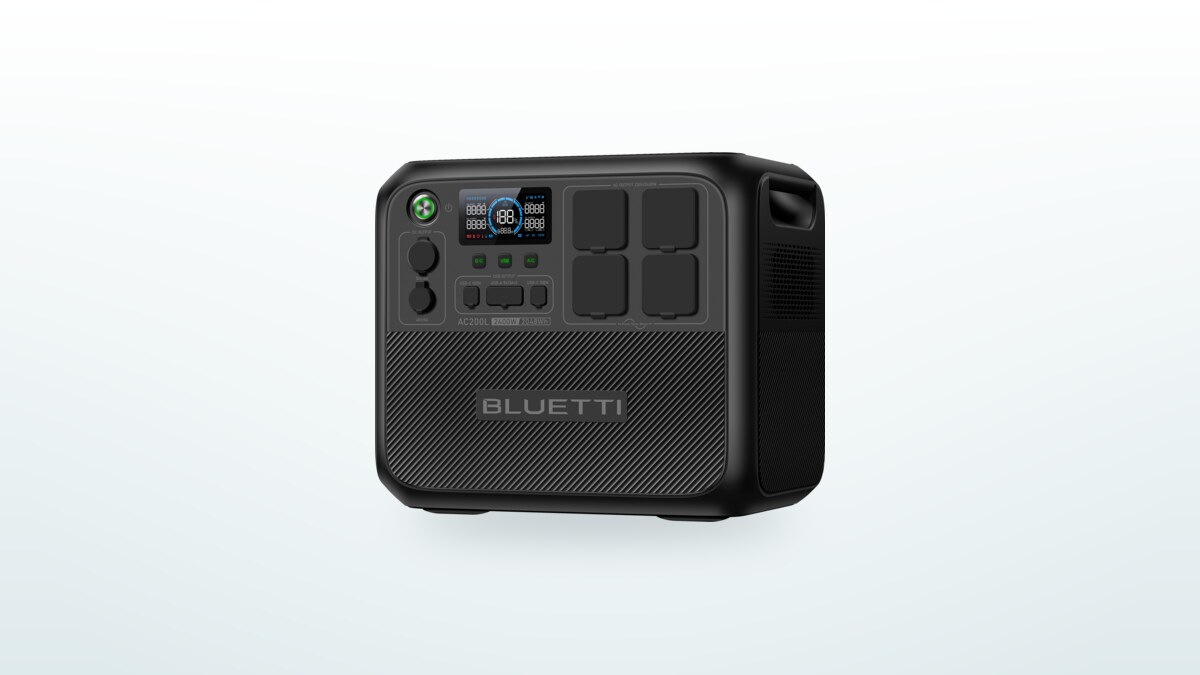
2048 Wh claimed: real-world efficiency between 76 % and 97 %, depending on what you measure
Efficiency is the point where the available figures diverge the most for the AC200L, without actually contradicting each other once you look at what each number is really measuring.
Counting the full cycle (charging from the mains, then discharging, including conversion losses) puts round-trip efficiency at about 76 %: of the 2217 Wh drawn while charging, 1.68 kWh actually comes back usable. Other figures, which count only the discharge of an already-full battery without the charging losses, run noticeably higher, between 85 % and 97 %. The manufacturer's own figure ("up to 92 % AC efficiency") covers only the inverter by itself.
These three numbers are not contradictory: they answer three different questions, how much comes back once everything is counted (round trip), how much comes out of an already-charged battery (discharge only), and how efficient the inverter is on its own. Absent a common protocol across these figures, usable capacity is best put at around 1780 Wh of the 2048 Wh claimed, or roughly 87 %, as a central order of magnitude rather than a definitive measurement.
Power Lifting at 3600 W: better suited to motors than resistive loads
Beyond the 2400 W continuous rating, Power Lifting mode claims to reach up to 3600 W. In principle, this function is meant to absorb the start-up spikes of motor-driven appliances (compressors, power tools), not to sustain a heavy resistive load continuously.
Without pinning down the exact limit, behavior seems to vary with the load: above 3000 W, a combined purely resistive load (kettle, toaster) sees its output power reduced during use, while a resistive heater alone can hold up longer before a thermal cutoff. These two situations do not cover the same loads and do not settle on an exact threshold. Motor-driven loads, by contrast, showed no sign of output limitation, consistent with the function's stated purpose.
No independent measurement with a clear protocol (oscilloscope or wattmeter on an actual compressor) was found to settle this point more precisely.
"50 dB maximum": a manufacturer figure, with no independent measurement found
The sound level Bluetti advertises, "50 dB maximum," is repeated identically across all of the manufacturer's own materials, without ever specifying the measuring distance. That is a marketing figure, not a lab measurement.
No independent sound-level measurement with a described protocol was found for this model. In everyday use, the unit runs particularly quiet, quiet enough that it can be hard to tell it is still running at full load, though no dB figure reliably backs up that impression.
This axis is therefore not factored into this review's detailed rating, for lack of a usable measured figure.
80 % in 45 minutes confirmed, with a Japanese version significantly capped
On the European version, Bluetti's claimed 0 to 80 % mains charge in 45 minutes holds up in practice, a rare case for this kind of spec where the claim and real-world experience do not always line up. The full charge itself even comes in slightly faster than announced: around 1h10 versus the stated 1h30.
Solar input is rated up to 1200 W on a single MPPT controller. With 800 W of panels, recharging takes 4 to 5 hours in good sun or 8 to 12 hours under overcast skies, durations consistent with an array sized below the rated maximum.
Worth noting for the sake of this review's rigor, with no bearing on the version sold in Europe: the version sold in Japan is significantly power-capped, a limitation tied to the local 100 V domestic grid, with lower figures than the European version: 2000 W continuous instead of 2400 W, 6000 W peak instead of 7200 W, and an 80 % charge in 60 minutes minimum instead of 45. A useful reminder that power station figures travel poorly from one market to another.
Expandable to 8192 Wh, but stacking is less polished than advertised
The AC200L's central selling point is its expandability: two B300 batteries take total capacity up to the claimed 8192 Wh, without changing the inverter. Another line, the B300K, also exists for this model but tops out a bit lower, at 7577.6 Wh for two units. On the software side, recognition is fast: the app displays the new total capacity within seconds of connecting.
On the physical side, a design flaw shows up specifically with the B300K battery: the extension ports on the main unit and on the battery sit on opposite sides instead of lining up, which forces one of the two units to be flipped around to use the supplied cable. Both stacking and side-by-side placement look visually unpolished, and the main unit's screen can end up facing away from the battery's control button once both are placed against a wall.
Another point worth knowing before expanding the system: rated lifespan differs between the two components, 4000 cycles for the B300K battery against 3000 for the AC200L main unit, and weight adds up without mercy (figures for the B300K): a B300K weighs about 29.5 kg, which pushes the combined total past 55 kg to move around.
20 ms backup switchover: a specification, not a measurement
The UPS function, which switches power over during a mains outage, is rated at 20 ms, a delay short enough to avoid restarting a computer or an internet router.
No independent measurement with timing equipment or an oscilloscope was found to verify this figure. The switchover itself working is not in question, but no precise measurement of the real-world delay was found.
An insertion defect specific to two sockets on the UK market
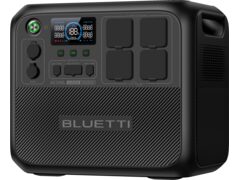
Two of the four mains sockets on the top of the front panel are difficult to use with British plugs (BS 1363 standard): a misalignment causes the plug to catch on the protective rubber gasket, preventing full insertion.
This defect has no corresponding marketing mention. British plugs are bulkier than French or German type E/F plugs, so whether this defect also affects standard French-style sockets is unknown, for lack of material on this specific point from the French market: that could equally mean the problem does not occur there, or simply that it has not come up yet.
5-year warranty claimed everywhere, absent from the contractual document
The AC200L's 5-year warranty period comes up identically throughout the manufacturer's own communications, a figure that looks solidly established at first glance.
Before buying, it is therefore worth having the exact warranty period confirmed directly with Bluetti's customer service rather than relying solely on product communications.
1499 € still listed on the official site, marked discontinued
The price found on Bluetti's official site is 1499 €, with a discount of 200 € shown off a reference price of 1699 €. That is a significant drop since launch in March 2024, when the price found was closer to 1799 €.
Worth knowing before buying: the product page on Bluetti's official site now carries a "Discontinued" notice, with the buy button disabled in place of the usual add-to-trolley option. The price is still shown for reference, but direct purchase through that channel is no longer possible at the time of writing: the successor model, the AC200PL, has taken its place in the manufacturer's own line-up.
Price and availability vary by market and by retailer, and this discontinued status is worth double-checking at the time of purchase. Where the AC200L is still stocked, it tends to show up through general marketplaces rather than the manufacturer's own store, at least until existing stock runs out.
No major lab comparison, and a limited long-term track record
The AC200L does not appear in any known major lab comparison to date, unlike other Bluetti models (AC180P, AC200MAX, EB3A, EB55).
On long-term reliability, no failure of the main unit is known to date, with internal temperature running around 40 °C under continuous load. But the product has been on the market in Europe for more than two years, and no reliability or degradation data at the one- or two-year mark was found for this specific model: still not enough of a track record to rule on the very long term.
Home backup, RV, job site: a base that grows with your needs
With 2400 W and UPS switchover, the AC200L covers a large share of a household during a mains outage: refrigerator, freezer, internet router and lighting run for many hours, and the expandability makes it possible to cover a multi-day outage by adding B300 batteries over time rather than switching stations.
In an RV or off-grid, the combination of expandable capacity and solar input up to 1200 W makes it a reserve that grows with actual needs, rather than a choice locked in at the time of purchase. On a job site without grid power, the 2400 W continuous rating and 7200 W peak comfortably cover common power tools, with no difficulty surfacing at these levels.
Weight and the lack of wheels, on the other hand, point these uses toward a fairly fixed location rather than frequent moves.
Against the EcoFlow Delta 2 Max and the Jackery Explorer 2000 v2
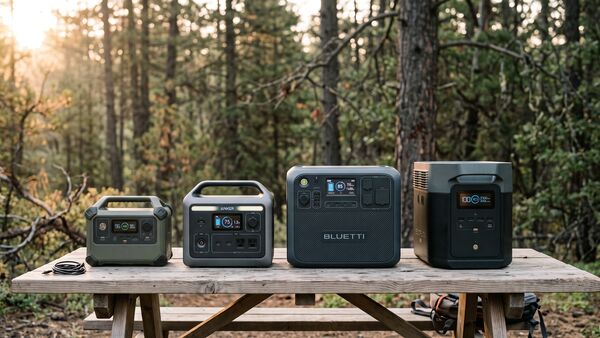
In this capacity segment, the AC200L sits between two references already covered on this site: the EcoFlow Delta 2 Max and the Jackery Explorer 2000 v2.
| Criterion | Bluetti AC200L | EcoFlow Delta 2 Max | Jackery Explorer 2000 v2 |
|---|---|---|---|
| Capacity | 2048 Wh | 2048 Wh | 2042 Wh |
| Power | 2400 W | 2400 W | 2200 W |
| Weight | 28.3 kg | 23 kg | 17.5 kg |
| Max extension | 8192 Wh | 6144 Wh | No |
The AC200L stands out for having the highest expandability of the three, at the cost of noticeably more weight than the Jackery, which is not expandable but much lighter. Against the EcoFlow, whose extension ceiling is lower, power and weight are close: the choice then mostly comes down to the additional-battery ecosystem and the price found at the time of purchase.
Who it suits, and who it does not
It suits anyone who wants to start with a powerful base and grow it over time rather than switching stations, home backup or off-grid use where the unit rarely needs to be moved, and anyone who values a fast charge that matches its claimed figures.
It does not suit anyone looking for a light station to carry around often, or anyone counting on the 5-year warranty without having it confirmed beforehand. For purely light, nomadic use, a more compact station remains the better choice.