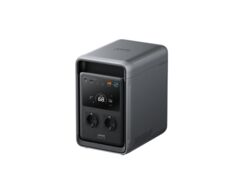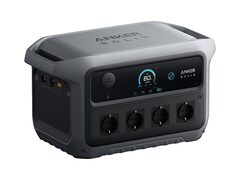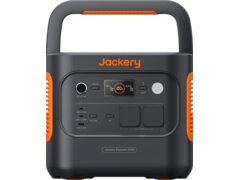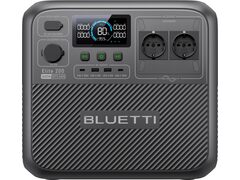

What the claimed 2010 Wh actually deliver
The Anker Solix S2000 packs a LiFePO4 battery rated at 2010 Wh nominal, built around 314 Ah prismatic cells. Like on any power station, that capacity figure says nothing about how much energy actually reaches a mains socket: between the battery output and the inverter that produces alternating current, some energy is lost as heat. On the S2000, conversion efficiency reaches 91 %, among the best in its category for a station of this capacity.
With a 91 % efficiency, the 2010 Wh nominal rating translates into around 1830 Wh genuinely usable at the mains output. It is this figure, not the capacity printed on the label, that determines how long a given appliance will actually run on the battery.
This efficiency largely explains the S2000's headline speciality: fridge backup. Anker claims up to 35 hours of runtime for a 700-litre fridge at 25 °C ambient, a figure backed by independent TÜV SÜD certification (A+ Runtime), a first for the category according to the brand. That promise is not limited to a single number: several scenarios span a wide range, from 33 hours in an estimate based on a fridge's average consumption, to 42 hours for a fridge alone down to 5 % remaining charge, up to over 60 hours when the station simultaneously powers a fridge, a router, lighting and phone charging.
| Condition | Runtime |
|---|---|
| Estimate based on a fridge's average consumption | 33 hours |
| Fridge alone, down to 5 % remaining charge | 42 hours |
| Fridge, router, lighting and phone charging together, down to 10 % | Over 60 hours |
| TÜV SÜD certified runtime (700-litre fridge, 25 °C ambient) | Up to 35 hours |
Far from a contradiction, this spread is actually a good sign: it shows the 35-hour certification is a conservative baseline rather than an inflated figure. Real-world runtime depends heavily on the efficiency of the fridge connected, room temperature and the number of devices sharing the load, but it matches or exceeds the manufacturer's claim across all of these scenarios.
The 1500 W ceiling against real-world appliances
The S2000 delivers 1500 W continuous, up to 1800 W in pass-through mode (mains and battery combined), and 3000 W at brief peak. On typical resistive loads (lighting, electronics, chargers, most office equipment), this ceiling holds up without difficulty: a coffee maker drawing 635 W or a full workstation setup around 350 W stay comfortably under the 1500 W mark, with a healthy margin to spare.
The difficulty shows up with motor-driven or heating-element appliances, which demand an inrush current well above their rated power at the moment of startup. A window air conditioner rated at 600 to 700 W has, in one case, tripped the station's overload protection and refused to start, despite a claimed 3000 W peak: for a split second, the compressor demands a current several times higher than its stated power, a spike too brief to be covered by the manufacturer's specifications but very real in use. A microwave rated at 1200 W, whose startup inrush can approach 1800 W, also sits close to the limit, particularly if another appliance is already running alongside it.
This ceiling is not a manufacturing flaw, it is a deliberate sizing choice: the S2000 explicitly targets a household's essential needs during an outage (fridge, home router, lighting, electronics), not powering a job site or a whole kitchen. It is also what justifies the existence, in the same lineup, of the Solix C2000 Gen 2 and its 2400 W continuous output for heavier needs.
Record-low standby and UPS switchover: what OptiSave really changes
Anker's OptiSave technology brings standby draw down to 6 W when the mains outputs stay active, and to around 2 W when they are switched off. Both figures rank among the strongest specs on this data sheet: a draw this low means the station can stay plugged in permanently as a UPS buffer without worrying about it draining between outages spaced weeks apart.
The switchover to battery power happens in under 10 ms during a mains outage, fast enough that a computer, a router or a home broadband box will not reboot. That is a genuine comfort for securing a remote-work session or avoiding a reset of sensitive equipment during a brief mains blip.
One point is worth spelling out for anyone considering the S2000 as backup for a medical device, though: Anker itself states that this switchover is designed to absorb fluctuations in the domestic power supply, not to serve as a regulated medical power source. For life-critical equipment such as a CPAP, the S2000 can offer a comfortable runtime buffer thanks to its capacity and very low standby draw, but it is not a device certified for that use: advice from a healthcare professional remains necessary before relying on it continuously.
Mains, solar and vehicle alternator charging
On mains power, the S2000 offers two charging regimes. Standard mode, drawing around 1150 W, fills the battery in about 2h18. UltraFast mode, switched on from the app and pushing the draw up to 1600 W, cuts that down to about 1h42. Both figures match what the manufacturer states.
On solar, the single MPPT input caps out at 400 W (11 to 60 V, 12.5 A), for a 20 to 80 % charge in 3 to 4 hours of good sunshine. That is a genuine limitation next to several direct rivals in the 2 kWh class, which accept 800 or even 1000 W of panels: anyone wanting a fast solar top-up, or planning to add extra panels later, will quickly hit the S2000's ceiling.
An option rarer on this format partly makes up for it: a dedicated input for a vehicle alternator charger, capable of delivering up to 400 W while driving, on top of the standard cigarette-lighter socket limited to 120 W. That is a genuine advantage for nomadic use or in a motorhome, where most direct rivals only offer basic 12 V charging.
Noise: quiet at rest, far less so under fast charging
At rest and under light load (below 300 W), the S2000's fan stays close to silent, with a stated level of around 30 dB. Under moderate load, that level climbs to around 35 dB. It is under fast charging, once the power draw goes above 1100 to 1150 W (UltraFast mode or heavy combined mains charging), that the fan becomes clearly more present, around 42 dB at one metre, a level described as uncomfortable at close range.
The station has a silent mode that can be switched on from the app, which caps charging power at 600 W or less to keep noise down. That is a practical option at night or in a living space, at the cost of a noticeably slower recharge. It is also worth noting that the fan can kick in intermittently even under moderate loads, to regulate internal temperature, a normal behaviour that can still surprise anyone expecting total silence under all circumstances.
Ports and controls: comprehensive for the class, with two caveats
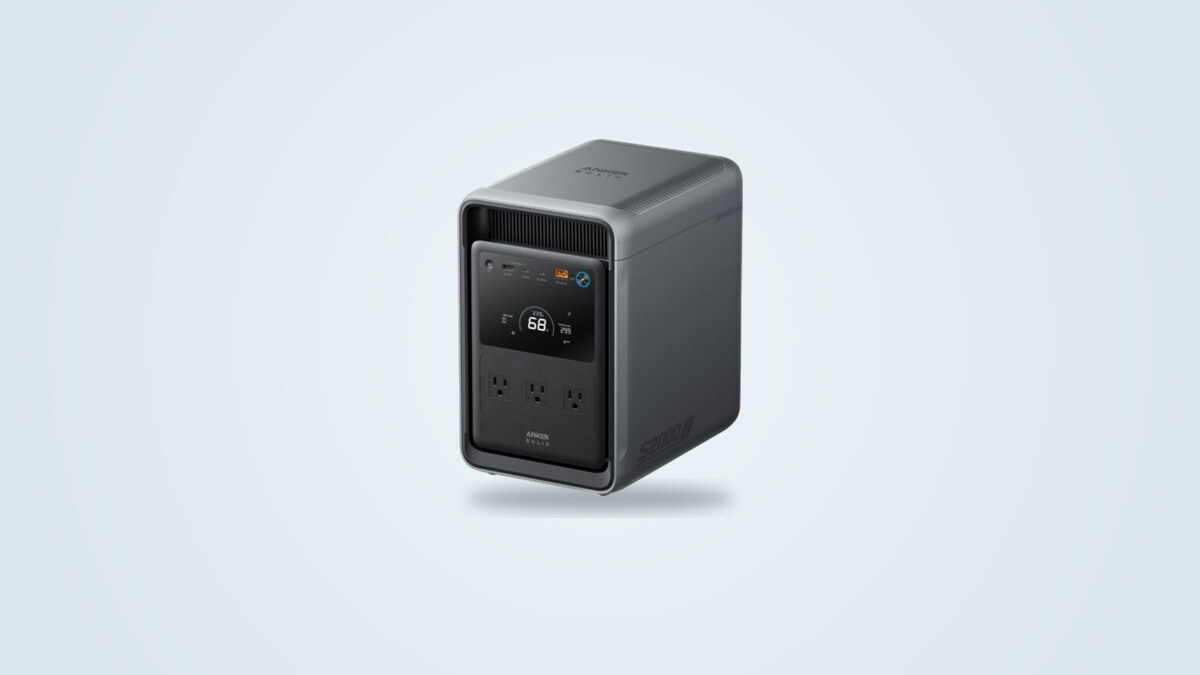
The S2000 offers 5 mains outlets, split between the front and rear of the unit (3 at the front, 2 at the rear), a line-up in keeping with 2 kWh-class standards. For charging small devices, it carries a 100 W USB-C port capable of charging most recent laptops directly, a second USB-C port limited to 15 W, and a 12 W USB-A port.
That second USB-C port deserves a caveat: 15 W is a modest output for a port launched in 2026, well behind the main port and behind what some rivals offer across both of their USB-C ports. Another gap worth flagging for this product class: there is no 12 V cigarette-lighter-style output on the unit, which rules out powering 12 V accessories directly (a small camping fridge, an air pump) without going through a mains socket.
On the control side, the S2000 carries Wi-Fi, Bluetooth and a dedicated app, which lets you monitor charge status, configure charging modes (standard, UltraFast, silent) and schedule certain behaviours remotely. The built-in LCD screen shows the essential information without needing to open the app, a practical touch for everyday use under a desk or in a utility room.
Build quality, reliability and a minor gauge quirk
Anker rates the battery for 10,000 cycles before it drops to 60 % of its original capacity, well above the 4000 to 6000 cycles claimed by direct rivals in the 2 kWh class. The comparison deserves a caveat, though: each manufacturer sets its own end-of-life threshold, 60 % for the S2000 versus 70 to 80 % for the others, and a lower threshold is mechanically easier to reach. Even accounting for that difference in method, the claimed lead stays clear. The manufacturer's warranty, meanwhile, runs to 5 years, a figure worth distinguishing clearly from the 15-year lifespan estimate featured in marketing materials: the first is a contractual commitment, the second a theoretical calculation based on one to two cycles a day.
No recall or safety incident has been recorded for this model to date. Over a month of intensive cyclic use, capacity stayed stable with no measurable loss, a positive sign, though it obviously says nothing about how the battery holds up over several years.
One real but minor flaw concerns the charge gauge: its accuracy degrades below 20 %, with the displayed percentage sometimes stalling for a long stretch before jumping straight down several points under a sudden load. This behaviour is purely a software quirk, it does not affect the actual capacity available, but it can throw off any anticipation of an imminent shutdown.
On operating conditions, the stated discharge range spans -20 °C to 40 °C, and the charging range 0 °C to 40 °C, figures in line with the rest of the category for indoor use or mild outdoor conditions.
The compact format: a genuine selling point
At 16.2 kg (35.7 lb) for 2010 Wh, the S2000 claims the title of lightest station in its capacity class, and the gap with direct rivals is clear: several exceed 17.5 to 24 kg for a comparable capacity. Its dimensions (208 x 282 x 323 mm) make it a unit that slides under a desk, into a utility room or into a car boot without difficulty.
This weight saving comes with a modest ergonomic trade-off: the unit has no traditional top handle, only recessed side grips. That is enough for an occasional two-handed lift, though a second handle would allow more confident carrying on a staircase. With no wheels or telescopic handle, the S2000 is carried by hand for the whole distance.
A phased global launch: United States, Europe, Japan
The Solix S2000 has been sold in the United States since June 2026, in a 120 V / 60 Hz version. After a launch price pitched noticeably higher, the going rate settled at around $650 to $700 from early summer onward, an initial anchor-price pattern followed by a quick drop that is fairly typical for this manufacturer. This version now has several months of track record behind it and accounts for almost all of the figures available for this model.
A European version has only just been announced, right at the start of September 2026, at 699.99 €, with the same technical specifications as the US model (2010 Wh, 1500 W continuous, 3000 W peak). At the time of publishing this review, no independent test of this European version has been found: the figures presented here relate to the US model, and there is no guarantee yet that they carry over identically to the unit sold in Europe.
A third version, calibrated for the Japanese market (100 V, the same 1500 W continuous output), is due to launch on 23 September 2026 at a price equivalent to around $1,200, and is not available yet.
For a European reader, the question is therefore no longer just technical but also a matter of timing: wait for the local launch, still too recent to have any usage track record or independent review, or go for the US version, which offers more track record but requires a voltage transformer, not just a plug adapter, to run a European household appliance off its mains outputs.
Up against direct 2 kWh-class rivals
| Criterion | Anker Solix S2000 | Anker Solix C2000 Gen 2 | Jackery Explorer 2000 v2 | Bluetti Elite 200 V2 |
|---|---|---|---|---|
| Capacity | 2010 Wh | 2048 Wh | 2042 Wh | 2074 Wh |
| Continuous / peak power | 1500 W / 3000 W | 2400 W / 4000 W | 2200 W / 4400 W | 2600 W |
| Weight | 16.2 kg | 18.9 kg | 17.5 kg | 24.2 kg |
| Rated cycles | 10,000 to 60 % | 4000 to 80 % | 4000 to 70 % | 6000 to 80 % |
| Max solar input | 400 W | 1000 W | 1000 W | 900 W |
The S2000 stands out clearly on two fronts, weight and claimed battery longevity, at the cost of a real step down in continuous power and solar input against both its own lineup and its direct rivals. The C2000 Gen 2, almost 3 kg heavier, offers an extra 900 W of continuous output and a solar input two and a half times more generous, for a higher price once it becomes available on the same market. The Jackery Explorer 2000 v2 and the Bluetti Elite 200 V2 follow a similar logic: more power on tap, at the cost of extra weight and a lower claimed battery lifespan.
The choice between these options therefore comes down less to an absolute ranking than to the intended use: the S2000 fully delivers on its promise for the loads it is sized for, without trying to compete on raw power against stations that weigh 2 to 8 kg more.
Who the S2000 suits, and who should look elsewhere
The Solix S2000 particularly suits anyone looking for a backup reserve to cover a household's essential needs during an outage: fridge, home router, lighting, electronics and phone charging. Its under-6 W standby also makes it a solid option for securing a remote-work setup against brief power blips, or for offering a comfortable runtime buffer for a medical device such as a CPAP, provided you bear in mind that it is not a certified medical device. Its manageable weight and compact footprint also suit occasional use for camping or a weekend away, particularly thanks to its vehicle-alternator charging capability.
It suits less well anyone needing to power heavy or high inrush-current appliances, such as an air conditioner, powerful electric heating or corded power tools: the 1500 W continuous ceiling, and especially its sensitivity to startup spikes, will quickly limit these uses. It is just as unsuited to anyone wanting to build a substantial solar setup: the 400 W input ceiling caps any serious expansion. Finally, for a European buyer in a hurry, the newly announced local version still lacks the track record needed to judge how it holds up over time on this specific market.