
What the stated 768 Wh are really worth
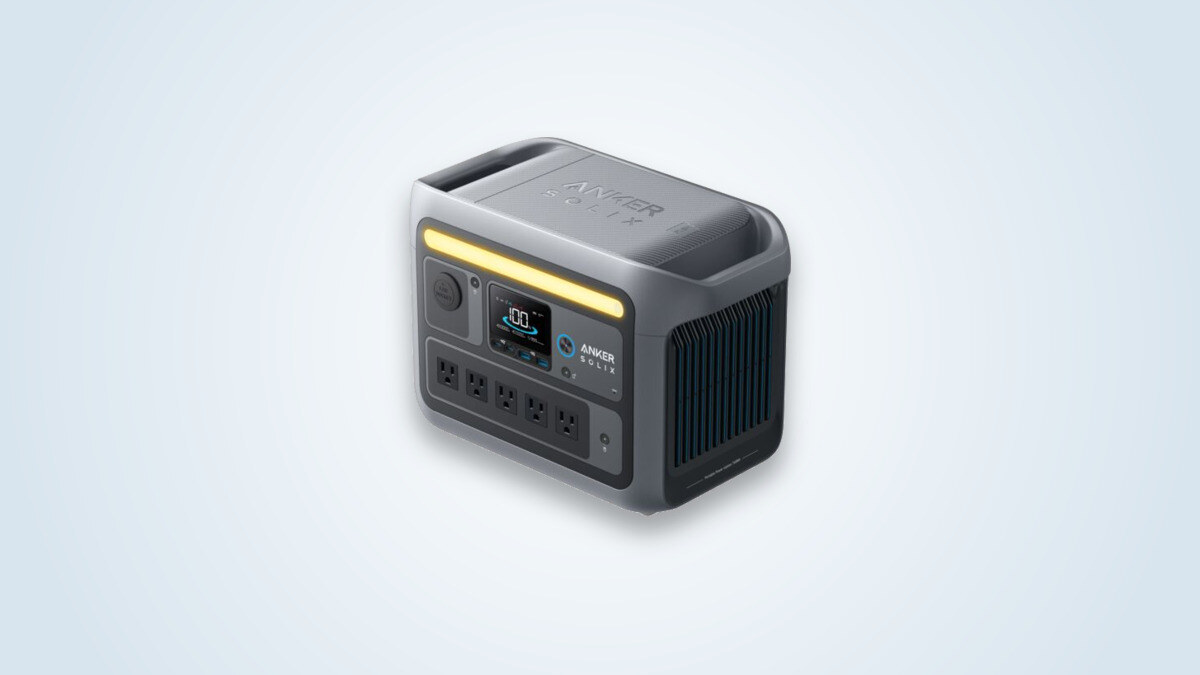
Anker states 768 Wh for the LiFePO4 battery in the Solix C800. That figure is the chemical energy stored in the pack, not what actually comes out of the outlets once the inverter, the BMS and safety margins are factored in. On this core hardware, the same battery and inverter as the Plus version, which only adds camping accessories, real usable capacity sits between 630 Wh on the AC output and 663 Wh on the 12V output, or 82 to 86% of the stated capacity.
The gap between the two outputs comes down to conversion: a 230V socket runs through the inverter, which spends energy producing a pure sine wave, while the 12V output stays in direct current and skips that step. This is not a flaw specific to this unit: it is the same mechanism that keeps usable capacity below rated capacity on any inverter-based station, and this 18% gap on the AC output sits within the market average rather than at its extremes.
A reassuring point for demanding use cases: this efficiency does not collapse as the load increases. Unlike a station whose inverter would draw a fixed amount of power that weighs proportionally more on small loads, the C800 keeps an AC output efficiency around 90%, which makes it nearly as sensible for trickle-charging a phone overnight as for running a kettle for a few minutes.
The real cost of the 58-minute promise
The headline figure Anker pushes hardest is the full recharge in 58 minutes, a rare feat in this capacity class. It is real, but it assumes two conditions the box does not spell out: access to a circuit capable of delivering up to 1100W continuously, and switching on the fast-charge mode from the Anker app, which is not the default setting out of the box.
Once both conditions are met, the station goes from 0 to 100% in 58 minutes on mains power. That speed is not free: it pushes the internal electronics hard, and the resulting fan noise is clearly audible for the whole charging session (more on this later in this review). For everyday use with no urgency, nothing stops you from leaving standard mode on and charging more quietly, for instance overnight.
Charge time is only half the equation: the station never returns more than the 630 to 663 Wh of real usable energy described above. Charging fast changes nothing about how much energy ends up available, only how long you wait to use it.
Five AC outlets: the real edge over the competition
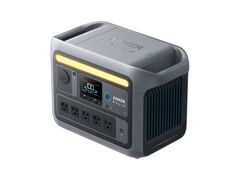
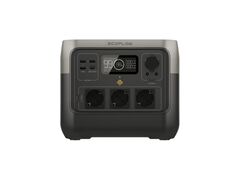
On paper, the Solix C800's 768 Wh capacity is far from unique: the EcoFlow River 2 Pro carries the exact same figure. It is elsewhere that the C800 really stands out, and the most visible gap is in AC connectivity: five 230V outlets, where most direct rivals offer only two or three.
| Model | Anker Solix C800 | EcoFlow River 2 Pro | Anker Solix C1000 |
|---|---|---|---|
| Capacity | 768 Wh | 768 Wh | 1024 Wh |
| 230V AC outlets | 5 | 3 | 4 |
| USB-C ports | 2 (100W) | 1 | 2 |
For home backup during an outage or an evening with friends while camping, this detail changes the experience in practice: no power strip needed, and no unplugging one device to power another. Five outlets mean a kettle, a string of fairy lights, a speaker and two chargers can all run at once, as long as the real combined draw stays under 1200W.
The obvious limit is that all five outlets share the same power budget. Plugging a 2000W space heater into any one of them will not work any better than on the other four: more outlets solve a distribution problem between devices, not a total power problem.
1200W continuous, 1600W peak: what it actually changes
For a 768 Wh capacity, most rivals cap their inverter under 1000W continuous. The Solix C800 delivers 1200W continuous, and up to 1600W at peak thanks to SurgePad mode, designed to absorb the initial inrush current of resistive appliances (kettle, toaster, small space heater) without tripping a safety cutoff.
In practice, this power headroom unlocks appliances that plenty of stations this size cannot run at all, or only below their rated draw. A 1500W kettle stays out of reach continuously, but a toaster or a small 1000 to 1200W fan heater run without issue, which is not true of a station capped at 600 or 800W. The predictable trade-off is that pushing the station near its ceiling burns through the 630 Wh of real AC-output capacity fast: at a steady 1200W, the reserve is gone in a little over half an hour.
The friction point: the fan under heavy load
The Solix C800 stays quiet at rest and under light use: the fan only kicks in from around 500W of continuous load, or once internal temperature passes 35 °C. Below that threshold, ordinary room noise is enough to cover it.
None of this is unusual: shedding several hundred watts of heat in such a compact footprint (10.5 kg, 37.1 x 20.5 x 25 cm) always requires active cooling. Most rivals close in capacity share the same trade-off, some with a blunter on/off fan behaviour where the C800 ramps up more gradually. For occasional backup use or a camping weekend, this noise stays marginal; for extended desk-side remote work with the station pushed near its limit continuously, it is worth keeping it out of the room you are working in.
The UPS function: switching over in under 20 ms
During a mains outage, the Solix C800 switches to battery power in under 20 milliseconds. That gap is short enough that a router, a desktop computer or a small fridge notice no perceptible interruption: most electronic power supplies ride through a break of a few tens of milliseconds without issue thanks to their own internal capacitors.
This UPS function turns the C800 into a genuine backup inverter for a household's sensitive equipment, beyond simple portable use. It requires leaving the station permanently connected between the wall outlet and the device to protect, in pass-through: mains power runs straight through the station without drawing on it while present, and the battery only takes over during a real outage.
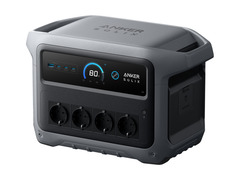
The limit of this feature lies in the runtime it protects, not its responsiveness: 630 Wh on the AC output is enough to keep a router and a laptop running for several hours, but far less time for a fridge whose compressor cycles on repeatedly. For a whole household across several days without power, a capacity closer to 1 kWh, like the C1000 in the same range, remains better suited.
Solar and car charging: the real limits
Away from a wall outlet, the Solix C800 accepts up to 300W of solar input through an XT60 connector, with a voltage range of 11 to 60V and a maximum current of 10A. A single MPPT controller manages this input: it is not possible to connect two differently angled panels, say facing east and west, and let each run at its own maximum power point, unlike stations fitted with two independent MPPT controllers.
With a panel able to reach the rated 300W and favourable sunlight, the manufacturer's documentation states an 80% charge in around 2 hours 20 minutes. With a more modest 200W panel, a full charge took 3 hours 30 minutes under real conditions, and 80% was reached in 2 hours 30 minutes: the gap between the two cases is consistent with the input power available, and gives a realistic range for anyone without consistently ideal sunlight. For regular nomadic use rather than occasional trips, this 300W ceiling, compared with the 1100W accepted on mains power, makes the solar input a top-up rather than a primary charging method.
Through a car's 12V socket, a full recharge takes around 7 hours: enough to top up during a long stretch of driving, without aiming for a fast charge. This remains the slowest of the three routes, well behind mains power and even behind full sunlight.
| Source | Max input power | Charge time |
|---|---|---|
| Mains (fast mode on) | 1100W | 58 min (0 to 100%) |
| Solar (300W panel, ideal conditions) | 300W | ~2h20 (0 to 80%) |
| Car 12V socket | ~110W | ~7h (0 to 100%) |
Its place in the Solix lineup and against direct rivals
Within Anker's Solix lineup, the C800 sits in a precise spot: above the compact C300X DC (288 Wh, no AC output at all, USB-C and DC only), below the C1000 (1024 Wh, 2000W continuous, four outlets). It fills a genuine gap in the range rather than acting as a simple marketing step between the two.
| Model | Capacity | Continuous power | AC outlets |
|---|---|---|---|
| Anker Solix C300X DC | 288 Wh | No AC output | 0 |
| Anker Solix C800 | 768 Wh | 1200W | 5 |
| Anker Solix C1000 | 1024 Wh | 2000W | 4 |
Outside the Anker lineup, the EcoFlow River 2 Pro remains the most relevant direct rival: capacity matches to the watt-hour (768), but 800W continuous against 1200W, and three AC outlets against five. The C800 wins on the two criteria that shape everyday use of a station this size the most.
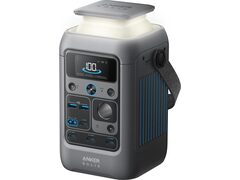
One thing worth checking before buying: the market carries several closely related variants under similar names. The C800 Plus adds two detachable camping lights and a telescopic pole around the same battery and inverter; a more recent variant, sold as the C800X, also exists with its own nuances around solar charging. The model covered in this review is the base C800 (manufacturer reference A1753), which sticks to the essentials: power, fast charging and AC outlets, without the camping accessories.
Reliability, app and warranty
The LiFePO4 battery in the Solix C800 is rated for 3000 cycles down to 80% of original capacity, and backed by a 5-year manufacturer warranty, well above the market norm of 2 to 3 years for most rivals. No safety defect is identified on this model: the housing carries the CE, RoHS and UN38.3 certifications expected for this type of product.
On the software side, the Anker app (Wi-Fi and Bluetooth) lets you track the charge, control outputs remotely and receive firmware updates. It remains fairly basic though, less polished than some rival interfaces, and occasional software glitches have been reported after a long period of inactivity, without this pointing to a widespread failure pattern or a hardware fault.
The station operates between 0 °C and 40 °C on recharge, and from -20 °C to 40 °C on discharge: below 0 °C, recharging is blocked to avoid damaging the cells through lithium plating, a standard protection behaviour for this chemistry that is worth planning around before winter use outdoors without heating.
Who it suits, who it does not
The Solix C800 is aimed first at a household wanting versatile home backup against power cuts: the UPS function protects sensitive electronics, and five AC outlets cover most of an evening off-grid without a power strip. It suits camping or event use with a group just as well, where the outlet count and 1200W of power absorb a kettle, a small PA speaker and everyone's devices charging at once without effort.
It suits less anyone after an upgradeable station: unlike other models in the Solix range, its 768 Wh capacity is fixed, with no expansion option. Its 10.5 kg destines it more for car transport than for carrying on a trek or a hike, where lighter, usually less powerful formats remain better suited. And for use centred on absolute quiet, extended remote work in a silent room for instance, the fan kicking in under heavy load is worth planning for.
Between the compact C300X DC and the powerful C1000, the C800 suits those after mid-range capacity without giving up output power or connectivity, without paying the premium for a near-1 kWh station they have no use for.