
What the claimed 21 to 24% efficiency is really worth
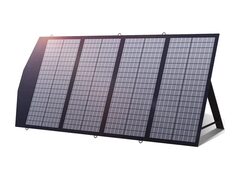
The Allpowers SP029 lists a peak output of 140W, set under standardised laboratory conditions (reference-grade sunlight, controlled cell temperature). That convention is useful for comparing two panels side by side, but it is never quite met outdoors: the angle of incidence, cloud cover and the panel heating up in full sun all pull the real output down, a pattern common to this entire category of product. For this format, a real-world output of 90 to 110W on a good summer day with the panel well aimed is the reasonable expectation, dropping sharply as soon as the sky hazes over or the incidence angle worsens.
On cell efficiency itself, Allpowers' own sales pages do not all tell the same story. The manufacturer's current official page for this model lists "polysilicon" (polycrystalline) cells at 21% efficiency. Other pages from the same manufacturer, on other markets, call the cells monocrystalline and claim 22 to 24%. An efficiency above 20% is hard to reach for polycrystalline cells, a technology that generally tops out around 17 to 18%: the more credible read is recent monocrystalline cells, but the confusion comes from the manufacturer itself, not from an outside source. This kind of gap between a single manufacturer's own pages is not isolated in this range: the Solax SE200 from the same brand, already reviewed on this site, also quotes a spread (23 to 25%) rather than one fixed figure.
The 25A MC4 output: the product's central argument
The SP029 outputs through an MC4 connector, the most widespread standard in the solar market, rated for up to 25 amps. That is what makes the panel compatible with almost every solar generator sold today, regardless of brand, where some manufacturers instead lock buyers into a proprietary connector. The cable kit bundled with the panel widens that compatibility further: an Anderson plug, common DC barrel connectors and alligator clips for charging a 12V car battery directly.
Another useful detail, missing from this site's own catalog entry but present in the manufacturer's documentation: the panel has a parallel-connection port for wiring in a second, identical SP029 to double the capture area, provided the receiving station's solar input can handle the combined power and voltage of both panels. The DC port itself is connector-rated for up to 10A, but the output it actually delivers stays capped at 18V and 3A by the panel's own electronics, not by the raw capacity of the socket.
Two USB ports: where it beats its Solax SE200 cousin
Alongside the MC4 output, two USB-A ports rated 5V and 2.4A each let you use the panel on its own, with no power station in between. That is a genuine difference from the Solax SE200, the 200W panel from the same brand already reviewed on this site, which offers no direct output at all and always requires a station in the loop. On the SP029, a phone or a small power bank can charge directly from the sun, even though the lack of a buffer battery means charging follows sunlight exactly and stops the moment a cloud rolls in.
One thing to flag: no USB-C port is fitted, only classic USB-A. Against laptops or recent phones that charge faster over USB-C, that is a real limitation. Several third-party pages mention a 60W USB-C PD port on the SP029, but that claim does not appear on the manufacturer's current official product page, which lists only the two USB-A ports and the DC output: better not to count on finding a USB-C port in the box.
4.49 kg (9.9 lb) for 140W: a van panel, not a hiking one
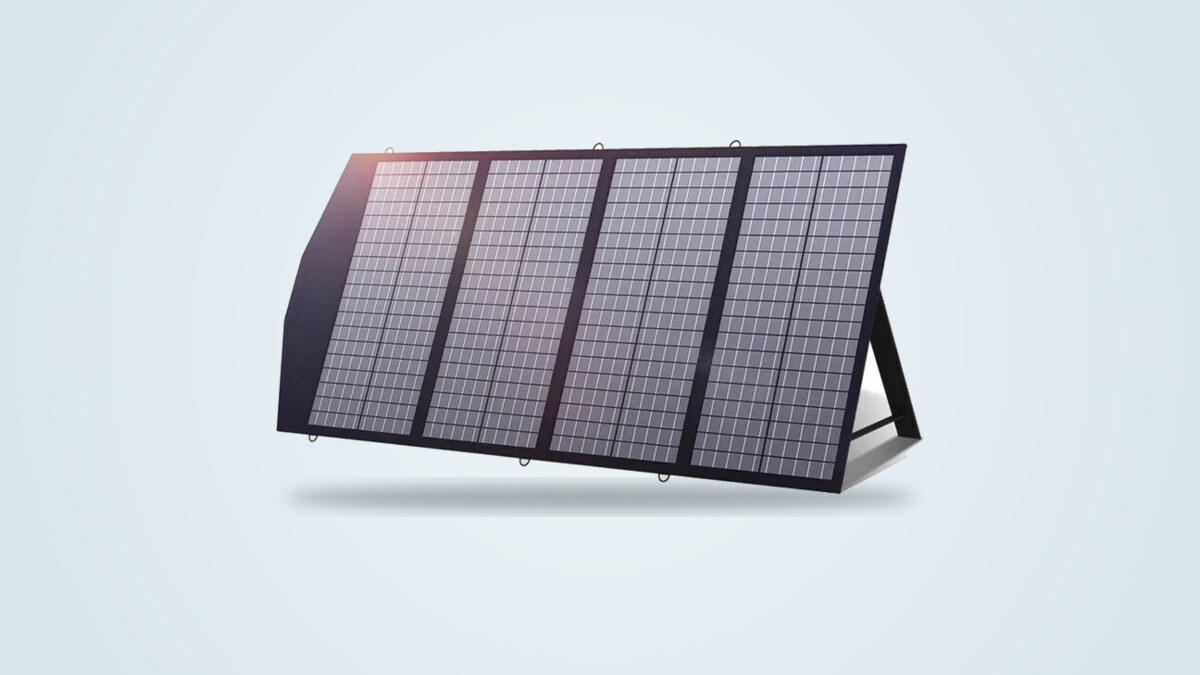
The SP029 weighs 4.49 kg (9.9 lb) and unfolds to roughly 5.5 ft (1.68 m) long by 25.2 in (64 cm) wide, before folding back down to a compact 25.2 x 14.4 x 1.2 in (64 x 36.5 x 3 cm). Relative to its output, that is a strong showing: 140W for 4.49 kg, or roughly 31W per kilogram, a better ratio than the Jackery SolarSaga 100W (about 4.7 kg/10.4 lb for 100W, or 21W per kilogram) already compared on this site.
Once unfolded, the panel is as bulky as any panel this powerful: it needs clear, fairly flat ground, and handling it with two people becomes preferable as soon as the wind picks up. The built-in, adjustable stand lets you angle the surface toward the sun without any extra accessory.
A protection rating that changes depending on the page you read
This instability is not unique to the SP029: it points to loose product messaging rather than a proven hardware flaw. No recall has been identified for this panel to date, nor any recurring report of a failure caused by water ingress. That said, the junction box and connectors remain the most exposed points on this type of product: better to shield them during sustained rain than to rely on a protection-rating figure that shifts from one source to the next.
How long it takes to refill a station in the sun
As a rough guide, and using the real-world output range above (90 to 110W), an Allpowers R600 (299 Wh) would refill in about 2h45 to 3h20, and an Allpowers R1500 (1152 Wh) in about 10h30 to 12h50. This simplified math ignores conversion losses and the slowdown as charging nears completion, but it gives a realistic order of magnitude for a sunny day.
The parallel-connection port mentioned above lets you wire in a second SP029 to roughly halve that time, provided the receiving station's solar input can handle the combined power and voltage of both panels: the SP029 outputs up to 19.5V at its maximum power point.
Against direct rivals from 100 to 200W
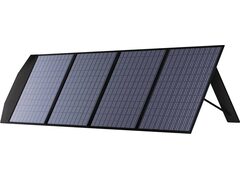
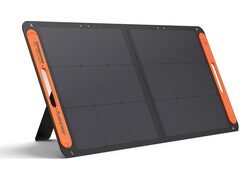
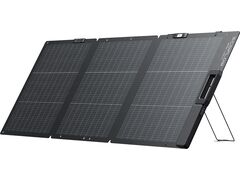
At around £145, the SP029 competes with foldable panels from 100 to 200W. Here is how it stacks up against three direct rivals already covered on this site: the Allpowers SP033 200W, the more powerful panel from the same brand, the Jackery SolarSaga 100W and the EcoFlow 160W.
| Criterion | Allpowers SP029 | Allpowers SP033 | Jackery SolarSaga 100W | EcoFlow 160W |
|---|---|---|---|---|
| Peak output | 140W | 200W | 100W | 160W |
| Weight | 9.9 lb | ≈ 17.6 lb | ≈ 10.4 lb | ≈ 15.4 lb |
| MC4 output | Yes, 25A | Yes | Yes | Yes |
| Direct outputs | 2 USB-A + 18V DC | None | 1 USB-A + 1 USB-C | None |
| Observed price | ≈ £144 | ≈ £257 | ≈ £214 | ≈ £299 |
Against the SP033 from the same brand, the SP029 gives up 60W of output but costs almost half as much and weighs almost half as little: for anyone who does not need 200W, it is the more rational trade-off. Against Jackery's SolarSaga 100W, known for its finish, the SP029 offers 40W more for a noticeably lower price, at the cost of a less established brand. Against the EcoFlow 160W, the SP029 is less powerful but costs about half as much while keeping direct outputs that the EcoFlow does not offer.
Build, warranty, and still-thin press coverage
Allpowers was founded in 2008 in Guangzhou, China. The brand is now well established in the power station and portable panel segment, with a wide catalog distributed across Europe, the United States and the United Kingdom. The SP029's manufacturer warranty runs for 24 months, extendable by registering the product on the official site, a length on the low side for the segment against the 3 to 5 years offered by some direct rivals.
No product recall has been identified for this panel to date. The flip side of that clean record is still-thin coverage from the Western specialist press for this specific model: most of the pages that mention it online are product listings or affiliate sites repeating the same specs from one another, without external cross-checking or detailed long-term usage reports. That does not mean the product is bad, only that the efficiency and waterproofing figures discussed above currently have no serious cross-check outside the manufacturer's own pages.
Who the SP029 suits, and who it does not
The SP029 is aimed first at anyone who already owns a power station and wants to refill it from the sun instead of relying on a petrol generator: its 25A MC4 output and cable kit cover almost every solar generator on the market. Its two USB ports also make it a sound pick for anyone who additionally wants to rescue a phone or a small battery without pulling the station out.
On the other hand, anyone shopping for a hiking or backpacking panel will find lighter options elsewhere: 4.49 kg (9.9 lb) is a van or motorhome weight, not a trekking one. Anyone after fast USB-C laptop charging should look at a different model, since the SP029 does not offer one. And anyone who wants a single, guaranteed protection-rating figure will need to accept the uncertainty discussed above, or pick a rival whose spec sheet is more stable.