
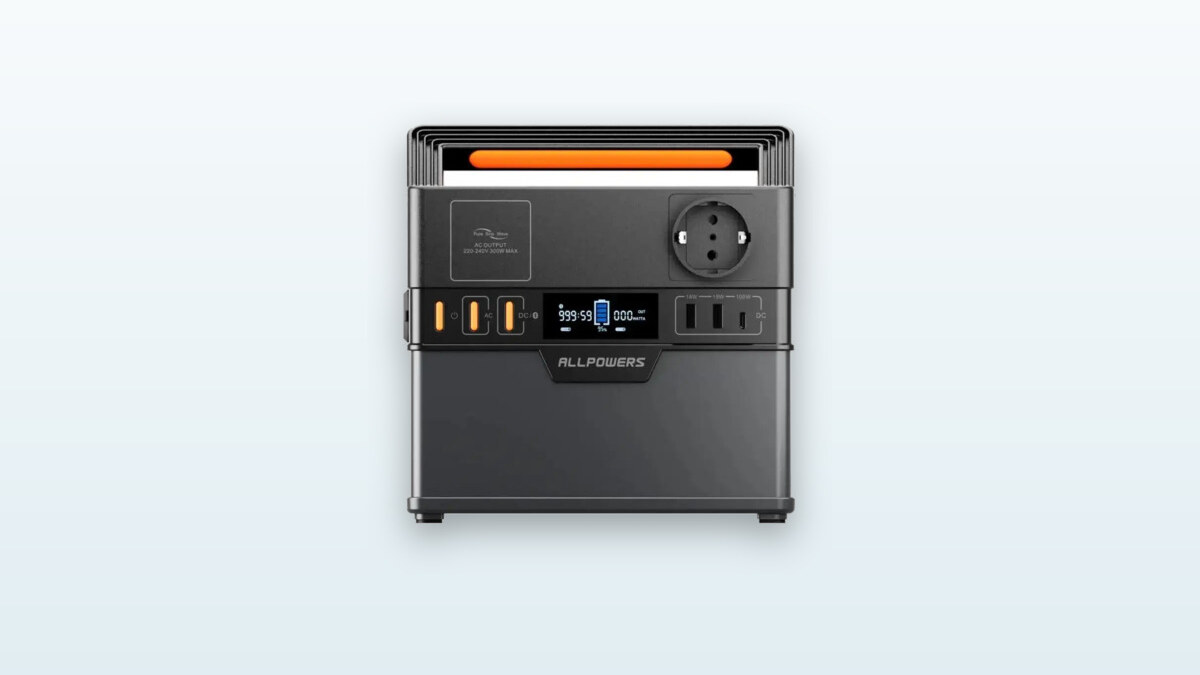
On paper: a compact, very well-equipped station
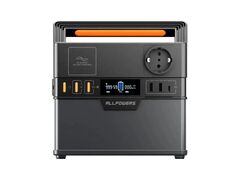
With 288 Wh of capacity, a continuous power of 300 W (600 W peak) and a price observed at 189 €, the Allpowers S300 Plus positions itself as a top-up power station for small and medium devices. It combines a mains socket, a USB-C 100 W port, two USB-A ports, a 12 V output, a built-in induction charger and an LED torch, all controlled through a Bluetooth app. Format and weight remain its most visible selling points: 206 x 165 x 110 mm for 3.4 kg.
S300 or S300 Plus? A naming mix-up that blurs reviews
The commercial name “S300 Plus” actually covers a minor evolution of an earlier model, the plain “S300”, sold since late 2022. Both names are used interchangeably even by the manufacturer and several retailers, with the same product listing or the same reference number sometimes showing one name or the other depending on the market. A concrete consequence for anyone comparing specifications found online: most of the figures circulating for this model actually concern the earlier version, not the one currently sold.
| Feature | S300 (previous) | S300 Plus (current) |
|---|---|---|
| Solar connector | Anderson | XT60 |
| Mains input | Slower | 200 W (≈ 1h30 for a full charge) |
| LED torch | Standard | Improved |
| Capacity and power | 288 Wh, 300 W / 600 W | Identical |
The core electronics, meaning the inverter and battery management circuit, did not change in the move to the Plus version. Anyone who already owns a solar panel or an adapter designed for the older Anderson connector will need an XT60 adapter.
USB-C 100 W: the difference between output and input
The USB-C port rated at 100 W only delivers that power on output, to charge a laptop or another device from the station: a genuine strength, rare at this format and this price. On input, to recharge the station itself through that same port, the power actually accepted caps at around 60 W, well below the 100 W shown on the spec sheet. A buyer counting on this port for a fast top-up via a powerful USB-C charger will be disappointed: the fastest recharge remains the dedicated mains socket.
Capacity actually delivered
The manufacturer itself publishes an efficiency figure for this model: about 85 % of the advertised capacity on mains output, and about 90 % on USB/DC output, or roughly 245 Wh and 260 Wh delivered out of the 288 Wh rated capacity. On the previous model, which shares the same electronics core, measured mains output dropped to around 69 % of the advertised capacity under a 250 W load, against 79 to 81 % on USB/DC output. The gap between the inverter (higher conversion losses) and direct DC/USB output is a common physical mechanism on this type of station, not an anomaly specific to this model.
500 W or 600 W peak? Documentation that contradicts itself
Peak power is not presented consistently by the manufacturer either: one specification table lists 500 W, while the descriptive text and the user manual both state 600 W. Since the manual is generally the most authoritative source, that is the figure used here. Either way, this power level suits small and medium devices (phones, laptops, lighting, a home internet box) rather than heavy appliances.
Fan: active as soon as AC output is used
On the previous model, which shares the same electronics core, the fan starts as soon as AC output is activated, even under light load: the noise level recorded reaches about 35 dB at activation and climbs to 44 dB after 30 minutes under a 250 W load. It stays silent in DC or USB-only use. This behavior has not been independently reverified on the Plus version, but nothing in the documented changes suggests it has changed.
NMC chemistry: the trade-off for the format and price
The manufacturer does not publish a charge-cycle count for this model. Retail listings put forward figures that vary wildly, by a factor of seven, which rules out relying on any of them as trustworthy. Its NMC chemistry (lithium-ion with ternary cells) generally ages faster than an LFP chemistry at an equal cycle count, a point worth knowing given that direct rivals all use LFP at this price and capacity level.
A UPS function documented by the manufacturer, worth confirming before buying
The manufacturer also documents an automatic switchover function in case of a mains outage (UPS), with an advertised switching time of 15 ms, useful for keeping a home internet box or a security camera powered without a noticeable interruption. This function did not appear in the most complete documentation available for the French market at the time of writing, and its real-world reliability has not been independently verified: worth confirming directly before a purchase that would specifically rely on it.
Connectivity and app: well-equipped, a few limits
Beyond the USB-C port, the S300 Plus offers two USB-A ports, a 12 V output for a car or a cooler, an induction charger on top and a built-in LED torch. The one notable limit on connectivity: a single mains socket, against two on some direct rivals. Finding the right alignment on the induction charger sometimes takes a bit of trial and error, and its power is not precisely fixed by the manufacturer's documentation either: the published figures range from 5 to about 10 W from one page to another, far from a fast induction charge. The Bluetooth app lets you monitor charging and switch outputs off remotely, though the connection can drop and need re-pairing more often than ideal.
The price actually charged
The official price observed is 189 €, against a list price of 299 €. This naming confusion between the S300 and the S300 Plus extends to several retailers, where the same product listing can show either name depending on the market.
Who it suits, who it does not suit
It suits anyone looking for a first compact, lightweight portable station for camping, van life or occasional home office use, with a tight budget and a genuine need for fast USB-C charging for a laptop.
It does not suit anyone who needs several mains sockets at once, a more durable LFP chemistry over time, or who would base a purchase on reviews found online without checking that they concern the Plus version rather than the previous model.