
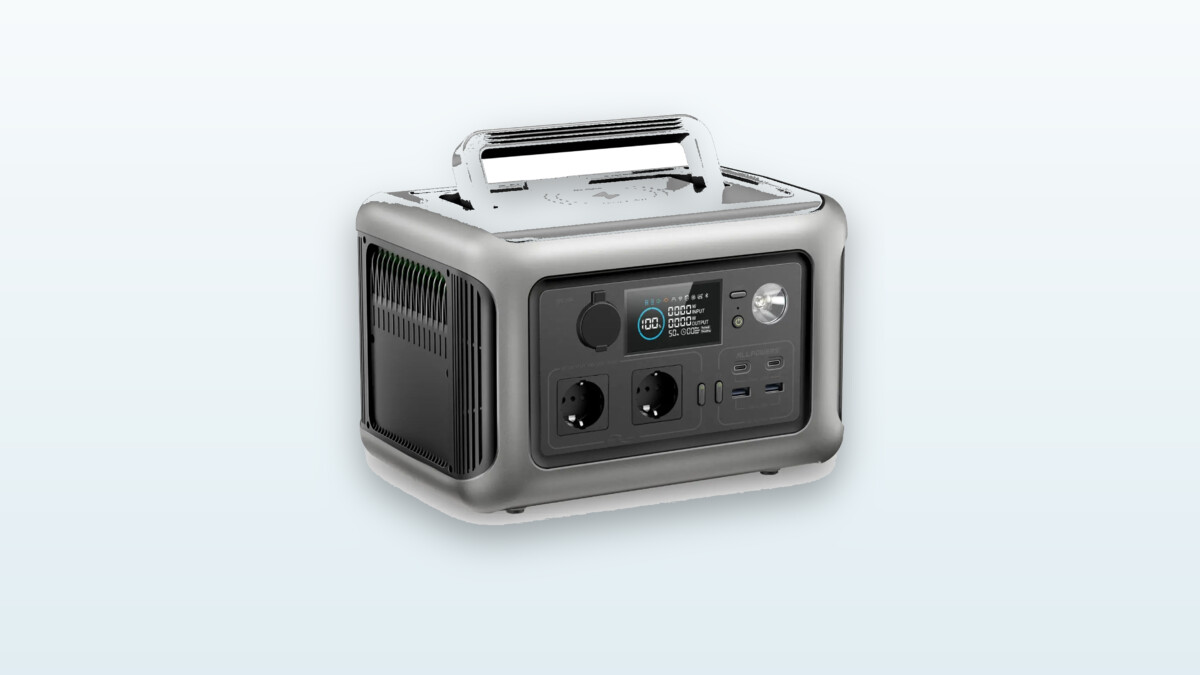
On paper: rare equipment at this price
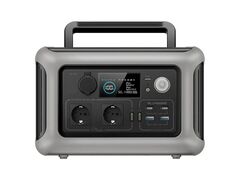
With 299 Wh of LiFePO4 capacity, a 600 W output (1200 W peak) and a listed price of 269 €, the Allpowers R600 immediately stakes its claim on equipment-to-price ratio. It combines two mains sockets, two USB-C ports including one at 100 W, two USB-A ports, a 12 V output and, notably, a built-in induction charger on top, a feature few rivals offer at this price. Mains recharging is advertised at one hour for a full charge, and the station also accepts solar input via an MPPT controller (220 W maximum, XT60 connector).
Real capacity: around 250 Wh, not 299 Wh
The capacity actually delivered sits around 250 to 252 Wh, or about 84 % of the advertised 299 Wh. This is a consistent value rather than an isolated case. The gap varies significantly depending on the output used: via USB-C, delivery climbs to 97-98 % of the rated figure, while it drops to around 75 % on the mains socket at low power. This behaviour comes down to a simple physical mechanism: the inverter draws roughly fixed power just to operate, which weighs proportionally more when the load drawn is small. In practice, the R600 delivers a larger share of its capacity for large, short loads than for extended use at low power.
The most serious issue: an abnormal charge loss at standstill
An abnormal charge loss at standstill affects some units: the battery can drain in just over a day even with nothing plugged in, as long as the mains output stays switched on. This defect affects several distinct units, which rules out a single isolated case. A non-functioning charging port, a separate issue, also affects another unit.
Inside, the R600 uses 32700-format LiFePO4 cells in an 8S2P configuration, a battery management system (BMS) and an inverter module with decent-quality components, with no identifiable design or assembly fault. This internal build quality, set against the charge loss observed, points to a BMS calibration or software setting issue rather than a defective part. An update or adjustment could in theory fix this, but no such fix has been confirmed to date.
The one-hour charge: true for most of it, not for all of it
The promise of a full charge in one hour holds true for most of the charge, backed by input power measured between 200 and 300 W. The last few percent slow down considerably, with input power dropping to around 50 W right at the end of the charge, adding roughly 30 extra minutes to reach 100 % rather than stopping right at the advertised hour: a behavior common to all lithium batteries at the end of a charge, not a flaw specific to the R600. Another point worth knowing: the R600 keeps drawing around 13 W continuously when left plugged into the mains without charging, a standby draw that is not zero.
Solar recharging: the 220 W ceiling remains unverified
The solar charging port (XT60, 12 to 60 V, 8.8 A, 220 W maximum) is confirmed to match its advertised specifications. With solar panels of 100 W or less, the power actually captured stays highly dependent on sunlight, between 50 and 70 W depending on conditions, a result consistent with the power of those panels rather than with a limit specific to the station. Nothing, however, confirms that the R600 actually reaches the advertised 220 W with a panel close to that ceiling.
The fan: the most consistent friction point
The fan comes up as the most consistently cited friction point. It runs on an all-or-nothing basis rather than progressive regulation, which makes it particularly noticeable as soon as it kicks in. It activates as soon as the unit is plugged into the mains, even with no charge in progress, with a cycle observed of around 4 minutes of silence for every 2.5 minutes of operation under a 50 W load. It does not, however, kick in when usage is limited to the USB ports. No dB figure exists for this product to date, despite a clear qualitative consensus that it is audible: this is a genuine data gap in this market, not a figure that should be estimated in its place.
The 5-year warranty: a figure that needs clarifying
The 5-year warranty, heavily promoted in the manufacturer's communications, does not apply automatically from the moment of purchase. The manufacturer's official documentation places the R600 in an extendable warranty category, with a no-action baseline of 24 months, extended to 60 months upon product registration via the official website, counted from the date of receipt. The warranty, moreover, only covers purchases made through the official sales channel.
A weight gap that goes beyond a simple packaging difference
The advertised weight is 5.6 kg. Retailer product listings show 5.8 kg instead, a minor gap that could be explained by rounding. But the weight actually measured climbs significantly higher, around 7.3 kg, a gap of more than 30 % from the advertised figure. This gap goes well beyond what a packaging or tare difference could explain, with no precise cause established here.
Connectivity and app: a genuine strength, an app that needs polish
Connectivity remains the most polished aspect of the R600: two mains sockets, two USB-C ports including one at 100 W (power delivered close to advertised in real-world use), two USB-A ports, a 12 V output and a built-in induction charger cover a lot of ground for this compact format. The Bluetooth control app, on the other hand, is seen as underdeveloped, with room to improve its usability, a point that comes up repeatedly. The station only has Bluetooth, with no WiFi, which limits remote control once out of range.
The price actually charged
The official price observed is 269 €, against a list price of 319 €. Slightly lower prices, around 248 €, can be found at other retailers. Occasional one-off promotions well below this exist from time to time through different sales channels, but they do not reflect the normally charged price. The product remains in the manufacturer's catalogue with no direct successor to replace it.
Who it suits, and who it does not
It suits anyone looking for a well-equipped first energy station on a tight budget, for camping, occasional remote work or basic UPS protection, willing to work with a real capacity closer to 250 Wh than to 299 Wh.
It does not suit anyone who needs total reliability for a critical backup use (a CPAP every night, medical equipment), given the charge loss at standstill affecting some units, nor anyone looking for silent operation.