
What the claimed 1056Wh are really worth
The R1500 Lite carries a 1056Wh LiFePO4 battery. Under a light, continuous mains load of around 90 to 110W (a laptop or a compressor fridge), it delivers about 757Wh before the displayed level reaches 5%, roughly 72% of rated capacity. Recharging fully from that same 5% level takes around 1186Wh back from the wall.
This ratio sits behind other Allpowers units in the catalogue assessed on the same basis (around 82 to 83% for the compact S200 and Volix P300, above 92% for the more capacious R2500 V2). The mechanism is as physical as it is electronic: the inverter draws a broadly fixed running overhead regardless of the load on the output side. On a mid-sized pack like this one, under a load of barely a hundred watts, that fixed overhead weighs proportionally more than it would on a larger pack or under a heavier draw. On large, short bursts of load (a kettle, a power tool), the proportion lost recedes mechanically.
The one-hour recharge promise, and what actually holds up
The spec sheet advertises a full recharge in 1 hour with the maximum 1200W mains input. The manufacturer's manual actually describes three mains charging levels, selectable from the app: a quiet mode at 400W (the default, self-adjusting setting), a standard mode near 800 to 1000W, and a fast mode that climbs to 1200W. These three levels come with very different full-charge times: around 3 hours at 400W, 2 hours at 800W, 1h30 at 1200W.
Two practical consequences follow. First, as long as fast mode is not switched on manually in the app, a full recharge takes close to 3 hours rather than 1 hour. Second, even in fast mode, the time needed lands closer to 1h30 than to 60 minutes. That 60-minute figure most likely refers to a charge up to 80%, which runs faster at constant current; the remaining 20% necessarily charges more slowly at constant voltage, which accounts for the gap against a full 100% charge.
1600W continuous, 3200W peak: what a resistive load reveals
The R1500 Lite holds its rated continuous power: mains output shows no weakness up to 1500W continuous, close to the 1600W ceiling. The manual, however, explicitly reserves the 3200W peak rating for a 3-to-5-second window, intended for the inrush current of a motor starting up (a compressor, a pump), not for a sustained resistive load.
The difference shows up on a purely resistive appliance such as a space heater: under a 2400W load, overload protection cuts the output after roughly 3 seconds, well short of the 3200W peak shown on the spec sheet. After several such trips in a row, the unit switches back on without issue, which speaks well of a protection mechanism that works as intended. For the reader, the practical takeaway is simple: plan around 1600W continuous for everyday use, and do not expect the peak rating to hold a fixed load for more than a few seconds.
The UPS function: reliable in principle, with a ceiling worth knowing
Left permanently connected between the mains and sensitive equipment, the R1500 Lite switches to its battery in under 15ms as soon as a power cut occurs: a computer or router plugged into its mains output does not reboot. This is the station's most useful function for home backup use.
The manufacturer's manual sets two conditions rarely repeated on the spec sheet: output must not exceed 1500W while the UPS mode is active, and a single-device setup is recommended rather than several loads plugged in at once. Beyond that, overload protection can trip at the worst possible moment, a genuine mains outage. For a router, a broadband box, a fridge or a computer taken on its own, this limit is not a practical problem; for a partial consumer unit with several circuits active at the same time, it is worth checking before installation.
650W of solar: a genuine asset for van life
The solar input accepts up to 650W, between 12 and 95V and up to 13A, through an XT60 connector with MPPT tracking of the maximum power point. That is a comfortable level for this format, enough to pair two folding panels of 200 to 300W without saturating the input. Charging from mains and solar at the same time brings the full recharge time down to around one hour, one of the more concrete arguments in this range for nomadic use.
Charging from a vehicle's cigarette lighter socket (12 or 24V) remains possible but noticeably slower than mains or solar, a backup option rather than a main solution on a long leg of a trip.
Ports and control: complete on paper, an app that needs polish
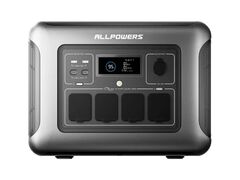
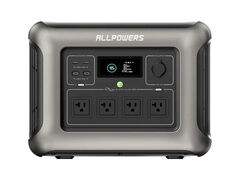
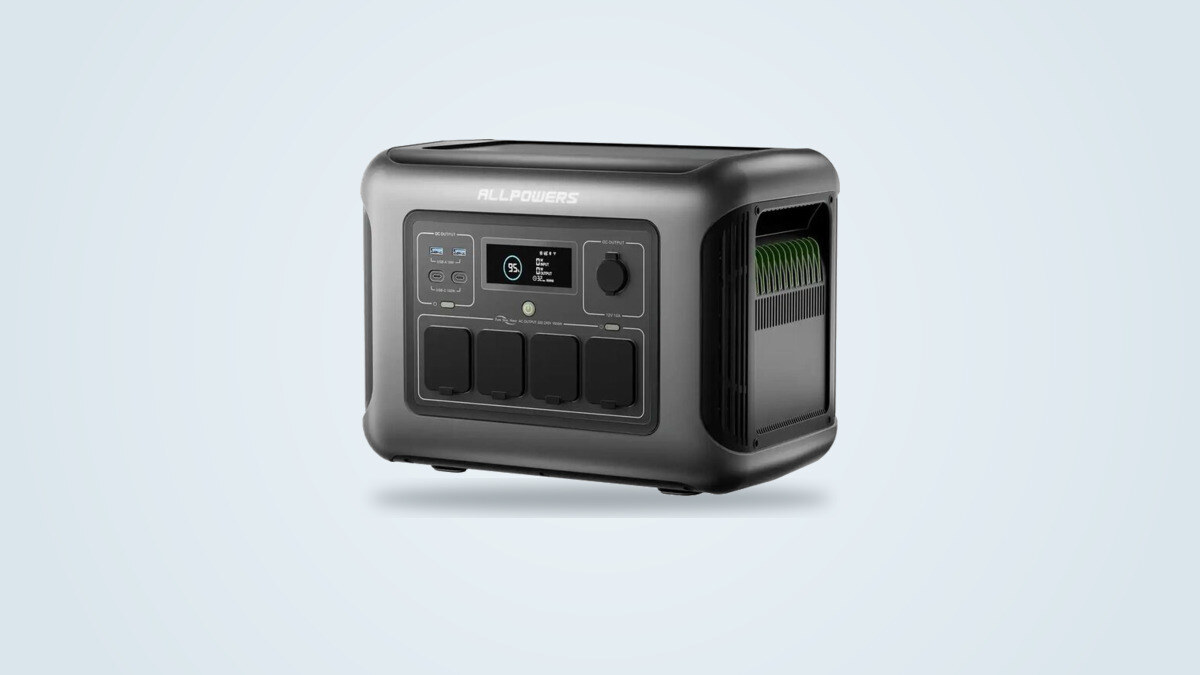
The output selection is generous for this format: 4 pure sine wave mains outlets, two 100W USB-C ports each (200W combined), two USB-A ports up to 18W, and a 12V output up to 120W for vehicle use. The LCD screen shows the active charging mode, remaining percentage, and input and output power in real time.
| Output | Specification |
|---|---|
| Mains | 4 outlets, pure sine wave, 1600W continuous (3200W peak) |
| USB-C | 2 ports, 100W each (200W combined) |
| USB-A | 2 ports, 18W maximum each |
| 12V vehicle | 1 output, 120W maximum |
Control combines WiFi and Bluetooth through the Allpowers app, wider coverage than several neighbouring models in the range limited to Bluetooth only. In practice, the app's connection is not always immediate: it requires the phone's location services to be turned on, and the link sometimes drops after the unit is switched off, forcing a fresh pairing. The app offers no consumption history, no temperature tracking, and no fine control over the fans.
Cooling and noise: quiet at rest, clearly audible under load
Four 60mm fans handle cooling. They stay off below 30W of charge or discharge, then spin up gradually: up to around 200W, the noise stays comparable to a desktop computer. Beyond that, or during a fast mains charge, the speed climbs noticeably and the unit becomes uncomfortable to sit next to for the duration of the charge.
The 35dB noise figure on the spec sheet is set by the manufacturer, with no independent cross-check available to date: treat it as a ballpark at idle rather than a guaranteed figure under full load.
Warranty and build: the same caveat as the rest of the Allpowers range
The LiFePO4 chemistry and the claimed 3500 cycles to 80% capacity put the R1500 Lite among the more durable Allpowers units in the catalogue, well ahead of the entry-level NMC models. Mains sockets, the solar input and the 12V port are protected by rubber covers, with the exception of the USB ports.
As with the rest of the Allpowers range, the advertised 5-year warranty follows a commercial policy that is conditional on registering the product online with the manufacturer: without that step, base cover stays at 24 months. A common commercial pattern in this sector, but one worth knowing before buying rather than discovering when filing a claim.
On the climate side, both mains and solar charging stop below 32 °F (0 °C), a common limit on LiFePO4 batteries and one set by the manufacturer's manual rather than by outdoor use in the depths of winter.
Against the R1500 and the R2500: which Allpowers to pick
Within the Allpowers range, the R1500 Lite sits at the entry point of the 1000 to 1200Wh segment, between the standard R1500 (already in the catalogue) and the more capacious R2500.
| Criterion | R1500 Lite | R1500 | R2500 |
|---|---|---|---|
| Capacity | 1056Wh | 1152Wh | 2016Wh |
| Continuous / peak power | 1600W / 3200W | 1800W / 3000W | 2500W / 4000W |
| Max mains input | 1200W | 1500W | 1500W |
| Max solar input | 650W | 650W | 1000W |
| Weight | 33 lb (15 kg) | 37 lb (16.7 kg) | 64 lb (29 kg) |
Against the standard R1500, the Lite gives up a little capacity and mains input power for a notably more accessible price: a sensible trade-off if budget matters more than the last few watts. Against the R2500, heavier and pricier, the Lite remains plenty for everyday van life or home backup use, in a format that is easier to move around. It is not, however, a substitute for a more capacious station for anyone after several days of runtime without a recharge.
Van life, home backup, mobile job site: the uses that suit it
In a van or motorhome, the 1600W (very briefly 3200W at peak) covers a compressor fridge, a kettle or a small microwave, and the 1056Wh rating lasts a good part of a day of reasonable use, a little less once real-world output is factored in. Solar input up to 650W helps top that back up while driving to the next stop or parked in full sun.
Kept charged at home, the unit switches automatically to battery in 15ms: a router, some lights or a fridge keep running with no noticeable interruption during a power cut, as long as total load stays under the UPS mode's 1500W cap and, ideally, is limited to a single sensitive device.
On a job site or in a mobile workshop, the pure sine wave inverter suits sensitive electronics, and the 4 mains outlets remove the need for a power strip when plugging in several medium-power tools (a drill, a jigsaw, a light welder). At 33 lb (15 kg), the unit is better suited to vehicle transport than to frequent carrying by hand over long distances.
Who the R1500 Lite suits, and who it does not
The R1500 Lite suits anyone after a first, versatile station for van life, home backup or a small mobile job site, on a tighter budget than the rest of the Allpowers range. Its genuinely functional UPS and full WiFi and Bluetooth control make it a solid base for protecting a few sensitive devices, and its 650W solar input gives it real nomadic use.
It suits less well anyone planning to run small loads continuously for a long stretch (a fridge alone over several days, say): real-world output, proportionally weaker under light loads than on other Allpowers units in the catalogue, cuts into effective runtime there. It is also not the right pick for anyone needing to power several demanding devices at once in UPS mode, or counting on the 3200W peak rating to hold a sustained resistive load rather than a brief current draw.